Understanding the Infraspinatus
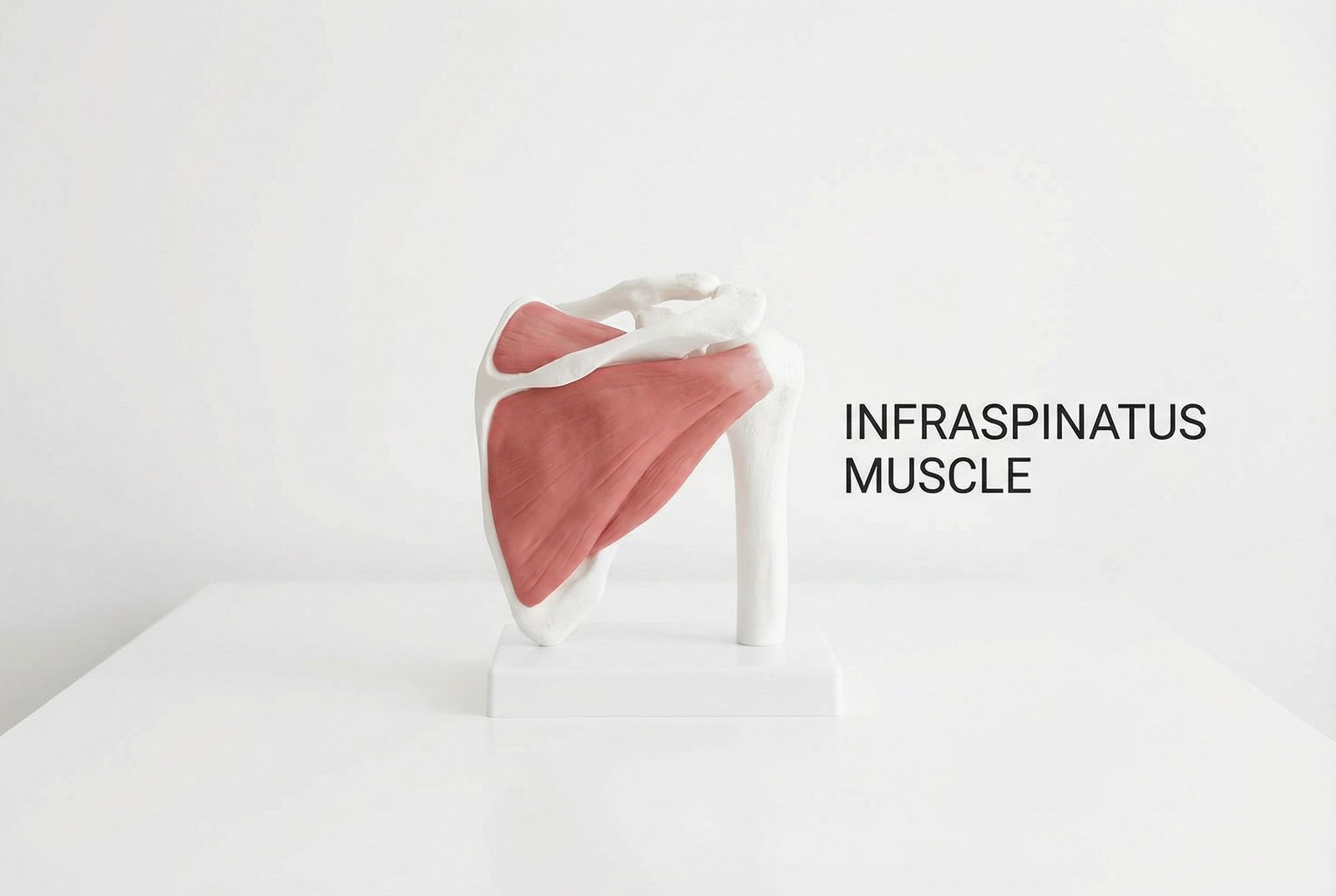
Infraspinatus Muscle Anatomy Posterior View Scapula
The infraspinatus is a thick, triangular muscle that fills the infraspinous fossa — the large concavity on the posterior surface of the scapula below the scapular spine. It originates from the infraspinous fossa and inserts onto the middle facet of the greater tuberosity of the humerus. Its primary function is external rotation of the shoulder — the movement of rotating the arm outward when the elbow is bent at the side.
As one of the four rotator cuff muscles (along with supraspinatus, subscapularis, and teres minor), the infraspinatus plays a critical role in glenohumeral dynamic stability — compressing the humeral head into the glenoid fossa during all shoulder movements. When the infraspinatus develops trigger points, this stabilizing function degrades, the humeral head migrates superiorly, and the subacromial space narrows — producing the mechanical impingement that is often blamed entirely on structural factors.
Trigger points develop in the infraspinatus through sustained internal rotation postures (computer work, driving, side-sleeping with the arm under the pillow), repetitive overhead activities (swimming, throwing, painting), and acute overload events (catching a heavy falling object). The muscle is particularly vulnerable because modern life demands sustained internal rotation — exactly the position that chronically loads and lengthens the infraspinatus.
The most distinctive feature of infraspinatus trigger points is their anterior referral pattern. Despite the muscle being located entirely on the posterior scapula, its trigger points project pain deep into the front of the shoulder — into the glenohumeral joint, the anterior deltoid, and down the lateral arm. This misdirected referral is the reason infraspinatus trigger points are so frequently misdiagnosed as bicep tendinitis, anterior impingement, or rotator cuff tears.
Anatomy & Trigger Points
The infraspinatus trigger points cluster in three primary locations: the central muscle belly (most common), the medial border near the scapular spine, and the lateral aspect near the glenohumeral joint. The central trigger point is the primary referral source for anterior shoulder pain, while the lateral trigger point produces more localized posterior shoulder aching. All three locations should be systematically palpated in any shoulder pain assessment.
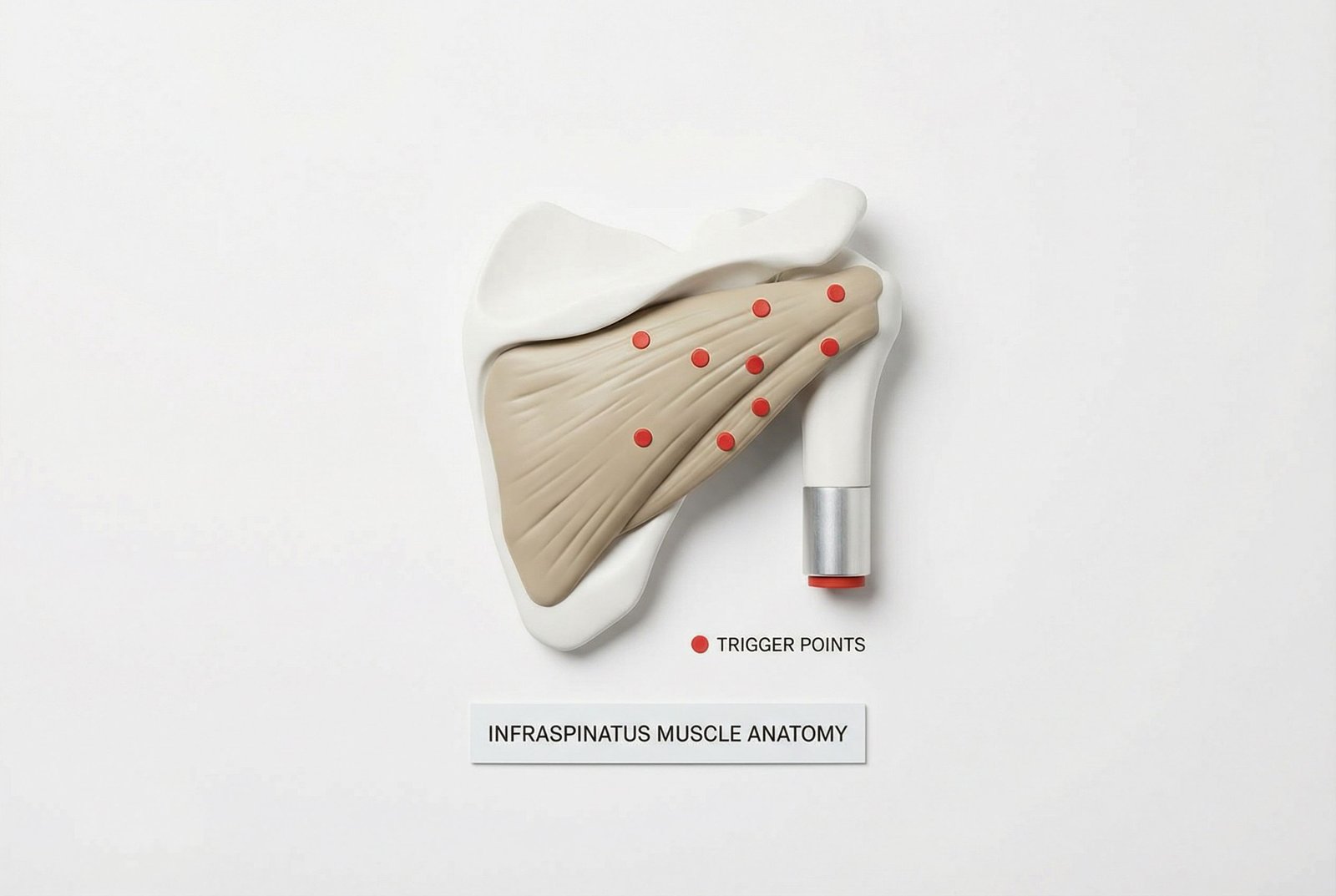
Infraspinatus Trigger Point Locations and Anterior Shoulder Referral
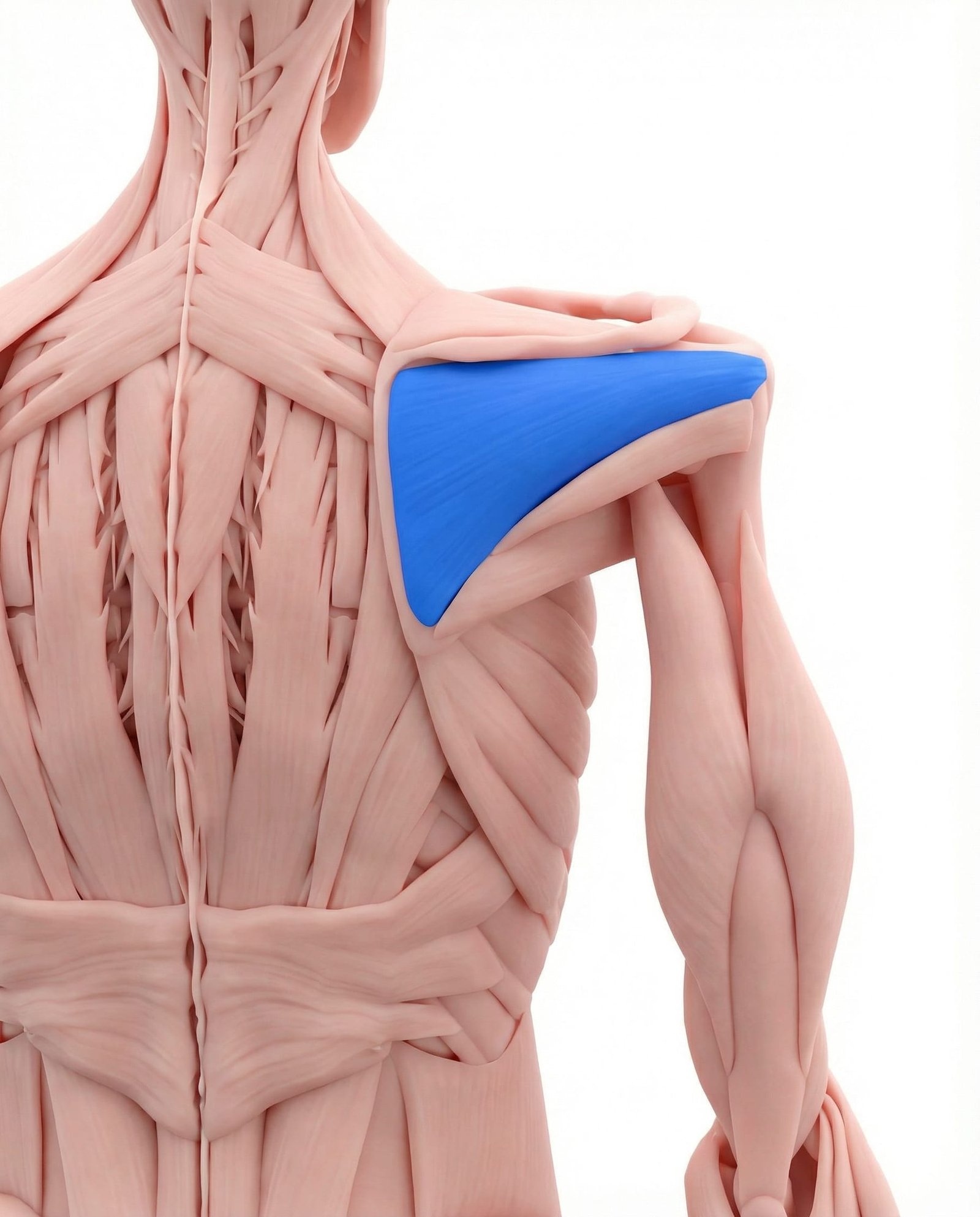
Deep anterior shoulder pain that the patient localizes to the front of the glenohumeral joint, the anterior deltoid, and down the lateral arm to the elbow. This is the classic referral pattern that mimics bicipital tendinitis and subacromial impingement. Patients consistently point to the front of the shoulder when asked where the pain is — never to the back where the muscle actually resides. This anterior referral from a posterior muscle is one of the most important diagnostic traps in shoulder pain assessment.
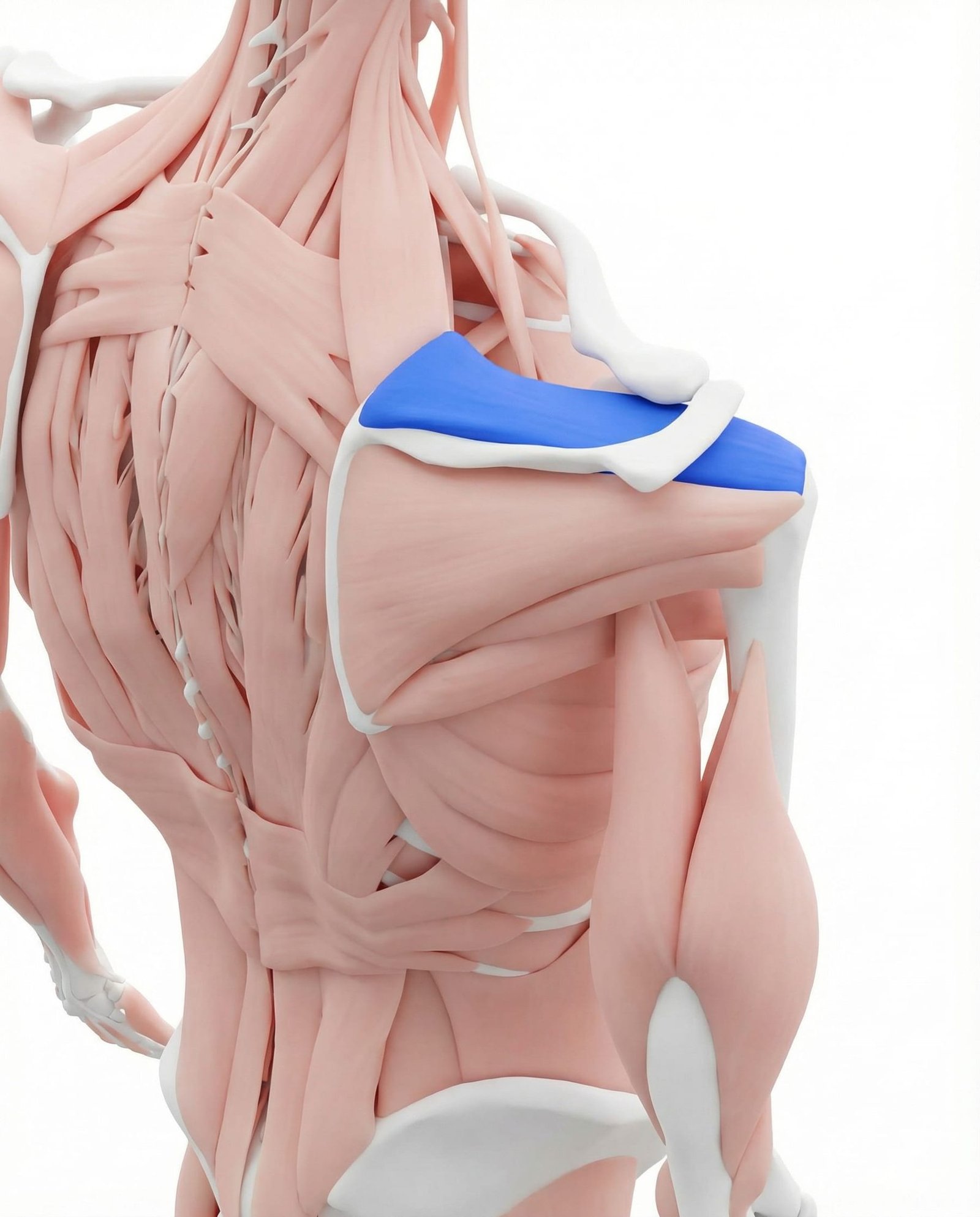
Deep lateral deltoid ache during the first 15-30 degrees of arm abduction and a painful arc at 60-120 degrees. Supraspinatus and infraspinatus trigger points frequently coexist and produce overlapping shoulder pain patterns that are nearly impossible to separate clinically without targeted palpation of each muscle individually.
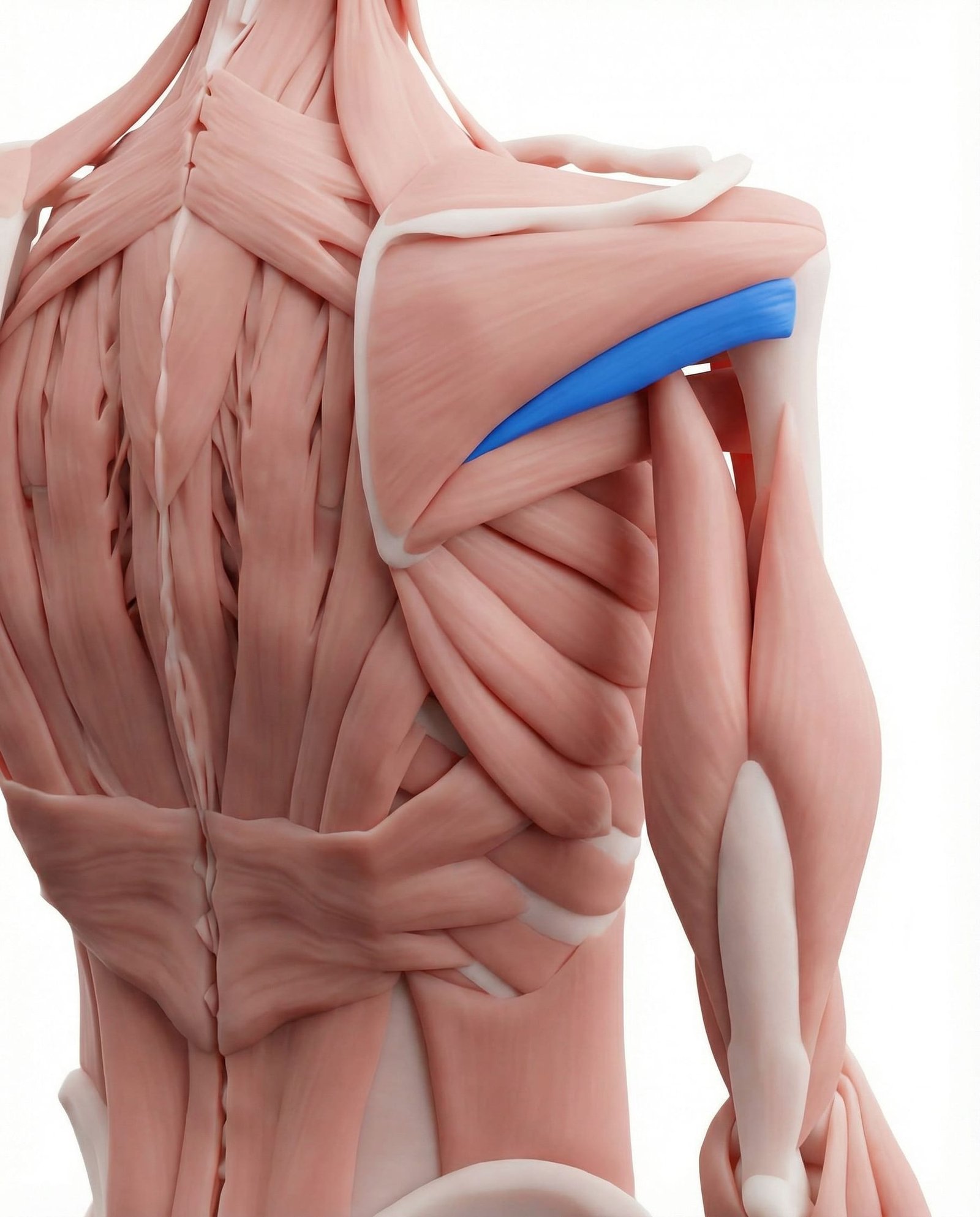
Sharply localized posterior shoulder pain at the glenohumeral joint line. Teres minor trigger points produce a more focal and posterior pain than the infraspinatus, but the two muscles work synergistically and their trigger points often develop together. Teres minor dysfunction should always be assessed when infraspinatus trigger points are identified.
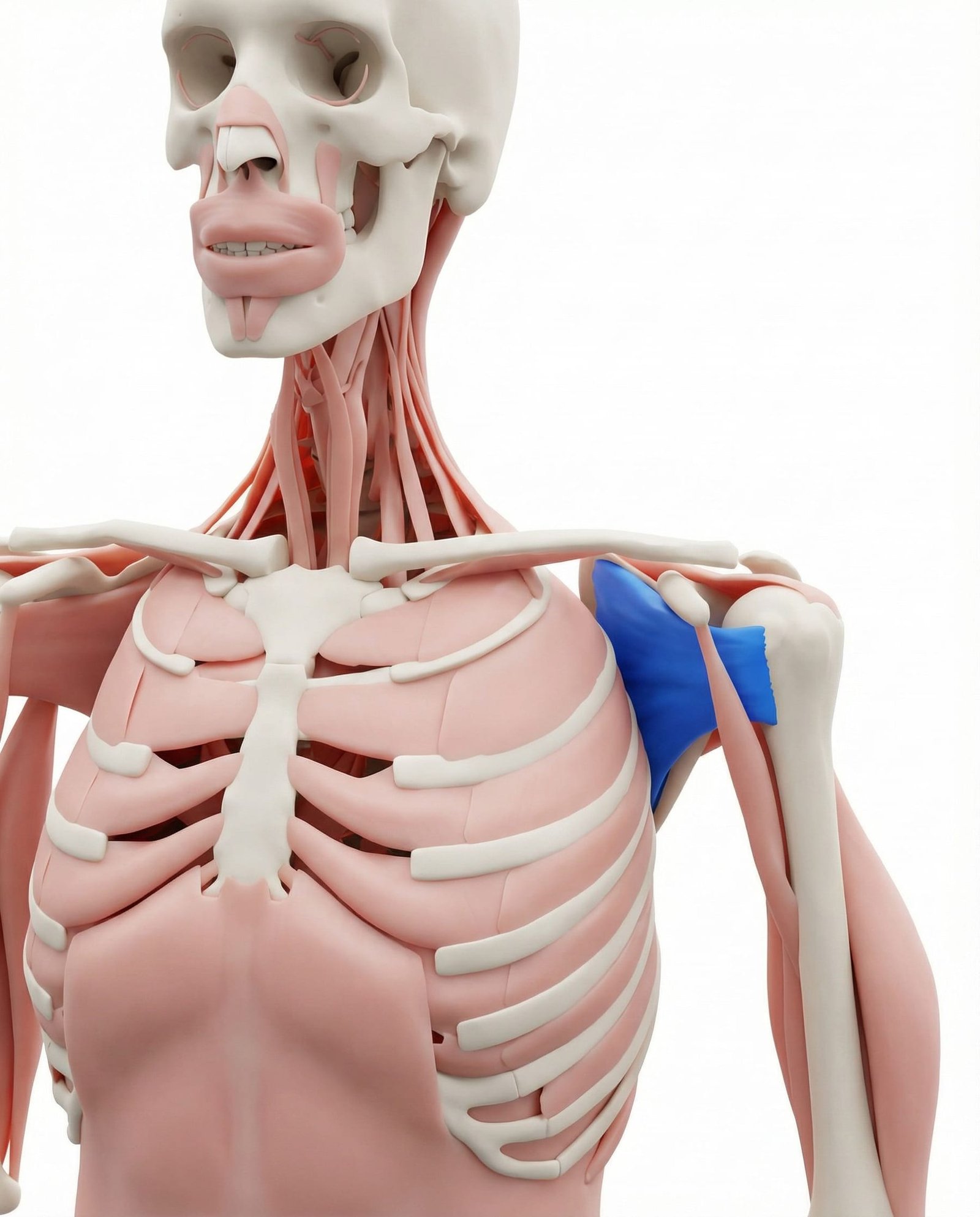
Deep posterior shoulder pain and a characteristic band of pain around the wrist (the "watch-band" pattern). The subscapularis and infraspinatus are antagonistic rotators — when one develops trigger points, the other almost invariably follows due to reciprocal inhibition and compensatory overload. Treating infraspinatus without addressing subscapularis is a common cause of incomplete shoulder pain resolution.
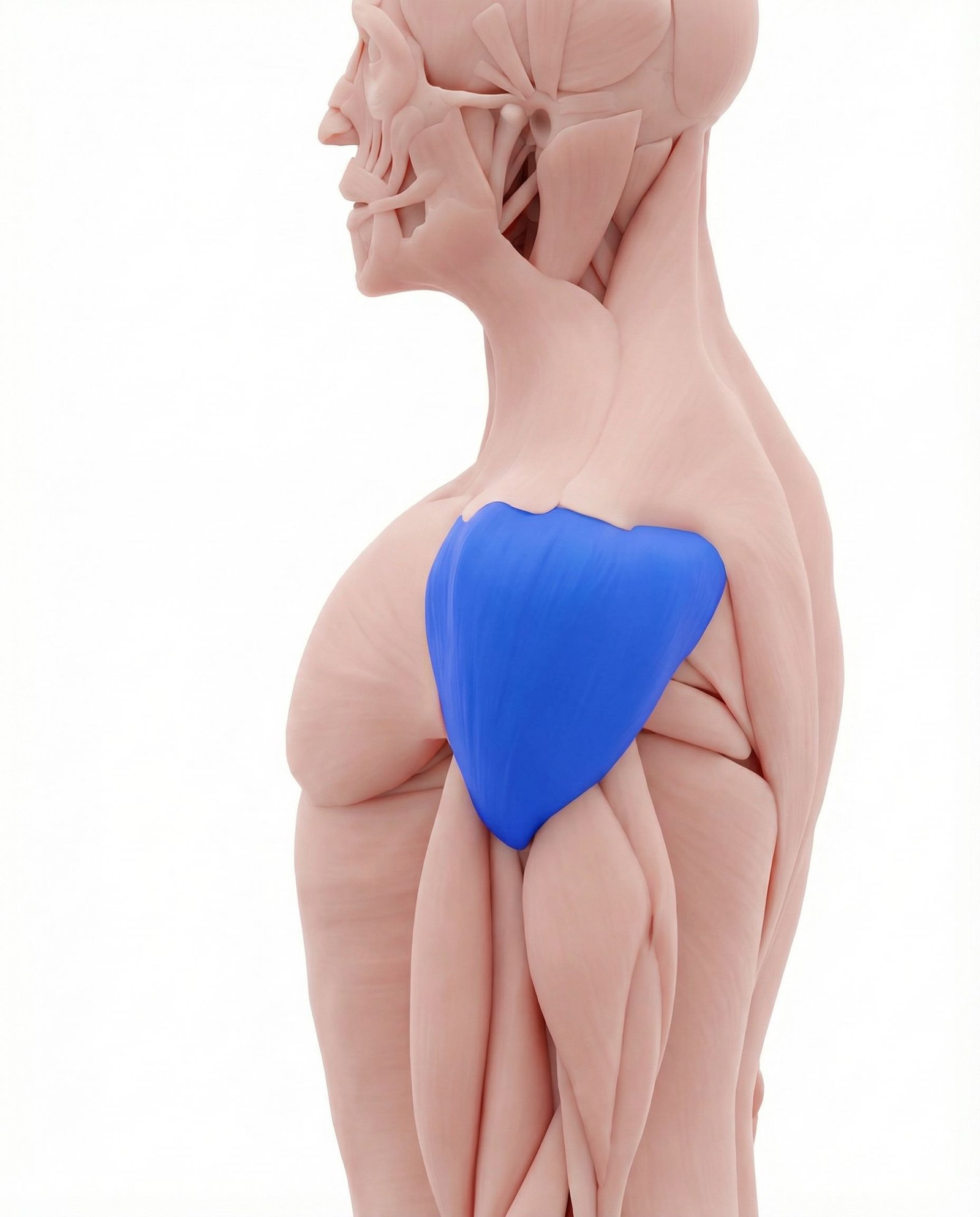
Posterior deltoid pain during overhead reaching and extension. The posterior deltoid overlies the infraspinatus and can develop secondary trigger points due to altered scapulohumeral mechanics when the infraspinatus is dysfunctional. Palpation must distinguish between superficial deltoid tenderness and the deeper infraspinatus trigger points beneath.
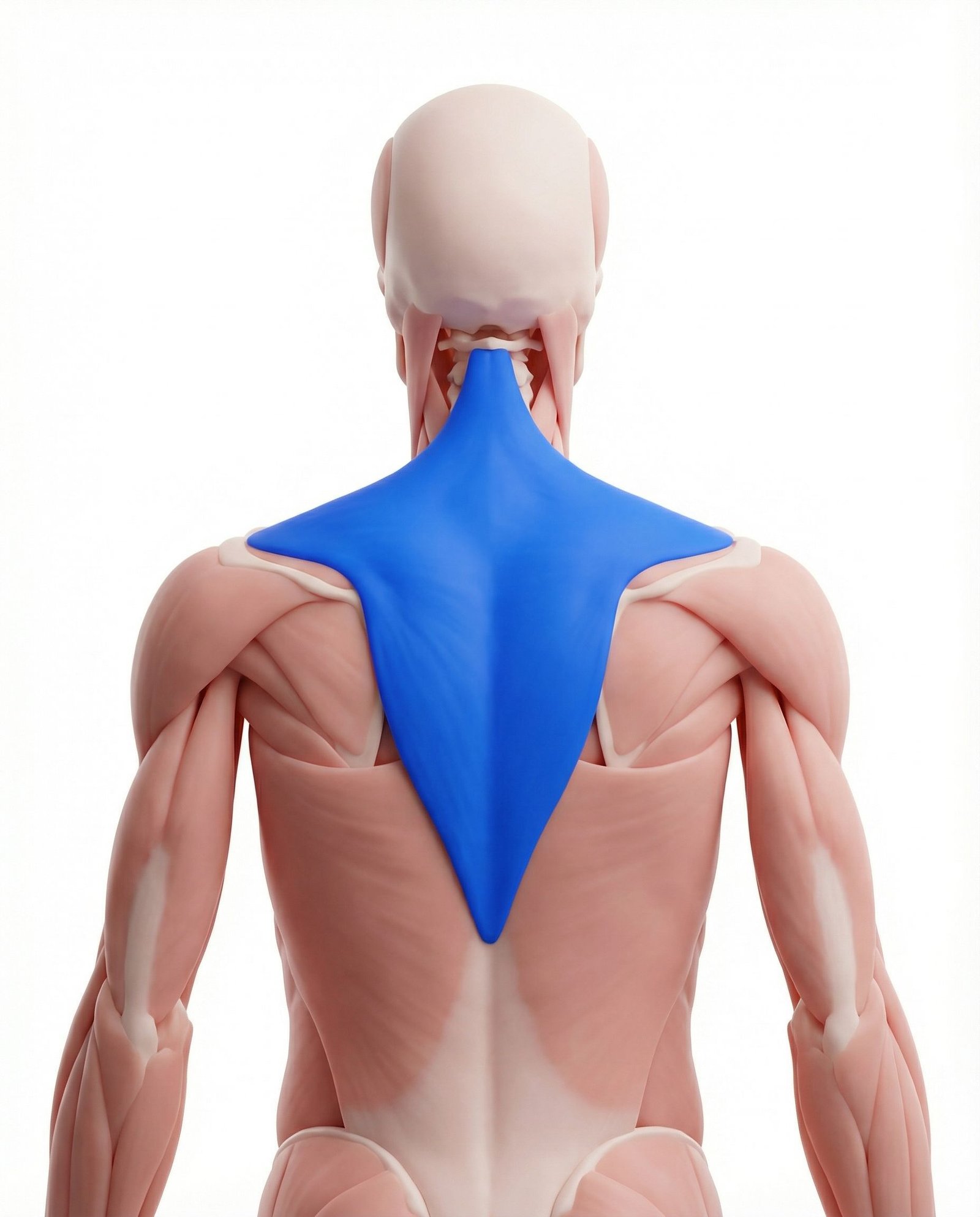
Neck-to-shoulder pain and temporal headache. The upper trapezius is the most common compensator when infraspinatus dysfunction alters scapular mechanics — the trapezius elevates and upwardly rotates the scapula to compensate for lost glenohumeral external rotation, overloading itself in the process.
Referral Patterns: The Anterior Shoulder Mimic
The infraspinatus produces one of the most clinically deceptive referral patterns in the body. The primary trigger point in the central muscle belly refers pain deep into the anterior shoulder — the glenohumeral joint, the bicipital groove, and the anterior deltoid region. Patients consistently point to the front of their shoulder and say "it hurts here, deep inside the joint." They never point to the back of the scapula where the pain actually originates.
The referral can extend distally down the lateral arm to the lateral epicondyle, and occasionally into the radial forearm and hand. When the lateral arm component is prominent, the pattern mimics C5-C6 radiculopathy or lateral epicondylitis. The infraspinatus trigger point pattern is worsened by overhead activities, reaching behind the back, and sleeping on the affected side — and it characteristically produces a deep, aching quality that patients describe as "inside the joint" rather than on the surface.
The shoulder that hurts in the front is almost always driven by a muscle in the back. The infraspinatus illustrates the cardinal rule of myofascial pain: where you feel it is almost never where it lives.
Anterior
Lateral Arm
Restricted IR
Self-Assessment Tests
These tests assess infraspinatus trigger point activity, external rotation strength, and the critical diagnostic finding: reproduction of anterior shoulder pain from posterior scapular palpation. The key test is the infraspinatus palpation — if pressing on the back of your scapula reproduces your front-of-shoulder pain, you have your diagnosis.
Infraspinatus Palpation Test
Direct Trigger Point Palpation of the Infraspinous Fossa
Resisted External Rotation
Manual Muscle Test for Infraspinatus Strength and Pain Provocation
Cross-Body Adduction Test
Horizontal Adduction Stretch for Posterior Shoulder Assessment
Shoulder Internal Rotation Screen
Combined Internal Rotation Range Assessment (Hand-Behind-Back)
Treatment Pathways
Effective infraspinatus treatment combines stretching (to restore internal rotation range), direct trigger point release (pressure or needling), and rotator cuff rebalancing (to prevent recurrence). The sequence matters: release the trigger point first, stretch to lock in gained range, then strengthen to maintain the correction.
Infraspinatus Cross Body Stretch and Self Release Techniques
Cross-Body Stretch & Sleeper Stretch
Sustained stretching of the infraspinatus is the most effective first-line intervention. The cross-body adduction stretch and the sleeper stretch directly lengthen the external rotators and restore internal rotation range — the key functional deficit created by infraspinatus trigger points.
- Cross-body stretch — affected arm across the chest, opposite hand pulls at the elbow, sustained 30 seconds
- Sleeper stretch — side-lying on affected arm, elbow at 90 degrees, push forearm toward the floor with the opposite hand
- Doorway posterior capsule stretch — forearm against doorframe, body rotates away from the arm
- Frequency: 3-5 repetitions of each stretch, 3 times per day minimum
- Never stretch into sharp pain — aim for a firm, tolerable pull at the posterior shoulder
Infraspinatus Self-Release
Direct pressure release of infraspinatus trigger points using a lacrosse ball against a wall or a Theracane. The infraspinatus is uniquely accessible for self-treatment because of its superficial position on the posterior scapula — making self-release highly effective when performed correctly.
- Lacrosse ball against wall — position ball on posterior scapula below the spine of the scapula, lean into it
- Sustained pressure release — hold each tender point for 60-90 seconds until pain decreases by 50%
- Theracane or cane hook — allows precise targeting of trigger points in the infraspinous fossa
- Percussive therapy — low amplitude, medium frequency over the infraspinous fossa
- Post-release: immediately perform cross-body stretch to lock in the gained range of motion
Dry Needling: Infraspinatus Protocol
Dry needling of the infraspinatus is one of the most rewarding procedures in trigger point therapy. The muscle is superficial, the trigger points are easily localized, and the local twitch responses are robust. Multiple studies show significant improvement in shoulder pain and external rotation range after a single needling session.
- Patient prone or side-lying with affected side up for optimal access
- Identify taut bands via palpation — typically 2-3 primary trigger points in the muscle belly
- Insert needle perpendicular to the scapular surface — depth 1.5-2.5 cm to the trigger point
- Elicit local twitch responses — 3-5 twitches per trigger point before withdrawing
- Post-needling: immediate gentle external rotation stretching and ice for 10 minutes
Rotator Cuff Rebalancing Program
Restoring the balance between the external rotators (infraspinatus, teres minor) and internal rotators (subscapularis, pectoralis major) prevents trigger point recurrence. This program addresses the underlying mechanical imbalance that caused the trigger points in the first place.
- Side-lying external rotation — lightweight, 15-20 reps, emphasis on controlled eccentric phase
- Prone horizontal abduction at 90 degrees — strengthens infraspinatus and lower trapezius simultaneously
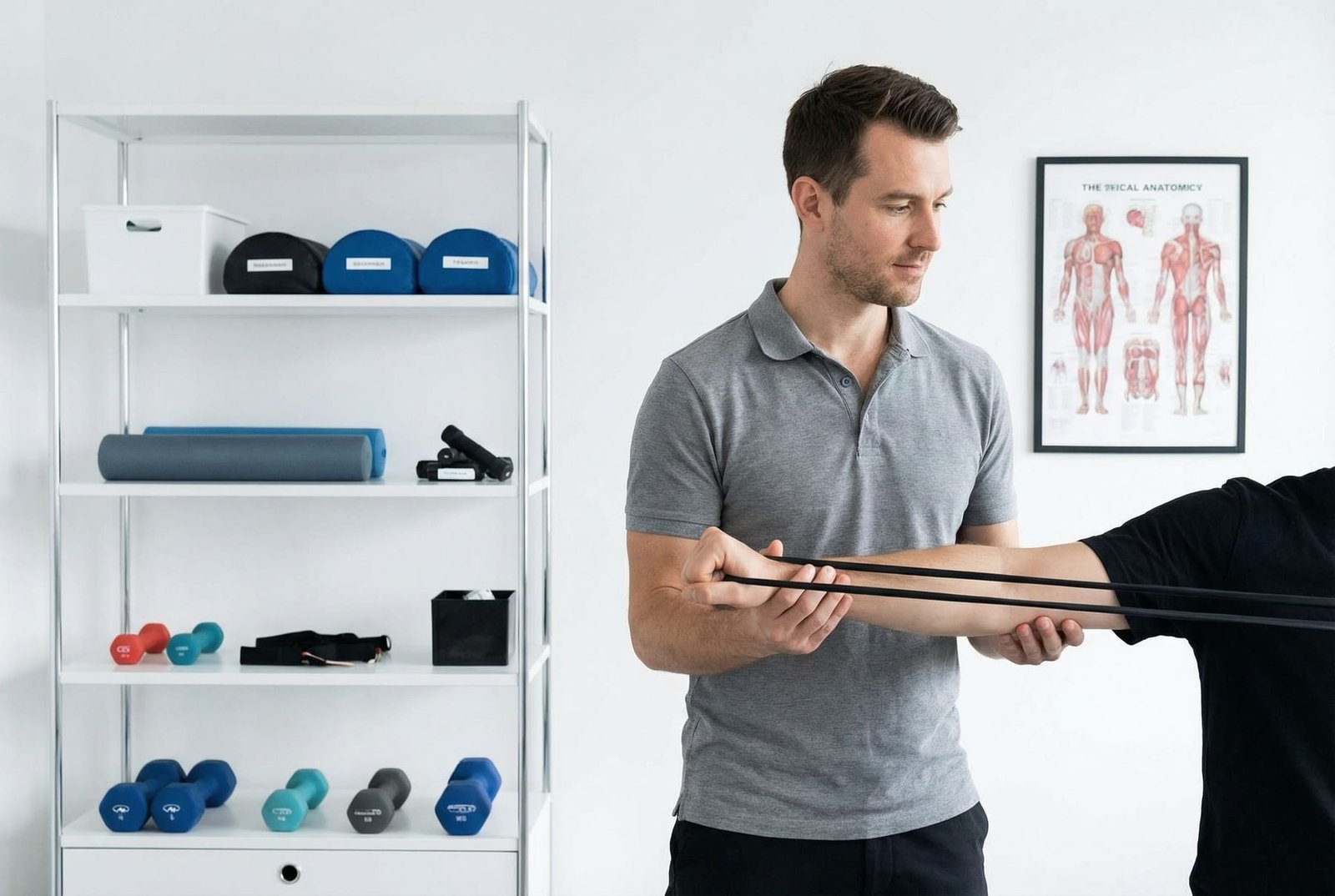
- Band external rotation at 0 and 90 degrees of abduction — sport-specific positions
- Scapular retraction exercises — rows, band pull-aparts to restore scapular positioning
- Progress to overhead strengthening only after pain-free external rotation is restored
Central Muscle Belly (TrP1)
Deep anterior shoulder pain — the primary referral point. Mimics bicep tendinitis, subacromial impingement, and glenohumeral joint pathology.
Medial Border (TrP2)
Deep inter-scapular aching near the scapular spine. Contributes to the "shoulder blade pain" that patients describe with overhead work.
Lateral Trigger Point (TrP3)
Posterior glenohumeral pain with distal extension down the lateral arm to the elbow — mimics C5-C6 radiculopathy pattern.
Satellite Points
Secondary trigger points in teres minor and posterior deltoid that develop from infraspinatus dysfunction and altered scapulohumeral mechanics.
Red Flags — When to See a Doctor
Most anterior shoulder pain is myofascial in origin and responds well to trigger point treatment, but certain presentations require imaging and specialist evaluation to rule out structural pathology that may need surgical intervention.
Key Takeaways
The infraspinatus is one of the most common muscular sources of anterior shoulder pain — its trigger points can refer pain deep into the front of the shoulder joint, the bicipital groove, and down the lateral arm, mimicking bicep tendinitis, subacromial impingement, and even partial rotator cuff tears on clinical examination.
The diagnostic key is reproduction: when firm palpation of the infraspinous fossa on the posterior scapula reproduces the patient's familiar anterior shoulder pain, the diagnosis is confirmed. This posterior-to-anterior referral pattern is one of the most clinically useful findings in myofascial pain diagnosis.
Infraspinatus trigger points restrict internal rotation of the shoulder by maintaining the muscle in a shortened, contracted state. The functional consequence is difficulty reaching behind the back (fastening a bra, reaching for a wallet) — a finding that is frequently attributed to adhesive capsulitis ("frozen shoulder") when it is actually muscular in origin.
The infraspinatus and subscapularis function as an antagonistic pair — when one develops trigger points, the other invariably follows. Treating only one side of this rotational pair is a common cause of incomplete resolution and recurrence. Both muscles must be assessed and treated in every shoulder pain presentation.
Prolonged computer work is the leading modern perpetuating factor for infraspinatus trigger points. The sustained posture of arms forward and internally rotated places the infraspinatus in a chronically lengthened, loaded position — the ideal conditions for trigger point development.
Some patients diagnosed with "rotator cuff tendinopathy" or "partial thickness tears" on MRI may have meaningful muscular contributors to their pain, including infraspinatus trigger points. Rotator cuff abnormalities on MRI are common in asymptomatic shoulders with increasing age (Sher 1995; Tempelhof 1999; Connor 2003), so the imaging finding alone does not establish the pain source — clinical correlation is essential.