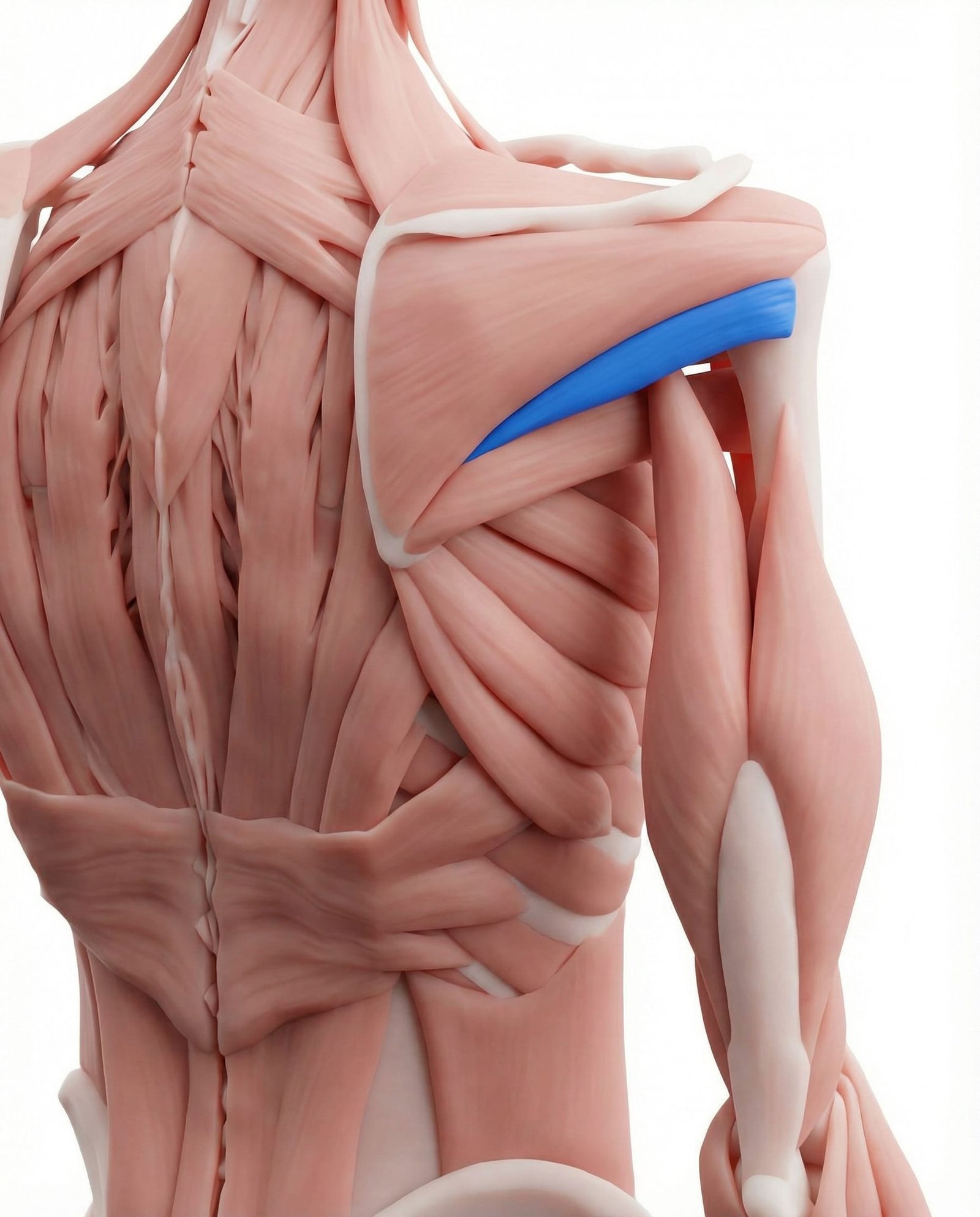
TrP 1
TrP1
Location. Lower back of shoulder blade
Pain referral. Back of shoulder, down arm
- Back of shoulder
- Deltoid area
- Back of arm
Localized deep aching at posterior deltoid region intensifying with arm use
Location. Lower back of shoulder blade
Pain referral. Back of shoulder, down arm
Location. Near infraspinous border of scapula
Pain referral. Posterior shoulder and upper lateral arm
Location. Inferior border near axillary margin
Pain referral. Posterior shoulder and posterior upper arm
Posterior shoulder pain. Localized deep aching at posterior deltoid region intensifying with arm use
Weakness in external rotation. Reduced external rotation strength impairing deceleration during throwing activities
Difficulty reaching behind. Pain and restriction when attempting behind-back movements like fastening garments
Sharp posterior shoulder pain. Teres minor trigger points create sharp localized pain at the posterior glenohumeral region
Pain with external rotation. External rotation loads the teres minor maximally provoking trigger point-mediated posterior shoulder pain
Difficulty reaching behind back. Internal rotation and adduction stretch the taut teres minor bands creating posterior shoulder restriction
Posterior shoulder catching sensation. Taut bands create uneven rotator cuff mechanics producing a catching sensation during arm movement
Posterior shoulder ache. Deep posterior shoulder pain from teres minor trigger point at inferior axillary border
Pain reaching behind back. Internal rotation and extension required for reaching behind back stretches sensitized teres minor
Posterior arm heaviness. Referred heaviness and ache down posterior upper arm from teres minor trigger point referral
Difficulty with external rotation. Inhibited teres minor reduces external rotation strength impairing shoulder function
Sleep disruption lying on affected side. Compression of teres minor trigger points during side-lying causes nocturnal shoulder pain
Throwing sports. Eccentric overload during deceleration phase strains teres minor muscle belly repeatedly
Swimming. Continuous external rotation demands during freestyle recovery phase fatigue teres minor
Overhead activities. Sustained arm elevation requires teres minor stabilization causing cumulative contractile fatigue
Poor posture. Rounded shoulders alter scapulohumeral rhythm increasing teres minor compensatory workload chronically
Repetitive overhead throwing. Throwing demands eccentric teres minor deceleration during follow-through creating cumulative overload
Swimming (backstroke and freestyle). Repetitive shoulder rotation during swimming strokes overloads the teres minor as an external rotator
Sleeping on the affected shoulder. Lateral sleep compresses the posterior shoulder against the mattress irritating teres minor trigger points
Chronic internal rotation posture. Sustained shoulder internal rotation stretches and weakens the teres minor creating trigger points
Rotator cuff strain or overuse. General rotator cuff overuse involves teres minor as it shares the posterior cuff load
Repetitive external rotation activities. Repeated shoulder external rotation overloads teres minor as a primary external rotator muscle
Throwing sports (deceleration phase). Eccentric teres minor loading during throw deceleration phase creates high-force fiber damage
Swimming (backstroke). Backstroke arm recovery requires repetitive external rotation overloading teres minor cyclically
Post-rotator cuff repair guarding. Protective muscle splinting after rotator cuff surgery creates sustained teres minor contraction
Sleeping with arm overhead. Sustained arm elevation during sleep stretches teres minor creating positional trigger points
Stand or sit with good posture. Bring your affected arm across your chest at shoulder height. Use your opposite hand to gently pull the arm closer to your body until you feel a stretch at the back of the shoulder. Keep the affected shoulder relaxed and down, not shrugged up toward your ear. The stretch should be felt in the posterior shoulder region where the teres minor is located. Hold for 20-30 seconds and release slowly.
Stand with your back to a wall and place a tennis ball between the wall and the back of your shoulder, just below the bony spine of the scapula where the teres minor muscle sits. Lean into the ball with comfortable pressure and slowly move your body up and down or side to side to roll the ball across the muscle. When you find a particularly tender spot, hold sustained pressure for 20-30 seconds. You can also bend and straighten your knees to control the rolling motion.
Stand with your elbow bent to 90 degrees and a folded towel tucked between your elbow and your side to maintain proper positioning. Hold a light resistance band that is anchored at waist height to your opposite side. Slowly rotate your forearm outward away from your body, keeping your elbow pinned to the towel at your side. Control the return to the starting position over 3 seconds. The movement should be pain-free or cause only mild discomfort.
Lie on your affected side with your shoulder and elbow each bent to 90 degrees, so your forearm points toward the ceiling. Using your other hand, gently push your forearm down toward the surface you are lying on, rotating your shoulder inward. You should feel a stretch at the back of the shoulder. Move slowly and stop if you feel any sharp pain. The stretch should be a gentle pulling sensation in the posterior shoulder area.
Avoid sleeping directly on the affected shoulder as this compresses the teres minor and aggravates the trigger point. If you are a side sleeper, sleep on the unaffected side and hug a pillow to support the affected arm in front of you. If you sleep on your back, place a small pillow or folded towel under the affected arm to keep it slightly elevated and supported. Avoid sleeping with the affected arm overhead or tucked under your pillow.
If posterior shoulder pain persists beyond 3-4 weeks of self-care, or if you experience significant weakness, catching, or locking sensations, consult an orthopedic specialist or sports medicine physician. A professional can differentiate between a teres minor trigger point and a structural rotator cuff tear through clinical tests and potentially imaging such as MRI or ultrasound. A physical therapist can provide targeted manual therapy including friction massage and joint mobilization to the posterior shoulder.