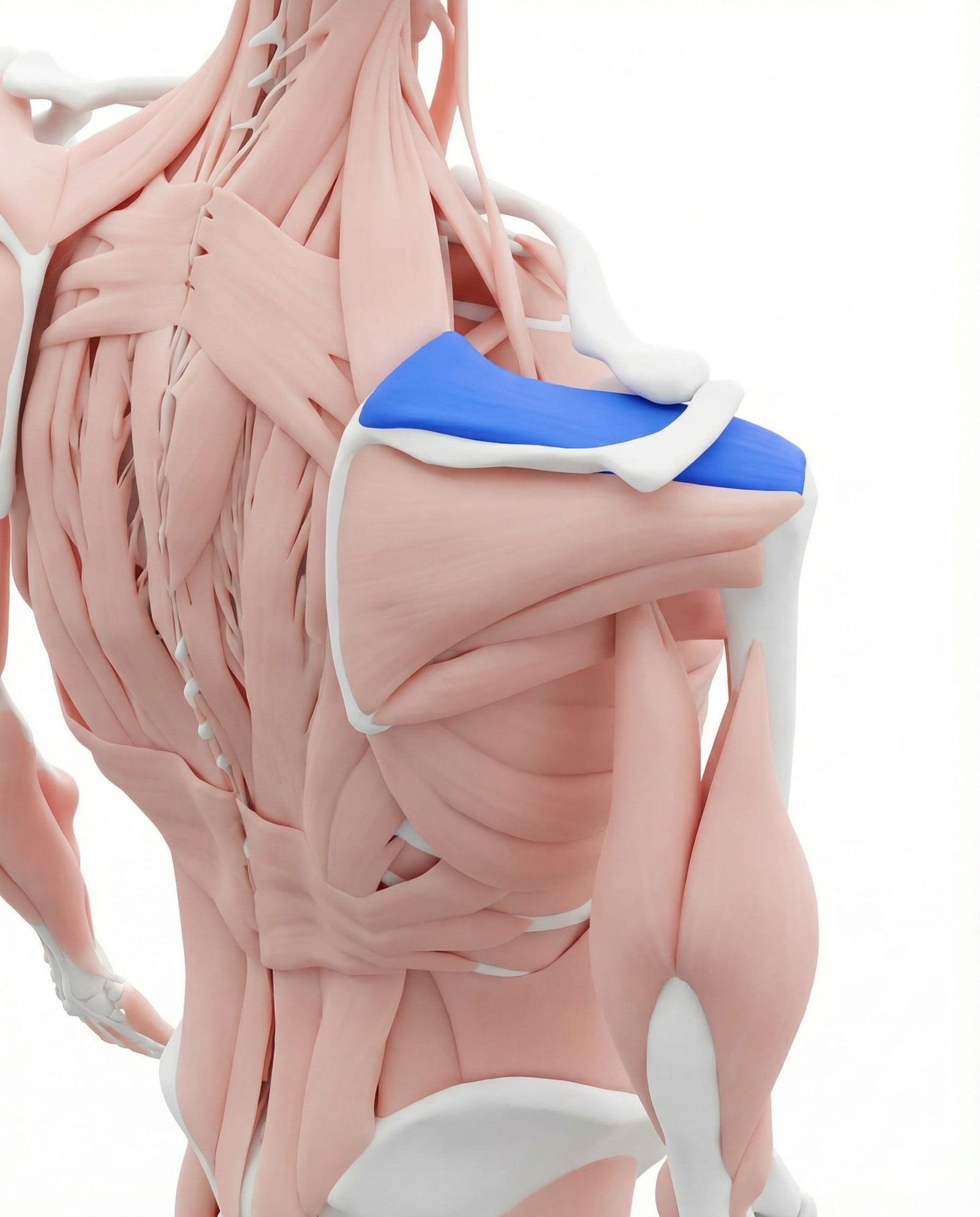
TrP 1
TrP1
Location. Top of shoulder blade, above spine
Pain referral. Outer shoulder, down arm
- Outer shoulder
- Down outer arm
- Elbow
- Wrist
- Deltoid area
Sharp pain at lateral shoulder during active abduction between sixty and one-twenty degrees
Location. Top of shoulder blade, above spine
Pain referral. Outer shoulder, down arm
Location. Top of shoulder, lateral
Pain referral. Outer shoulder, down arm
Location. Musculotendinous junction of supraspinatus near greater tuberosity
Pain referral. Deep ache in lateral elbow (lateral epicondyle region)
Pain when lifting arm. Sharp pain at lateral shoulder during active abduction between sixty and one-twenty degrees
Pain at night. Persistent deep ache disturbing sleep especially when lying on affected side
Weakness in abduction. Difficulty initiating arm abduction due to supraspinatus trigger point inhibition
Shoulder impingement. Taut band elevates humeral head reducing subacromial space and mimicking impingement
Lateral shoulder pain. Pain over lateral deltoid from distal supraspinatus trigger point referral to insertion
Arm weakness. Impaired abduction initiation from supraspinatus trigger point inhibition of force production
Pain with abduction. Shoulder abduction directly loads compromised distal supraspinatus trigger point fibers
Lateral elbow pain mimicking tennis elbow. Supraspinatus TrP3 refers pain distally to lateral epicondyle mimicking extensor tendinopathy
Forearm weakness. Elbow pain from supraspinatus referral inhibits grip and forearm extension force production
Pain with gripping. Lateral elbow referred pain activates during grip as wrist extensors co-contract at epicondyle
Difficulty lifting objects with elbow extended. Combined shoulder and elbow loading stresses supraspinatus trigger point and referral zone
Deep lateral arm ache. Referred aching along lateral upper arm from supraspinatus musculotendinous junction trigger point
Overhead work. Sustained arm elevation above shoulder height chronically overloads supraspinatus muscle fibers
Swimming. Repetitive arm recovery phase demands continuous supraspinatus activation and abduction effort
Throwing. Forceful abduction during wind-up phase stresses supraspinatus beyond its recovery capacity
Repetitive lifting. Repeated arm elevation with load causes cumulative fatigue in supraspinatus tendon-muscle junction
Poor posture. Forward head and rounded shoulders alter scapular mechanics increasing supraspinatus workload
Bone spurs. Subacromial osteophytes mechanically irritate supraspinatus tendon promoting trigger point formation
Repetitive overhead work. Repeated arm elevation fatigues supraspinatus at musculotendinous junction creating trigger points
Throwing sports. Throwing demands rapid supraspinatus activation for humeral head compression during acceleration
Carrying heavy loads at arm length. Sustained shoulder abduction load to carry objects at sides overloads supraspinatus isometrically
Overhead pressing exercises. Heavy overhead pressing maximally loads supraspinatus at vulnerable musculotendinous junction
Occupational overhead reaching. Workplace overhead tasks create sustained supraspinatus demand exceeding tissue tolerance
Bring the affected arm across your chest at shoulder height. Use the opposite hand to gently pull the arm closer to your body just above the elbow. You should feel a stretch at the top and back of the shoulder where the supraspinatus sits. Hold for 20-30 seconds while breathing deeply, then release slowly. Avoid pulling so hard that it causes sharp pain.
For acute pain or after activity, apply an ice pack wrapped in a thin cloth to the top of the shoulder for 10-15 minutes to reduce inflammation. For chronic stiffness, use a moist heat pack on the same area for 15-20 minutes to promote blood flow and relaxation. If pain is both chronic and activity-related, alternate between ice after activity and heat before stretching.
Lean forward and support yourself with your unaffected arm on a table or chair. Let the affected arm hang straight down, completely relaxed. Gently sway your body to create small circular motions in the hanging arm, about the size of a dinner plate. Do 10 circles clockwise and 10 counterclockwise. The key is to let gravity and body movement create the motion, not the shoulder muscles.
For isometric abduction, stand with the affected arm at your side and press the back of your hand outward against a wall. Hold for 10 seconds with moderate effort, then relax. For the empty can exercise, hold a very light weight (1-2 pounds) with your arm at your side and thumb pointing down. Slowly raise your arm out to the side at a 30-degree forward angle to about 60 degrees, then lower slowly. Stop if pain is sharp.
Reorganize frequently used items to be at or below shoulder height to minimize overhead reaching. Use a step stool when you must access high shelves. When sleeping, avoid lying on the affected shoulder. Instead, sleep on your back or unaffected side with a pillow supporting the affected arm in front of you. This prevents compression of the supraspinatus tendon during sleep.
If you experience significant shoulder weakness, inability to lift your arm, or persistent night pain that disrupts sleep for more than 2-3 weeks, consult an orthopedic specialist or physical therapist. Describe the pain location at the top of the shoulder and the painful arc during abduction. An evaluation may include imaging to rule out a rotator cuff tear or subacromial bursitis.