What Is a Trigger Point?
The science behind the “knot” in a muscle
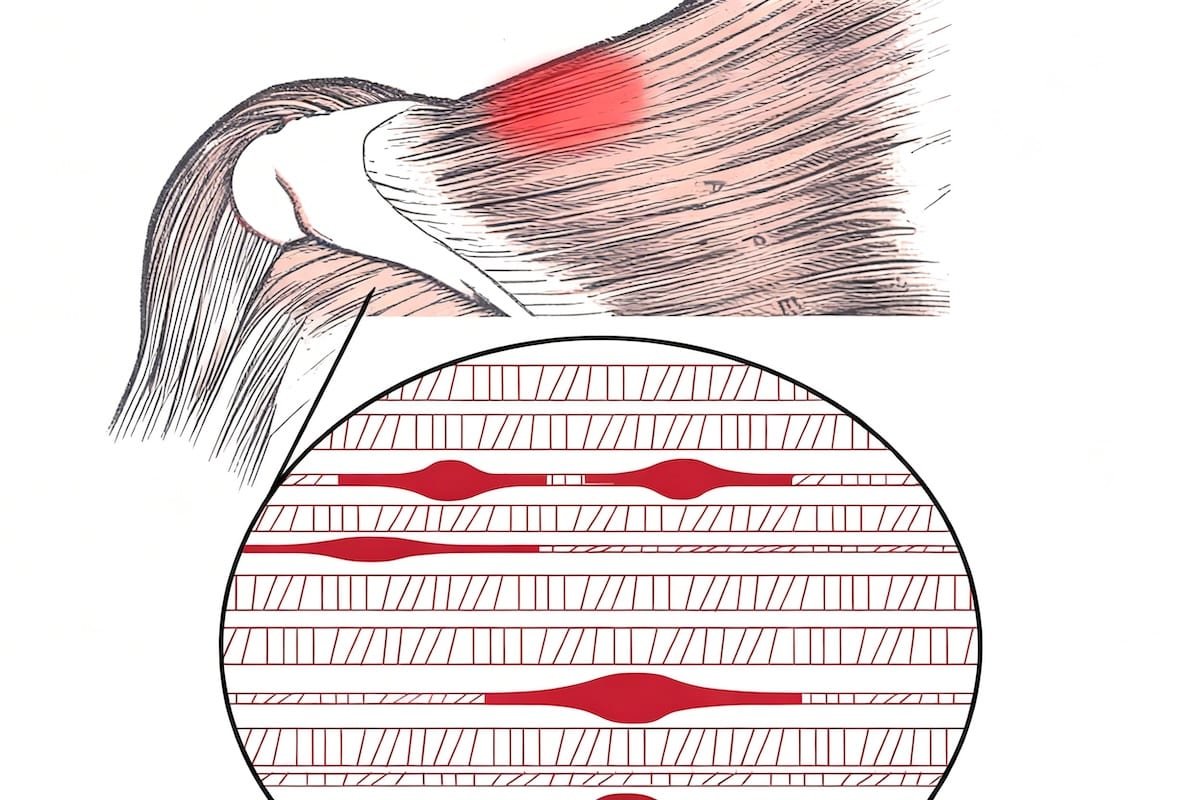
Trigger Point Anatomy
Taut Band and Contraction KnotA trigger point is usually described as a hyperirritable spot within a taut band of skeletal muscle. Patients often experience it as a “knot,” “nodule,” or highly tender point inside a larger painful muscle.
At the microscopic level, one influential model places trigger points near dysfunctional motor endplates — the junctions where nerves communicate with muscle fibers. This model helps explain why a very small focal area can produce a larger and sometimes distant pain pattern.
Exactly how trigger points begin and persist is still debated, but most current models involve a mix of local muscle overload, altered motor-endplate behavior, reduced local circulation, and heightened sensitivity of nearby nerve endings.
The “Energy Crisis” Theory
A widely used model — but not the only one
One of the best-known explanations for trigger point persistence is the integrated hypothesis, sometimes called the “energy crisis” model. It is useful, but it should be understood as a model rather than a final proven explanation for every case. Here is how the cycle is often described:
Excess Acetylcholine
The motor endplate may release more signaling chemical than usual, encouraging sustained contraction in a small group of muscle fibers.
Sustained Contraction
Some sarcomeres remain shortened, creating the small nodule or “knot” clinicians often palpate as part of a taut band.
Compressed Capillaries
The locally shortened fibers may reduce nearby circulation, making the area less able to clear metabolic byproducts efficiently.
Local Ischemia / Metabolic Stress
Reduced circulation may create a state of local metabolic stress, which may help explain why the tissue feels sore, irritable, and slow to recover.
Sensitizing Substances Released
The local biochemical environment may become more sensitizing, with substances that lower pain thresholds and increase local tenderness.
Reinforced Irritability
Pain, guarding, and altered motor control may then perpetuate the pattern, making the trigger point harder to settle without changing the cycle somehow.
This model helps explain why trigger points can persist. It also helps explain why treatment often works best when local symptom reduction is paired with movement, load adjustment, and correction of perpetuating factors.
The Taut Band
Understanding the physical structure often felt around a trigger point
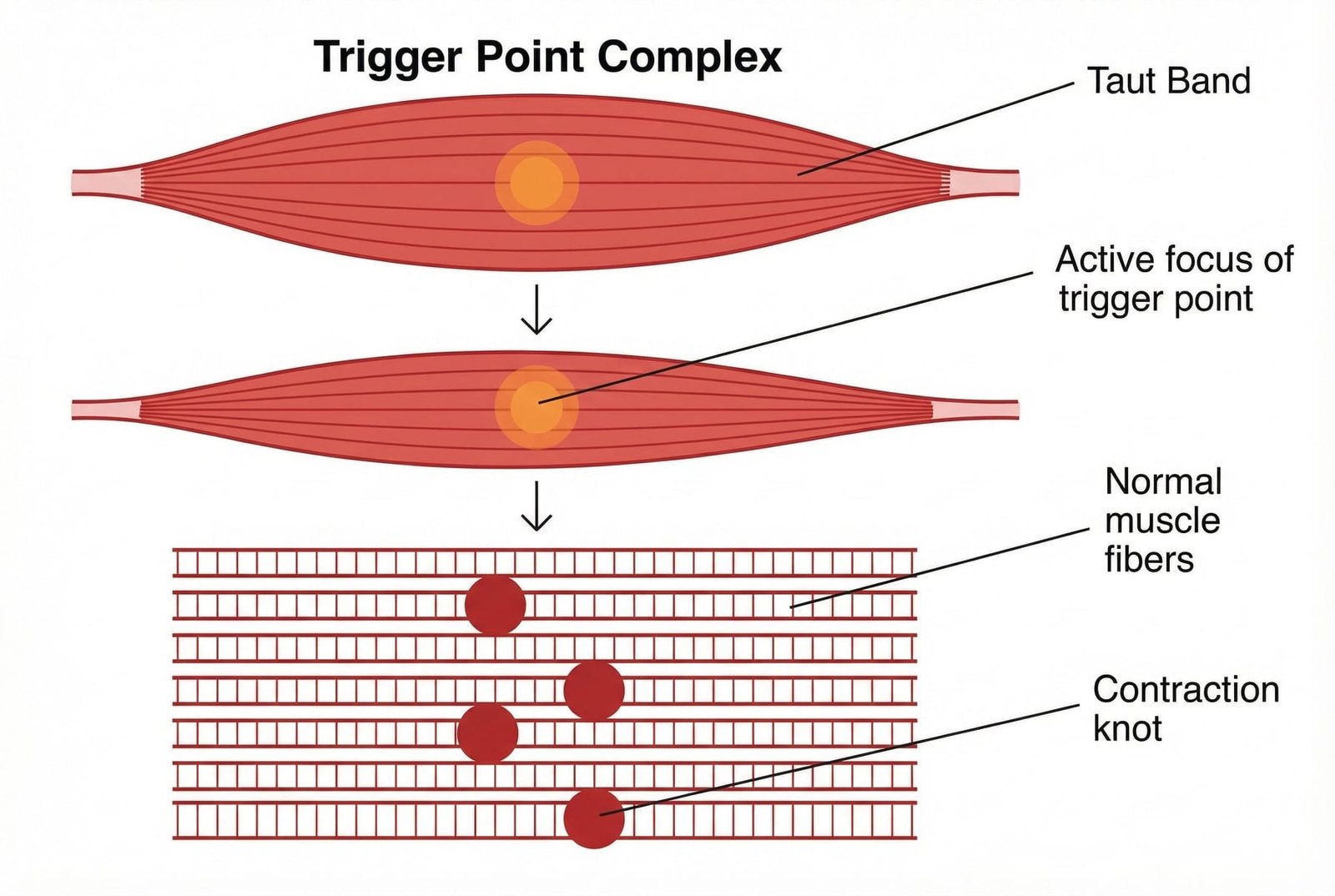
Taut Band Diagram
Muscle Fiber Cross-SectionWhen you run your fingers across a muscle and feel a ropey or tense strand, you may be feeling a taut band. The trigger point itself is usually described as the most tender nodule within that band.
A taut band is different from general “tightness” in a whole muscle. It feels more like a discrete segment or strand within a larger muscle, and pressing it may reproduce local pain or a referred pain pattern.
Taut Band Features
- ▶Palpable rope-like or tense strand within part of the muscle
- ▶May contain one or more distinctly tender nodules
- ▶Can reproduce familiar local or referred pain when pressed
- ▶May be associated with reduced stretch tolerance or altered movement
General Muscle Tightness
- ▶The whole muscle feels broadly stiff or shortened
- ▶There may be no single focal nodule
- ▶Stretching may help more readily
- ▶Referral patterns are less typical or less consistent
Active vs. Latent Trigger Points
Two common clinical states with different behavior
Active Trigger Points
Active trigger points are the ones most strongly linked to spontaneous pain. They often produce an ongoing ache or familiar referred pain pattern even when they are not being pressed.
Causes & Perpetuating Factors
What can create trigger points — and what helps them persist
Direct Trauma
A fall, blow, or sudden strain can irritate muscle tissue and create a painful local reaction. In some patients this appears to set the stage for trigger point development in the injured region.
Muscle Overload
A heavy lift, a sudden spike in training, or any demand that exceeds the muscle’s current capacity can leave the tissue reactive, painful, and prone to trigger point activity.
Sudden Movements
Quick, uncontrolled movements — such as catching yourself during a stumble or a rapid twist — can overload muscle fibers and leave a region unusually irritable afterward.
Perpetuating Factors
Even when trigger points improve with treatment, they often return if the broader contributors are not addressed. These factors are not equally important in every patient, but they are often worth reviewing when progress stalls.
Referred Pain
Why the source of pain is often not where the pain is felt
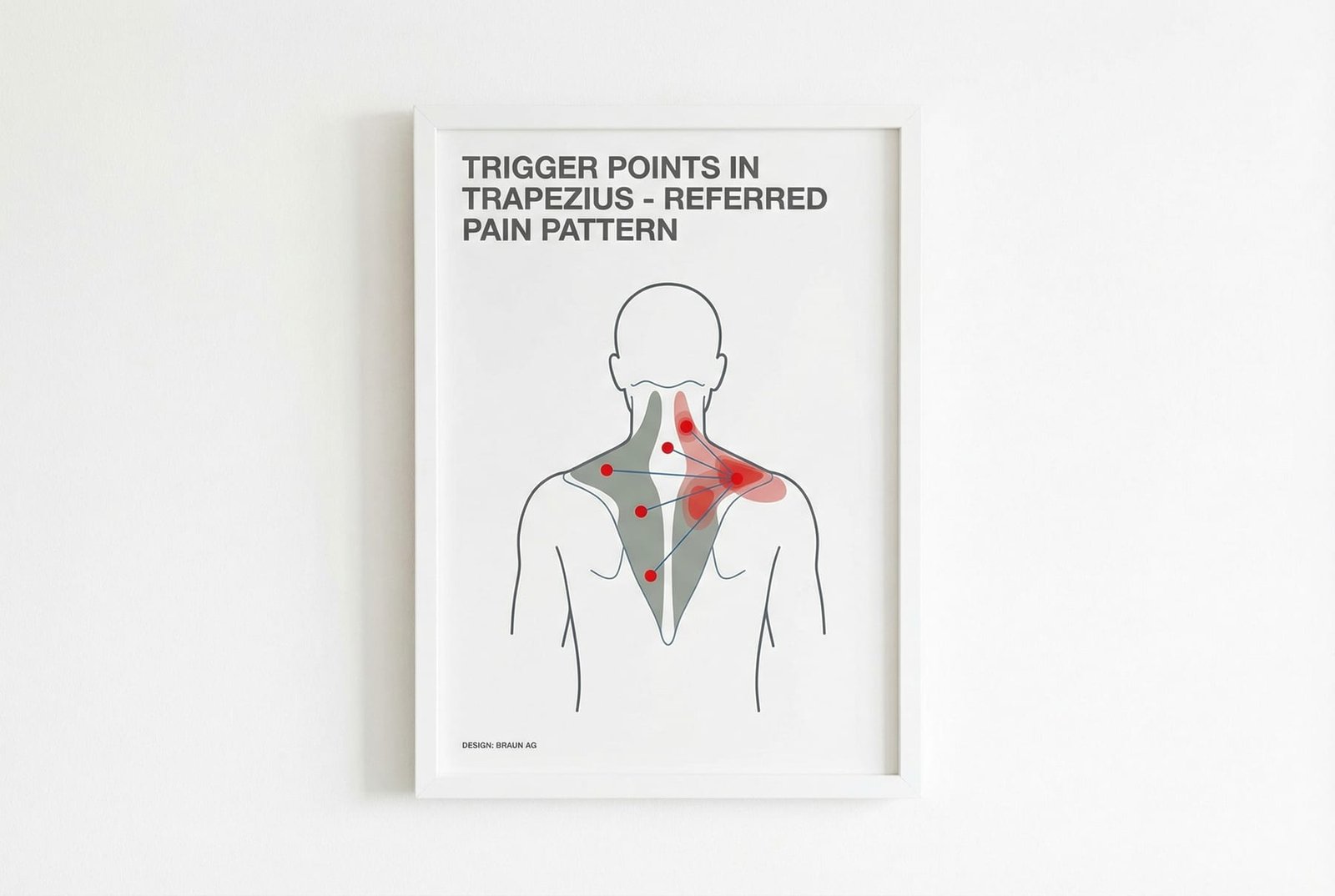
Referred Pain Map
Common Trigger Point PatternsReferred pain is one of the most important ideas in myofascial pain. It means that the place where you feel pain may not be the place where the key problem is located.
The painful area is not always the pain source — and that is one reason myofascial pain is so often misunderstood.
Classical myofascial pain maps, especially those described by Travell and Simons, remain useful because many muscles do show recognizable referral patterns. At the same time, these maps should be used as clinical guides, not as absolute proof.
The most common explanation is that pain signals from one tissue converge with signals from another body region at the spinal-cord level, making the brain interpret the pain as coming from a different place.
Common Referral Patterns
Sternocleidomastoid (SCM)
May contribute to pain around the eye, forehead, ear, or face, and in some patients to dizziness-like symptoms.
Sometimes assumed to be only migraine, sinus, or vestibular trouble without enough cervical assessment
Masseter
May create pain in the teeth, ear, jaw, and temple region, sometimes strongly resembling dental pain.
Dental work may be pursued before the jaw muscles are examined carefully
Upper Trapezius
May send pain up the neck and into the temple, contributing to a classic tension-type headache pattern.
Reduced to “just stress” without identifying the muscular source or perpetuating posture
Gluteus Minimus
May send pain down the side of the hip and leg and can overlap with some sciatica-like presentations.
A spinal explanation may be assumed too quickly when imaging does not match the symptom pattern well
Infraspinatus
Can contribute deep pain in the shoulder and upper arm, sometimes felt more in the front of the shoulder than over the muscle itself.
Often confused with local shoulder tendon or joint problems without examining cuff trigger points
Scalenes
Can contribute arm pain, tingling, or heaviness that overlaps with nerve entrapment or radicular patterns.
Frequently mistaken for distal entrapment or cervical root pain without enough neck / thoracic outlet assessment
Local Contracture
A small part of the muscle remains unusually shortened or irritable within a taut band.
Reduced Local Circulation
That local contracture may reduce circulation and contribute to metabolic stress in the area.
Sensitized Tissue
The local biochemical environment may lower the threshold for pain and tenderness.
Altered Motor Endplate Behavior
The motor endplate remains one of the major theoretical sites involved in trigger point formation and persistence.
Central Sensitization
When the nervous system begins amplifying the pain problem
When trigger points and related pain persist for a long time, the nervous system may become more reactive. This does not mean the pain is imagined — it means the nervous system has become better at producing pain from a lower level of input.
This helps explain why pain can spread, why seemingly mild input becomes disproportionately painful, and why purely local treatment sometimes stops being enough in chronic cases.
Stage 1: Local Pain
MildAt this stage, the painful response is mainly local and clearly linked to pressure, movement, or use of the affected muscle. Symptoms are usually easier to map and easier to calm.
Stage 2: Spinal Sensitization
ModerateWith persistent input over time, pain processing may become more amplified. Pain may begin to spread, and the region may become more sensitive than would be expected from the local tissue alone.
Stage 3: Broader System Involvement
SevereIn long-standing cases, the pain picture may become more widespread, less clearly tied to one muscle, and more influenced by sleep, mood, stress, fatigue, and general nervous-system sensitivity.
Signs That Sensitization May Be Part of the Picture
Allodynia
Light touch or pressure feels painful when it normally should not.
Hyperalgesia
Painful stimuli feel much more painful than expected.
Expanding Pain
Pain spreads beyond the original region or referral map.
Poor Local Treatment Response
Purely local treatment helps less than it used to, or only very briefly.
Sleep and Mood Changes
Sleep, concentration, stress tolerance, or mood become more affected by the pain pattern.
Widespread Sensitivity
Multiple body areas begin to feel tender or reactive.
Key Takeaways
Trigger points are a widely recognized clinical concept in musculoskeletal medicine, but not every detail of trigger point biology is fully settled.
The “energy crisis” model is useful because it explains how local contraction, metabolic stress, and pain can reinforce one another over time.
Referred pain means the painful area may not be the main source, which is one reason trigger point pain is often misread at first.
Latent trigger points can still affect movement, stiffness, and load tolerance even when they are not producing spontaneous pain.
Longstanding trigger point pain can become part of a larger sensitization pattern, which is why treatment sometimes has to expand beyond the local muscle.
Perpetuating factors such as sleep, stress, posture, workload, and nutrition often matter as much as the direct treatment itself.