Treatment Decision Guide
Flowchart OverviewQuick Assessment
Question 1 of 6
How long have you had pain?
The Treatment Ladder
Myofascial pain treatment often works best when approached step by step. Many patients improve with foundational care and never need higher-complexity options.
The best treatment plan is one you understand, can follow consistently, and can adjust over time with your clinician.
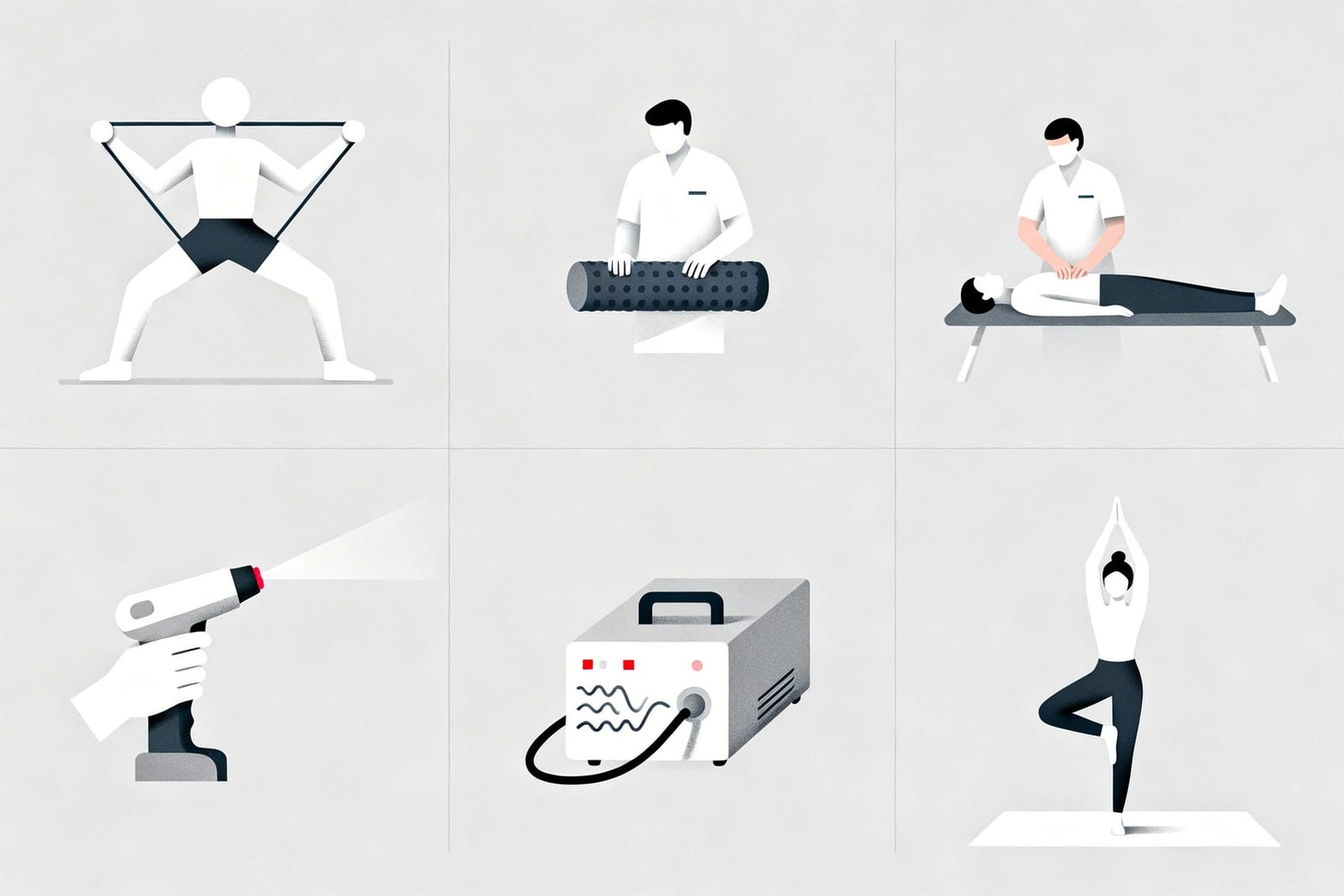
Treatment Ladder
Stepwise Approach DiagramFoundation
- Self-care: heat, self-massage, stretching
- Ergonomic improvements
- Sleep optimisation
- Stress and recovery awareness
A reasonable starting point for almost everyone
Professional Treatment
- Manual therapy / Physical therapy
- Exercise programme
- Dry needling (if open to needles)
- Pain education
Often the next step when foundation work is not enough
Escalated Interventions
- Trigger point injections
- Shockwave therapy
- Medications (topical or oral)
- CBT / Pain psychology
Usually for persistent, more severe, or more complex cases
Comprehensive Approach
- Multidisciplinary pain programme
- Advanced interventions in selected cases
- Combined pharmacological support when appropriate
- Coordinated rehabilitation and behavioral care
Usually reserved for more treatment-resistant or highly complex presentations
Treatment Comparison
| Treatment | Evidence | Cost | Needles? | Self-Use | Speed |
|---|---|---|---|---|---|
| Self-Care (heat, self-massage, stretching) | Strong | $ | No | Yes | Days–Weeks |
| Manual Therapy | Strong | $$ | No | No | Days–Weeks |
| Dry Needling | Strong | $$ | Yes | No | Immediate–Days |
| Trigger Point Injections | Strong | $$$ | Yes | No | Immediate |
| TENS | Moderate | $ | No | Yes | Immediate |
| Shockwave Therapy | Moderate | $$$ | No | No | Weeks |
| Acupuncture | Moderate | $$ | Yes | No | Weeks |
| Exercise Therapy | Strong | $ | No | Yes | Weeks |
| Pain Neuroscience Education | Strong | $ | No | Partially | Weeks |
| CBT / Pain Psychology | Strong | $$ | No | Partially | Weeks–Months |
| Sleep Optimisation | Moderate | $ | No | Yes | Weeks |
| Medications (topical / oral) | Moderate | $–$$ | No | Yes | Days |
Common Treatment Mistakes
Skipping the Foundation
Jumping immediately to advanced interventions without addressing sleep, posture, movement, and self-care often leads to unstable results.
Passive-Only Treatment
Relying only on treatments done to the patient — without enough active rehabilitation — often leads to symptom relief without lasting resilience.
Ignoring Perpetuating Factors
Trigger points often return if the workload, posture, sleep deficit, stress load, or movement pattern creating them remains unchanged.
Stopping Too Early
Many patients stop once they feel somewhat better, even though the system has not yet rebuilt enough capacity to prevent recurrence.
Treating Symptoms Without a Working Model
Medication and symptom relief can be useful, but they work best when linked to an actual plan for the source and perpetuating factors.
One-Size-Fits-All Thinking
The best plan depends on pain duration, distribution, irritability, prior treatment response, patient preference, and practical constraints.
Next Steps
Start with the foundation, then build the plan step by step with your clinician.