Understanding Medical Cannabis for Pain
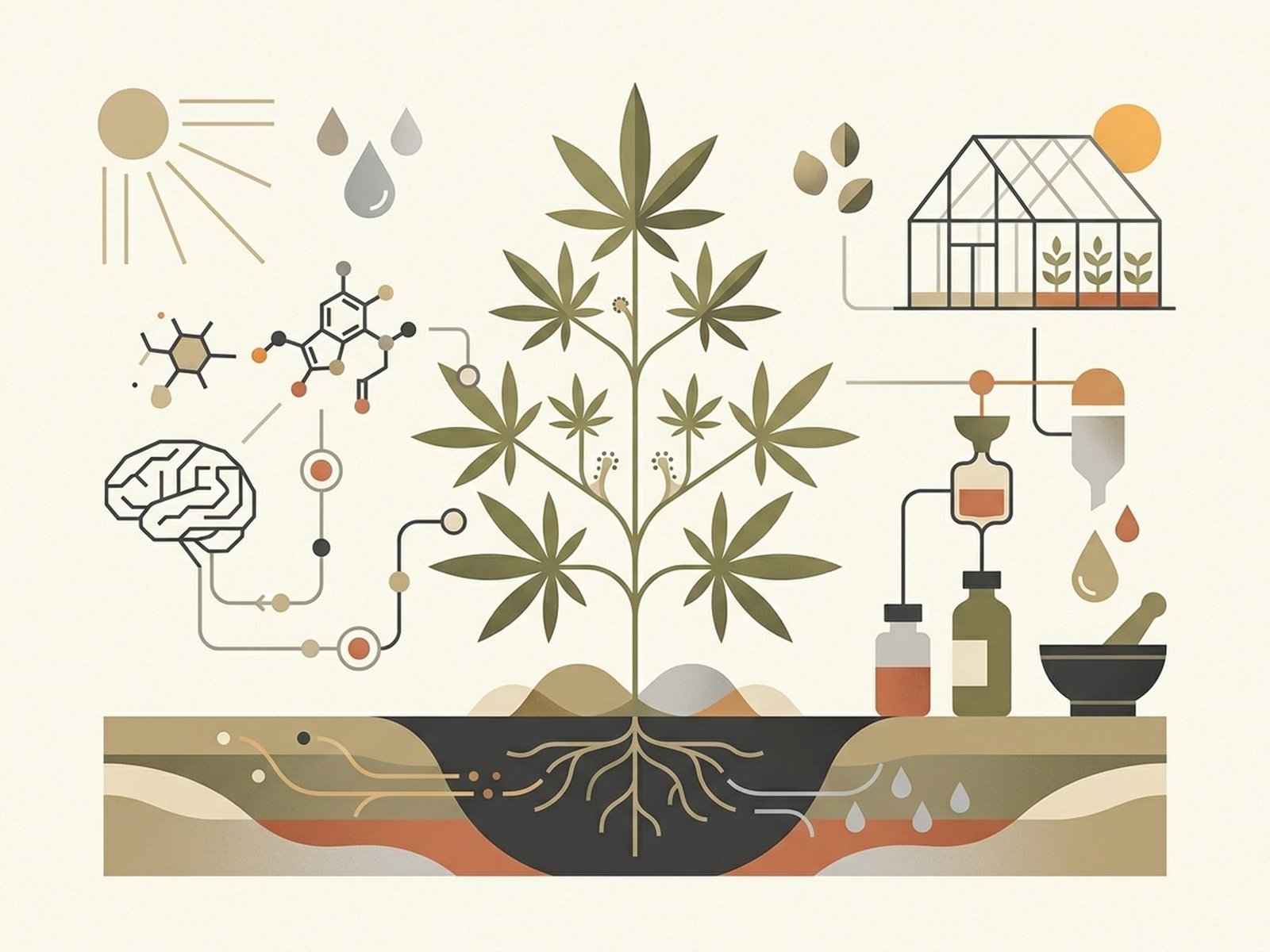
Endocannabinoid System
Overview and Pain PathwaysMedical cannabis refers to the use of cannabis-derived products in a clinical context, usually with THC, CBD, or both. In chronic pain discussions, the interest comes from the endocannabinoid system’s role in pain signaling, mood, sleep, stress, and immune regulation.
The endocannabinoid system is relevant because it helps modulate nociception and stress physiology. This is one reason cannabis is discussed not only for pain intensity, but also for anxiety, sleep disturbance, and other factors that often complicate chronic pain.
For myofascial pain specifically, cannabis should be framed cautiously. The strongest rationale usually appears when MPS overlaps with broader chronic pain features rather than when the presentation is simply a few localized trigger points.
Cannabis is not a first-line treatment for MPS. It is more appropriately discussed as a possible adjunct in selected refractory cases after standard rehabilitation, self-care, and more conventional medication options have been reviewed.
Key Cannabinoid Profiles
Clinical cannabis discussions usually focus on THC, CBD, the balance between them, and the broader product profile. The most important distinction is between potential benefit and tolerability, not between “good” and “bad” cannabinoids.

Cannabinoid Profiles
THC, CBD, and TerpenesTHC is the cannabinoid most closely associated with intoxication, but it is also the component most often discussed in relation to analgesia, sleep effects, and muscle-relaxant effects in cannabis-based medicine. Its clinical role is highly individual and limited by psychoactive side effects in some patients.
CBD is often discussed as the less intoxicating cannabinoid and is commonly positioned as the “gentler” component in cannabinoid-based therapy. It is frequently considered when anxiety, stress reactivity, inflammation, or poor tolerance of THC are part of the clinical picture.
Cannabis-based therapy is often described in terms of the balance between THC and CBD rather than one compound alone. Higher-THC products may produce stronger analgesic or sedating effects but also more cognitive and psychiatric side effects. More CBD-dominant approaches are often discussed when daytime function or tolerability is the main concern.
Terpenes are often discussed as contributors to the overall effect profile of cannabis products. Although the “entourage effect” is widely referenced, clinical use should remain cautious because terpene claims are easier to market than to prove rigorously in individual patients.
The endocannabinoid system is involved in pain signaling, mood, stress regulation, and immune signaling. This is one reason cannabis-based medicines are discussed in chronic pain, especially when pain overlaps with sleep disruption, stress, anxiety, or broader pain amplification features.
Mechanisms & Clinical Evidence
Cannabis is discussed in chronic pain because of its possible effects on pain modulation, muscle tension, sleep, stress, and mood. The evidence base is mixed and highly dependent on condition, product type, route, and study design.
For MPS specifically, the rationale is strongest in patients whose pain is refractory and complicated by poor sleep, anxiety, widespread sensitivity, or overlap with central sensitization. It should not be sold as a direct or universal “trigger point treatment.”
The most clinically responsible way to discuss cannabis is not “Does it help pain?” but “Which patient profile, if any, justifies the tradeoffs?”
Mixed Evidence
Pain literature is heterogeneous
Sleep / Anxiety
Often part of the clinical rationale
Adjunct
Not stand-alone care
Patient Selection & Assessment
Patient selection is central. Cannabis should be considered only when the pain phenotype, psychiatric risk, medication profile, and functional goals all make the discussion reasonable.
MPS Severity & Adjunctive Role
Patient Selection Criteria
Sleep & Anxiety Component
Comorbidity Assessment
Opioid-Sparing Goal
Harm Reduction Evaluation
Legal & Access Assessment
Jurisdiction & Program Eligibility
Treatment Pathways
These pathways reflect the main clinical contexts in which cannabis is discussed: sleep-related symptom burden, daytime tolerability concerns, opioid overlap, and route-related safety questions. They are not dosing protocols.

Routes of Administration
Onset and Duration ComparisonNighttime Symptom Strategy
One of the main reasons cannabis is discussed in chronic pain is its potential relevance to sleep disruption. In some patients, the most meaningful clinical benefit is not direct pain relief alone, but improved sleep quality and reduced nighttime distress.
- Discuss only under clinician supervision
- Focus on whether sleep, pain, and next-day function improve together
- Avoid framing cannabis as a universal sleep solution
- Reassess whether any benefit is worth the side-effect burden
- Use symptom tracking rather than impression alone
Daytime Adjunctive Strategy
For some patients, the main clinical concern is whether a cannabis-based approach can reduce distress or pain without impairing function. That balance is often more important than the label of the product itself.
- Preserve daytime function as the priority
- Avoid assuming symptom relief is helpful if cognition or performance worsens
- Use only as part of a broader care plan
- Do not substitute cannabis for rehabilitation or behavioral care
- Reassess whether the real-world tradeoff is acceptable
Opioid Reduction Strategy
Cannabis is sometimes discussed in harm-reduction conversations when chronic pain treatment already involves opioids. This should be managed as specialist medication care, not as self-directed trial and error.
- Requires full medication review
- Should be coordinated by the prescribing team
- Needs monitoring for sedation, cognition, and overall function
- Must not be approached casually because multiple CNS-active substances may be involved
- The key question is whether safety and function are improving, not only whether pain scores change
Route of Administration Considerations
Different cannabis formulations differ in onset, duration, predictability, and side-effect profile. Route decisions belong to the treating clinician and local regulatory framework, not to casual experimentation.
- Route selection should be medically supervised
- Onset and duration vary substantially by formulation
- Product labeling and regulation differ widely by jurisdiction
- Avoid assuming that “medical” automatically means standardized or low-risk
- Use only through legitimate clinical and legal pathways
Contraindications & Cautions
Cannabis is not a low-consequence option for every chronic pain patient. Psychiatric history, age, driving, cardiovascular history, and medication interactions all matter.
Personal or first-degree family history of psychosis or schizophrenia
CriticalTHC-containing cannabis can worsen or precipitate psychotic symptoms in susceptible individuals. This is one of the strongest reasons to avoid routine THC use.
Adolescence / younger age at regular THC exposure
CriticalRegular THC exposure is more concerning in younger people because of cognitive, psychiatric, and dependence risks. This requires a much more cautious threshold than in mature adult pain care.
Cardiac arrhythmia history or major cardiovascular instability
CautionCannabis can affect heart rate and cardiovascular physiology. Cardiac history matters before treatment is considered.
Driving or operating machinery
CautionCannabis can impair judgment, reaction time, and motor performance. Patients need explicit counseling about safety-sensitive activities.
Drug interactions or additive sedation risk
CautionCannabis can interact with other CNS-active substances and may complicate warfarin, sedatives, opioids, and other medication regimens. Full medication review is important.
Key Takeaways
Cannabis-based therapy in chronic pain is best framed as a selective adjunctive option, not as first-line treatment for ordinary localized MPS.
The strongest practical reasons it is discussed are usually sleep disruption, anxiety overlap, central sensitization features, and refractory pain.
THC and CBD have different clinical tradeoffs, and product choice cannot be reduced to simple marketing claims.
Cannabis should never be treated as a self-directed protocol when psychiatric risk, cognitive impairment, legal issues, or medication interactions are in play.
The most useful question is not whether cannabis is “natural,” but whether it is appropriate, safe, and worth the tradeoffs in this particular patient.