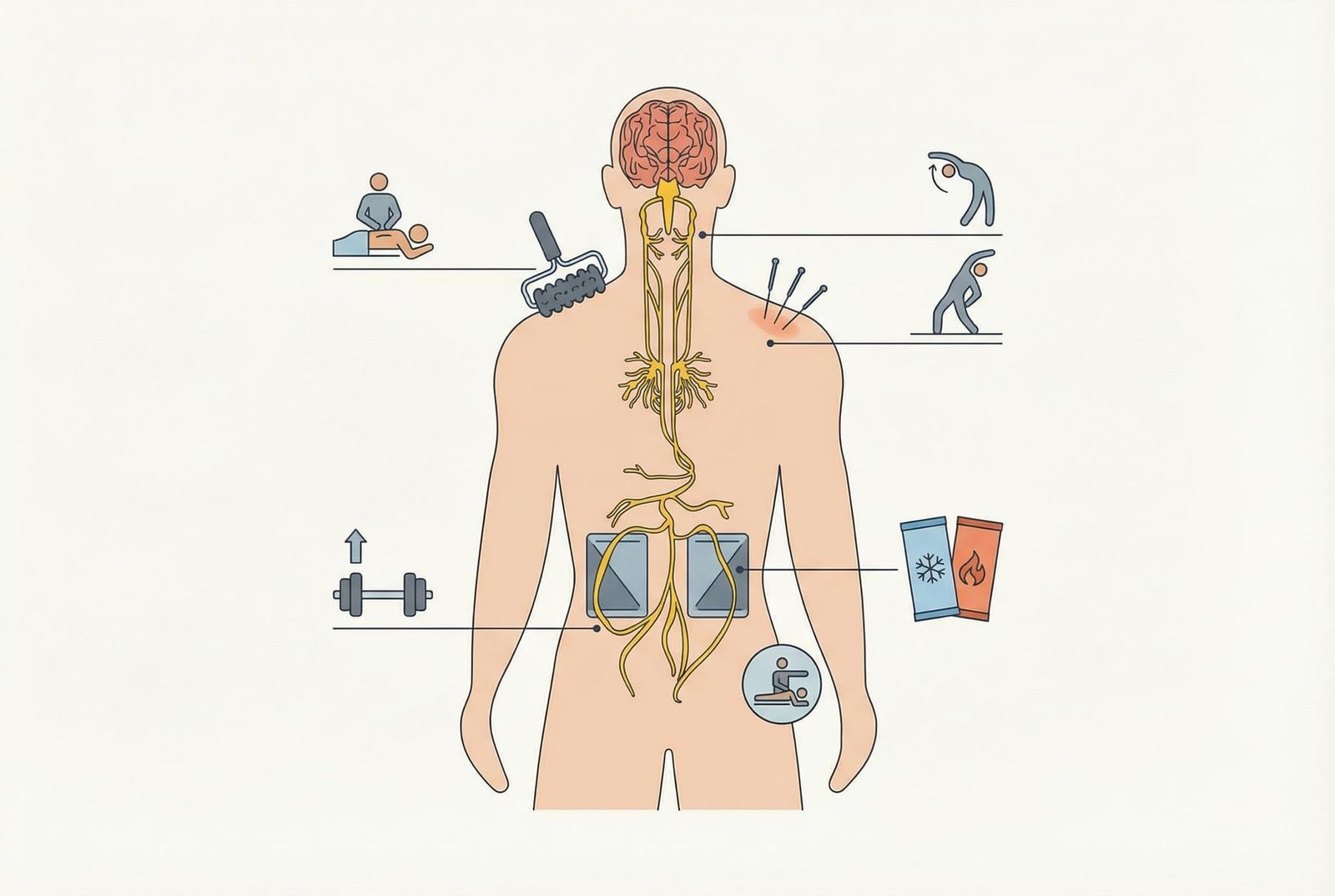
Common Treatment Errors
Visual GuideMost Common Treatment Errors
01
02
03
Self-Treatment Mistakes
Using Improper Tools
Starting with very hard or very aggressive tools can make self-treatment more irritating than helpful.
Better ApproachStart with softer or more forgiving tools and increase intensity only if the tissue tolerates it wellRolling Directly on Joints or the Spine
Pressure applied directly to bony structures is usually less helpful and often less comfortable than pressure applied to the actual muscle or soft tissue.
Better ApproachAim for the muscle belly or the irritated soft-tissue region rather than the bone, joint line, or spinous processesHolding Your Breath During Treatment
When patients tense and hold their breath, the tissue often becomes more guarded rather than more willing to release.
Better ApproachKeep the breath slow and steady so the body stays as relaxed as possible during treatmentTreating Through Sharp or Severe Pain
A treatment sensation can be strong without being useful. Sharp or escalating pain is usually a sign to back off rather than push harder.
Better ApproachUse a level of pressure that feels tolerable and productive rather than punishingInconsistent Treatment Schedule
Doing a lot one day and nothing for the next week is often less effective than a simpler, regular routine.
Better ApproachUse shorter, more consistent sessions that fit real life and can be repeatedNot Warming Up First
Very cold, guarded tissue often responds poorly to treatment delivered abruptly.
Better ApproachUse gentle movement or heat first if that reliably improves toleranceProfessional Treatment Issues
Inadequate Training
Not every provider has specific experience in trigger point assessment, referred pain, or myofascial reasoning.
What to Look ForA clinician who can explain the pattern clearly, examine the relevant muscles, and connect treatment to the bigger movement / posture pictureRushing the Assessment
A very brief or overly local assessment may miss relevant contributors such as posture, sleep, stress, referred pain, or adjacent muscles.
What to Look ForA structured evaluation of pain behavior, movement, likely pain sources, and perpetuating factorsOne-Size-Fits-All Approach
Using the same protocol for every patient often misses what makes one case different from another.
What to Look ForA treatment plan that reflects your pain distribution, irritability, history, and recovery patternFocusing Only on Symptoms
A treatment that only chases the pain flare but never addresses the behavior, load, posture, or sleep pattern behind it often stalls out.
What to Look ForA clinician who can explain not just what hurts, but why it may keep recurringOver-Reliance on a Single Modality
Massage-only, injection-only, or exercise-only treatment may help some patients, but many do best with a broader, staged approach.
What to Look ForA multimodal plan where different tools support one another rather than competeRecovery Phase Mistakes
Immediately After Treatment
Correct Approach: Use a short recovery window, hydrate, move gently, and judge the session by how you function afterward — not just how intense it felt
- Returning to heavy or repetitive loading too quickly
- Ignoring hydration, sleep, or recovery after a strong session
- Assuming soreness automatically means the treatment was “working” well
During Recovery
Correct Approach: Use graded return to activity, consistent home exercises, and correction of the pattern that likely triggered the flare
- Switching to complete rest for too long
- Skipping the home program entirely
- Returning to the same aggravating pattern immediately
Long-Term Maintenance
Correct Approach: Keep a simple maintenance routine, respond early to recurrence signals, and continue working on recovery factors over time
- Dropping all preventive habits as soon as pain improves
- Ignoring early warning signs until a flare is severe
- Treating stress, sleep, and pacing as unrelated to the pain
Keys to Successful Treatment
Patience and Consistency
Multi-Modal Thinking
Address Root Contributors
Build Self-Efficacy
Listen to the Pattern
Work With Knowledgeable Providers
Patience and Consistency
Persistent pain patterns usually develop over time. Improvement often depends more on consistency than on intensity.
Multi-Modal Thinking
Many patients do best when treatment includes local work, exercise, recovery support, and lifestyle or ergonomic change together.
Address Root Contributors
Symptoms are easier to keep from returning when the things driving them are identified and reduced.
Build Self-Efficacy
Learning what helps, what flares the pain, and how to respond early gives patients more control and often better outcomes.
Listen to the Pattern
Pain changes, fatigue patterns, sleep, and activity response are all useful forms of feedback when interpreted calmly and consistently.
Work With Knowledgeable Providers
A good provider helps make the pattern clearer, not more confusing.