What Is Low-Dose Naltrexone?

LDN
Mechanism of Action DiagramLow-dose naltrexone (LDN) refers to low-dose use of naltrexone, a medication better known at standard doses for addiction treatment. In low-dose chronic pain discussions, the rationale is very different: the medication is explored for possible neuroimmune and pain-modulating effects rather than for sustained opioid blockade.
The reason LDN attracts attention in chronic pain is that it may influence central sensitization and neuroinflammatory signaling in ways not addressed by many standard analgesics. That does not make it routine care. It remains an off-label medication usually considered only after careful review of the pain phenotype and prior treatment history.
LDN is best viewed as a selective specialist option for centralized or neuroimmune-linked pain states — not as routine treatment for simple localized trigger point pain.
Clinical interest in LDN has grown because of small trials, mechanistic plausibility, low cost relative to many newer therapies, and a generally favorable tolerability profile. Its evidence base remains limited, which is why it should be presented with caution rather than certainty.
Mechanisms of Action
LDN is interesting because it is discussed through several overlapping mechanisms related to neuroimmune signaling, central sensitization, and endogenous opioid modulation. No single mechanism fully explains the treatment response in every patient.
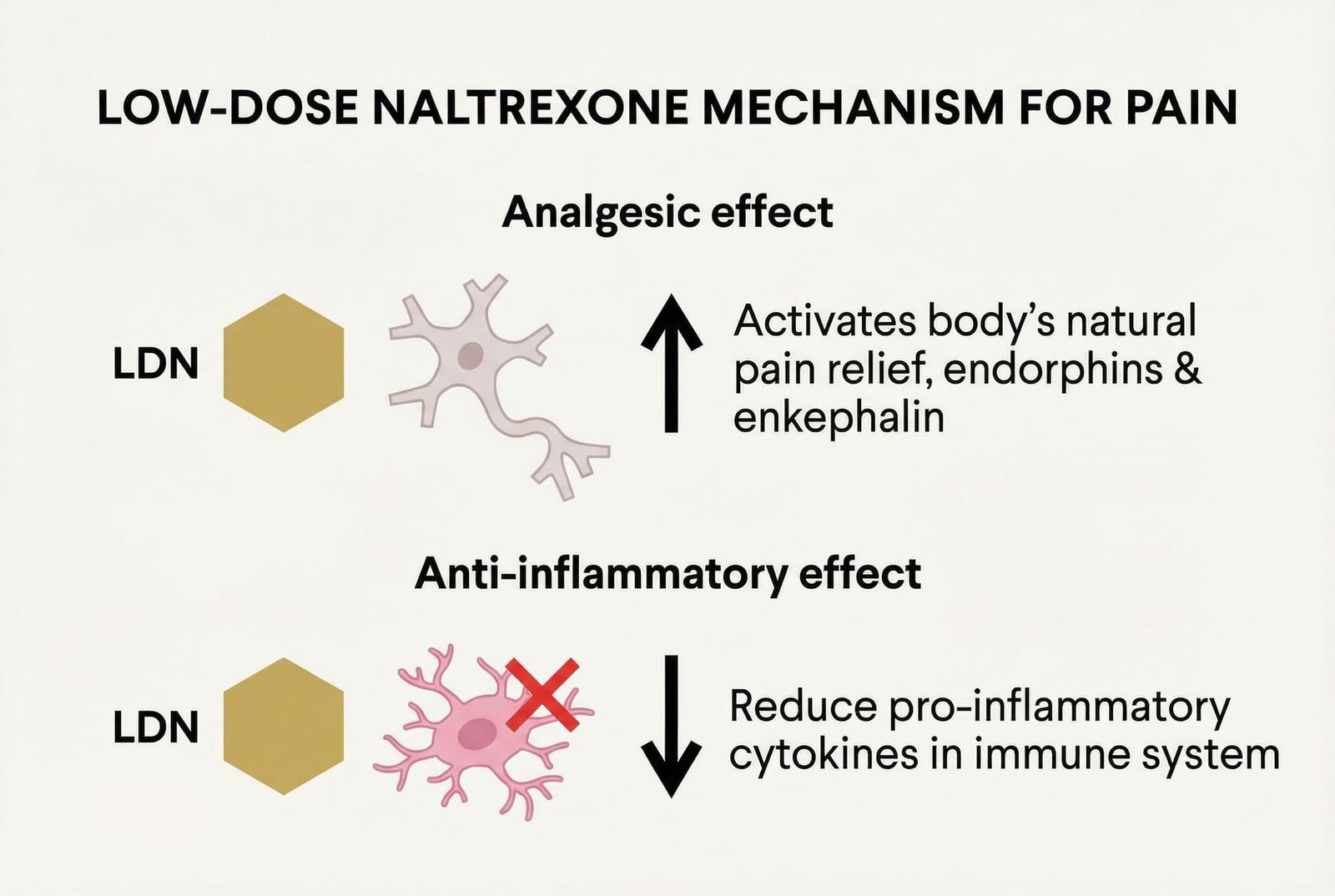
Mechanisms of Action
Mechanism DiagramTLR4 (Toll-Like Receptor 4) Modulation
LDN is often discussed in relation to Toll-like receptor 4 (TLR4) signaling on microglia and immune cells. This is one reason it is thought to have neuroimmune effects that differ from its standard-dose addiction-medicine use.
Microglial Modulation
One proposed reason for interest in LDN is that it may modulate microglial activity and neuroinflammatory signaling. In chronic pain states with central sensitization, that mechanism is considered clinically relevant, even though the exact downstream effects remain an area of ongoing research.
Endogenous Opioid Rebound Theory
A longstanding theory is that brief opioid-receptor blockade at low doses may be followed by a rebound increase in endogenous opioid activity. This is one proposed mechanism, though it should be presented as a theory rather than a complete explanation for clinical benefit.
Anti-Inflammatory Cytokine Shift
LDN is also discussed as a possible modulator of inflammatory signaling, including pro- and anti-inflammatory cytokines. This fits with the broader idea that some chronic pain states involve neuroimmune amplification in addition to mechanical pain drivers.
OGF-OGFr Axis Modulation
Some researchers have suggested that LDN may influence the opioid growth factor (OGF) and OGF receptor axis, which may be relevant to immune and tissue-regulation pathways. This remains a mechanistic area of interest rather than a clinically definitive explanation.
NMDA-Related Effects at Very Low Doses
At the lower end of dosing strategies, some authors discuss possible interaction with broader pain-amplification pathways, including NMDA-linked mechanisms. This remains more theoretical than established in routine chronic pain care.
Use & Titration Principles

LDN Use Principles
Step-by-Step IllustrationInitiation — Start Conservatively
Titration — Gradual Adjustment
Target Dose — Individualized
Timing — Chosen by Prescriber
Compounding / Preparation Considerations
Assessment Timeline
Clinician-Directed Timing
Slow Titration
Compounded Use
Evidence Base
The evidence base for LDN in chronic pain is still limited. The most cited studies are small fibromyalgia trials and review-level discussions suggesting promise rather than definitive proof. That means it should be discussed honestly: interesting, sometimes useful, but not established to the same degree as older mainstream chronic pain drugs.
Younger et al. 2013 — Pilot Crossover Trial
Younger & Mackey 2009 — Initial Pilot
Systematic Review Literature
Chronic Pain Conditions — Emerging Evidence
Myofascial Pain Syndrome-Adjacent Evidence
Safety & Tolerability Data
Small Trials
Gradual Response
Best Signal
LDN vs Gabapentinoids vs SNRIs vs TCAs
Primary Mechanism
Onset to Benefit
Common Side Effects
Evidence Grade
Central Sensitization
Abuse/Dependence
Approximate Monthly Cost
Best Candidate
Side Effects & Tolerability
LDN is often described as relatively well tolerated, but “well tolerated” does not mean “risk free” or “appropriate for self-directed use.” Side effects, psychiatric history, and sleep-related reactions still matter and should be reviewed with the prescriber.
Drug Interactions
Practical Considerations
LDN presents practical barriers because it is off-label, often compounded, and not universally familiar to prescribers. Those barriers are real and should be discussed before starting a trial.
Compounding Pharmacy Access
- Because low-dose formulations are often prepared through compounding channels, pharmacy access can be a practical barrier. Patients should use a legitimate compounding process directed by a prescriber rather than attempting to create low-dose versions themselves.
Insurance Coverage Challenges
- Coverage is often limited because this is generally an off-label compounded use. Cost, pharmacy access, and ongoing out-of-pocket expense should be discussed up front.
Prescriber Education Gaps
- Some clinicians are familiar with LDN, while others are not. The absence of large, definitive trials means that prescribing culture varies widely. That makes specialist discussion especially important.
Patient Expectations
- LDN should not be presented as a fast-acting pain reliever or as a guaranteed answer. If it helps, the improvement is often gradual and should be judged by sleep, pain, function, and overall symptom burden — not by immediate dramatic change.
Formulation Considerations
- Preparation details, fillers, and formulation tolerability may matter in compounded medication. Filler choice can matter for patients sensitive to specific excipients, so ask the compounding pharmacy what the preparation contains.
Monitoring and Follow-Up
- Formal laboratory monitoring may be less burdensome than with some other medications, but follow-up is still important. The main question is whether pain, sleep, function, and tolerability are improving enough to justify continuing.
LDN is pharmacologically distinct from standard-dose naltrexone and is usually discussed through neuroimmune and central sensitization mechanisms rather than addiction treatment mechanisms.
Its evidence base is limited but promising, especially in fibromyalgia and related centralized pain states rather than isolated focal trigger point pain.
Its strongest rationale in myofascial pain is when MPS overlaps with central sensitization, widespread pain, fatigue, sleep problems, or fibromyalgia-like features.
The most important safety issue is concurrent opioid use, which is an absolute contraindication.
LDN should be framed as one possible part of a multimodal chronic pain strategy under clinician supervision, not as a self-directed treatment or a stand-alone cure.
A proper trial requires patience, realistic expectations, and specialist review of whether the pain phenotype actually fits the medication.
Low-dose naltrexone is a specialist off-label option worth considering in some chronic pain patients with central sensitization or neuroimmune features, especially when simpler options have not helped enough. It is not routine first-line care for localized myofascial pain, and it should never be presented as something to self-manage without proper medical supervision.
Absolute Contraindication: Concurrent Opioid Use