What Are Corticosteroids?

Corticosteroids Treatment
Overview DiagramCorticosteroids — also referred to as glucocorticoids in this therapeutic context — are synthetic analogues of cortisol, the endogenous steroid hormone produced by the adrenal cortex. Cortisol is the body’s main endogenous anti-inflammatory and immunomodulatory hormone. Synthetic corticosteroids have been engineered to amplify the glucocorticoid effect while minimizing mineralocorticoid activity, which is the part more associated with salt retention and blood-pressure effects.
The distinction between glucocorticoid and mineralocorticoid activity is relevant to drug selection. Glucocorticoid activity mediates anti-inflammatory and immunomodulatory effects through the glucocorticoid receptor. Mineralocorticoid activity is generally less desirable in most soft-tissue injection settings. Modern injectables such as triamcinolone, dexamethasone, and betamethasone are therefore chosen primarily for glucocorticoid potency with relatively little mineralocorticoid activity.
In myofascial pain syndrome, corticosteroids are injected directly into or adjacent to selected trigger points when the clinician believes local inflammatory activity is meaningfully contributing to pain. The goal is targeted local anti-inflammatory treatment rather than systemic therapy. In practice, this approach makes the most sense when a trigger point seems especially reactive or inflamed rather than when the pain appears purely mechanical, motor-endplate-driven, or centrally amplified.
Corticosteroids are powerful anti-inflammatory tools, but their role in myofascial pain is more selective and limited than in some other conditions.
Corticosteroid trigger point injection is not appropriate for every trigger point. Repeat injections at the same site can cause cumulative local tissue damage including subcutaneous atrophy, fat necrosis, skin depigmentation, and tendon weakening. For that reason, this is usually a selective and use-limited tool rather than a routine repeat strategy.
Mechanisms of Action

Mechanisms of Action
Mechanism DiagramPhospholipase A2 Inhibition
NF-kB Pathway Suppression
Pro-Inflammatory Cytokine Downregulation
Leukocyte Migration Inhibition
Peripheral Nociceptor Desensitization
Genomic vs Non-Genomic Effects
Drug Profiles
Triamcinolone Acetonide
Common Trigger Point SteroidKenalog
Methylprednisolone Acetate
Widely AvailableDepo-Medrol
Dexamethasone Sodium Phosphate
Lower Atrophy RiskDecadron
Betamethasone (Celestone Soluspan)
Dual-Phase ActionCelestone Soluspan
Corticosteroid Comparison at a Glance
Relative Potency
Formulation
Onset
Duration
Atrophy Risk
Best Use Case
Injection Technique
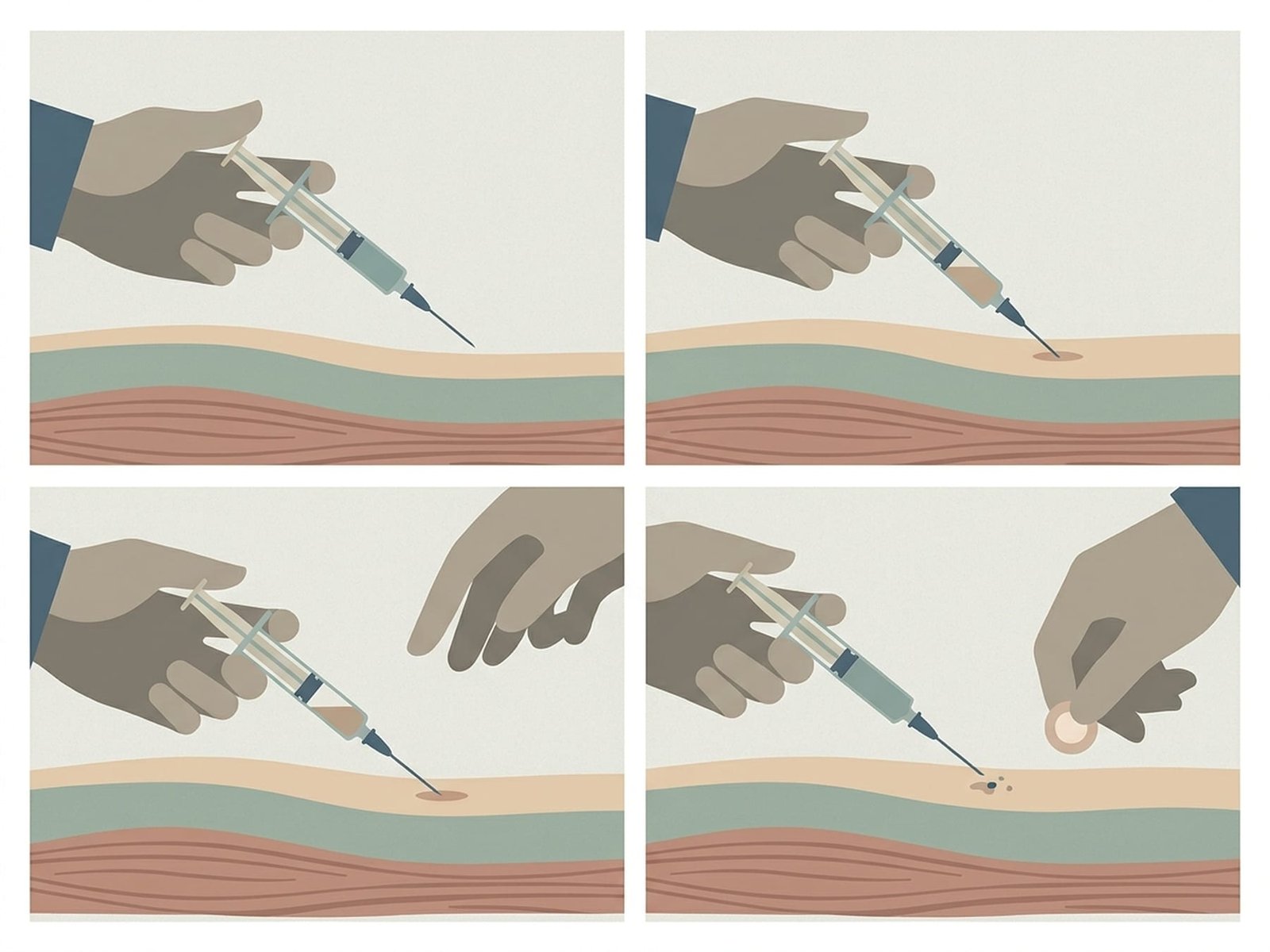
Injection Technique
Step-by-Step IllustrationPatient Assessment & Trigger Point Identification
Drug Selection & Preparation
Needle Selection & Skin Preparation
Injection Technique
Ultrasound Guidance (When Indicated)
Post-Injection Care
Evidence for myofascial pain
The evidence base for corticosteroid trigger point injection is moderate but mixed. Several randomized trials have compared steroid-containing injections with lidocaine alone and with dry needling, with inconsistent results regarding the added value of the corticosteroid component. A common interpretation is that the mechanical disruption of the trigger point may be very important, while corticosteroids may add value in more inflammatory presentations.
Frost et al. (1980)
Hopwood & Abram (1994)
Trigger point injection literature (general)
Borg-Stein & Simons (2002) — Review
Corticosteroid Trigger Point Injection vs Other Interventions
Mechanism
Onset of Action
Duration of Relief
Cost per Session
Evidence Level
Retreatment Limit
Best For
Risks & Limitations
Ideal Candidates & Contraindications
Ideal Candidates & Contraindications
- Trigger Points with Apparent Local Inflammatory Features — Patients whose trigger points show more obvious local inflammatory features — such as warmth, tenderness with local tissue irritability, or reactive swelling — may be the best candidates for corticosteroid trigger point injection. In these cases the anti-inflammatory mechanism has the clearest rationale.
- Subacute Myofascial Pain Syndrome Unresponsive to Initial Conservative Care — Patients with myofascial pain lasting several weeks to a few months who have not responded adequately to physical therapy, stretching, NSAIDs, and other conservative treatment may be reasonable candidates for a steroid-based injection, especially if pain is limiting participation in rehabilitation.
- Trigger Points Contributing to Limited Range of Motion — When trigger point activity is contributing to significant motion loss because of pain and guarding, corticosteroid injection may help create a window in which mobility work and rehabilitation become easier to tolerate.
- Patients Who Responded Previously to Corticosteroid Trigger Point Injection — A clearly positive response to a previous corticosteroid trigger point injection suggests that repeat treatment may help again, provided frequency limits and tissue risks are respected.
- Patients with an Apparently Inflammatory Phenotype — Some patients seem to show a stronger inflammatory component — for example, more pronounced local flare response followed by meaningful relief. These cases may represent a better fit for corticosteroid use than non-inflammatory trigger points.
Absolute Contraindications
Relative Contraindications
Corticosteroids are synthetic glucocorticoid analogues with broad anti-inflammatory effects upstream of both the COX and LOX pathways.
Their use in trigger point injection is best understood as targeted and selective, not as a universal first-line injectate for every trigger point.
Triamcinolone acetonide is one of the most commonly used preparations, while dexamethasone may be preferred when lower atrophy risk matters more than depot duration.
The usual practical limit of 3 to 4 injections per site per year reflects concern about cumulative local tissue risk rather than a purely arbitrary rule.
Clinical evidence suggests corticosteroids may provide somewhat longer relief than anesthetic alone in selected trigger points with inflammatory features, but they are not clearly superior in every case.
Risks include local tissue atrophy, skin depigmentation, tendon weakening, blood glucose elevation, HPA axis suppression, and post-injection flare.
Ideal candidates are usually patients with selected inflamed or reactive trigger points that have not responded adequately to conservative treatment.
Corticosteroid trigger point injection is often best viewed as a bridge treatment — useful for reducing inflammation and pain enough to allow rehabilitation, while the broader perpetuating factors are addressed.
Corticosteroid trigger point injection is a potent but selective intervention within myofascial pain management. It is most useful when a trigger point appears to have a meaningful inflammatory component that is driving pain and dysfunction. The anti-inflammatory effect is broader than that of NSAIDs because corticosteroids act upstream of both the COX and LOX pathways. However, cumulative local tissue risk — including atrophy, fat necrosis, tendon weakening, and skin change — limits how often the treatment should be repeated. For that reason, corticosteroid trigger point injection is usually best viewed as a bridge therapy: a way to reduce pain and inflammation enough to create a rehabilitation window, while stretching, physical therapy, and correction of perpetuating factors are pursued.
Corticosteroid Injection Limits