Why This Conversation Is Hard
If you have felt dismissed, confused, or stuck in the diagnostic process, you are not alone. Myofascial pain can be difficult to communicate because the symptoms are real, but the most familiar medical tests are often unrevealing.

Talking To Your Doctor
Overview IllustrationOften Invisible on Routine Testing
Variable Medical Training
Stress Can Confuse the Picture
Short Appointment Windows
Invisible Pain Is Hard to Explain
How to Describe Your Pain
The more specific your description is, the easier it is for a clinician to examine the right tissues and think through the right differential.
A better appointment usually starts with a better story: clear location, clear pattern, clear triggers, and clear next questions.
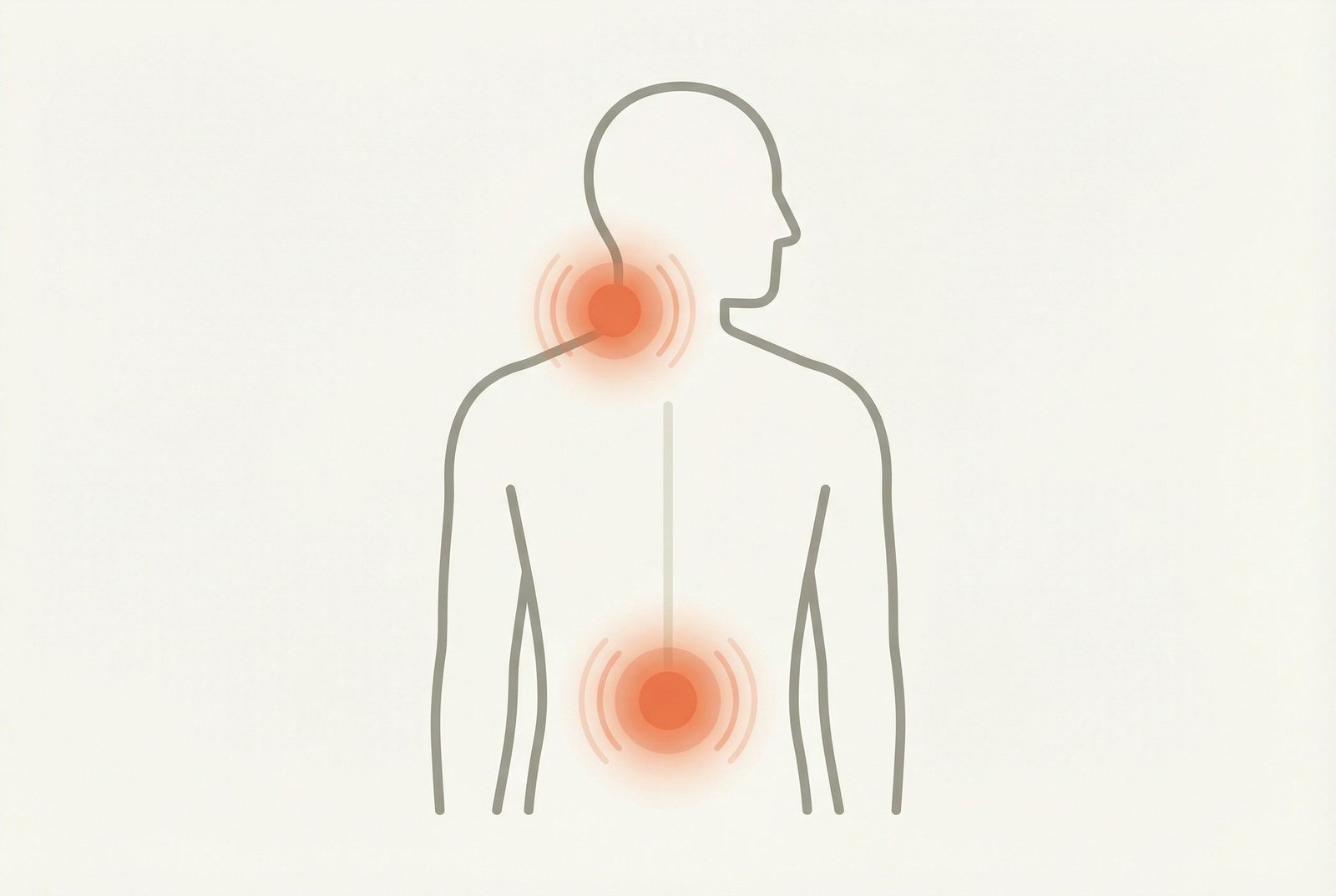
How to Describe Your Pain
Step-by-Step IllustrationBefore & After: Describing Your Pain
It hurts everywhere.
“It hurts everywhere.”
Try saying“I have a persistent sore area at the top of my right shoulder that sends a deep ache toward my right temple. It usually gets worse after long computer work.”
Why it works:This version gives location, referral, timing, and a trigger rather than a global statement that is hard to examine.The pain moves around.
“The pain moves around.”
Try saying“When I press this spot near my right hip, I sometimes feel pain down the outside of my leg. A similar thing happens from a spot near my shoulder blade that sends pain down the arm.”
Why it works:This helps introduce the idea of referred pain without sounding overly scripted.I have been hurting for years and nobody can figure it out.
“I have been hurting for years and nobody can figure it out.”
Try saying“I have had deep neck and shoulder pain for three years. Imaging has not shown a clear explanation, and the pain seems to follow repeatable muscular patterns.”
Why it works:This keeps the frustration honest but turns it into a useful clinical summary.Nothing works.
“Nothing works.”
Try saying“Heat helps temporarily. Massage helps for a day or two. Ibuprofen reduces the edge for a short period. I still feel like the main problem is returning and I have not found a durable plan yet.”
Why it works:This gives the doctor actual treatment response data instead of a dead end statement.Pain Vocabulary
Precise words help translate your lived experience into something a clinician can work with. You do not need to sound overly technical — just specific.
Aching
Burning
Deep
Dull
Sharp on pressure
Radiating
Throbbing
Tightness
Stiffness
Tingling or altered sensation
Terms That Can Help the Conversation
Trigger point
Referred pain
Taut band
Reproduces my pain
Myofascial pain syndrome
Template for Describing Each Painful Area
For each pain area, try to cover location, quality, timing, triggers, and what helps. That structure usually gives the clinician a much more usable picture.
Location
Quality
Timing
Triggers
What Helps
Questions to Ask Your Doctor
Open-ended questions about the differential and exam steps keep the visit moving toward a plan.
First Visit
When you are bringing up myofascial pain or referred muscle pain for the first time
First Visit
- “Could this pain be myofascial or referred from muscle rather than only structural on imaging?”
- “Would you be willing to examine the specific areas where pressing reproduces my familiar pain?”
- “Do you think trigger points or referred pain patterns could be part of what is happening?”
- “If not, what diagnosis do you think best explains this pattern?”
- “If this is not your main area, is there a clinician you would recommend who works with chronic musculoskeletal pain?”
- “Would physical therapy or another movement-based approach be reasonable while we continue clarifying the diagnosis?”
Follow-Up Visit
When you are checking progress or asking how to adjust the plan
Follow-Up Visit
- “These are the parts of treatment that have helped and the parts that have not — how should we adjust the plan?”
- “I have tracked a few repeatable pain patterns. Can we review whether they change your differential or the next treatment step?”
- “Would it make sense to add a more targeted treatment for the areas that are not improving?”
- “At what point would you consider referral to a pain specialist, physiatrist, or another clinician with more myofascial experience?”
- “What would count as meaningful progress over the next few weeks?”
- “Could stress, sleep, posture, or another perpetuating factor be making the pain harder to treat?”
If Dismissed
When the conversation is not going where it needs to go
If Dismissed
- “I understand the tests are normal. Given that, what diagnoses are still on the table for persistent muscular pain like this?”
- “Could we discuss whether a myofascial component is still possible even though imaging is normal?”
- “If this is not your leading diagnosis, what are the main alternatives you are considering?”
- “Would you be comfortable referring me to someone who evaluates chronic musculoskeletal pain more frequently?”
- “Could we document the symptoms I reported and the options we discussed, so I can track the next step clearly?”
Your Pain Journal Template
A short pain journal often makes appointments more productive because it turns a vague memory into a pattern the clinician can actually review.
What to Track Each Day
Date & Time
Tuesday, March 4, 2:30 PM
Consistency helps reveal patterns that memory often misses.Pain Location
Right upper trapezius referring toward the right temple
Be as specific as you can. Include where the pain starts and where it seems to spread.Pain Level (0-10)
6/10 at rest, 8/10 when pressing the sore spot
Tracking both resting pain and provoked pain can be more useful than a single number.Activity When It Started
After 2 hours of desk work without a break
Body position, repetition, stress, and duration all matter.What Makes It Worse
Prolonged sitting, stress, carrying a bag on one shoulder
Include physical, environmental, and emotional triggers when they are clear.What Makes It Better
Hot shower helps for 20 minutes; stretching helps briefly
Even partial or temporary relief is clinically useful information.Impact on Daily Life
Could not concentrate well at work and skipped exercise
Function matters as much as pain intensity in many clinical decisions.What You Tried & Result
Massage ball on the area helped for about an hour
This helps your doctor see what is already worth building on.If You Are Being Dismissed
If the conversation keeps stalling, the goal is not to escalate emotionally. The goal is to clarify the reasoning, ask what is still being considered, and request the next appropriate step.
Normal Tests Do Not End the Discussion
Request a Referral Clearly
Know When a Second Opinion Makes Sense
Ask for Clear Documentation
Look for the Right Kind of Clinician
Bringing Research to Your Appointment
Research can help, but only if it supports the conversation rather than trying to dominate it. The best use of research is to make the discussion more specific and collaborative.
Reference Established Sources, Not Just Social Media
Use Diagnosis Terms Carefully
Frame Research as Questions
Ask About Evidence-Based Options
Bring a One-Page Summary
For Your Support Person
A support person can make the visit calmer and more organized, especially when pain, fatigue, or anxiety make it hard to remember everything in the room.
Validate Without Taking Over
Help Track Patterns
Speak Up Carefully
Prepare Together Before the Visit
Continue Learning
These pages cover symptom understanding, visit preparation, clinical referrals, and treatment planning.
When to See a Doctor
Know which symptoms are routine and which should prompt prompt evaluation.
Building Your Care Team
Which kinds of clinicians are often most useful in chronic musculoskeletal pain care.
Self-Assessment Tool
A guided way to organize pain patterns and likely muscle contributors.
Getting a Diagnosis
What a reasonable diagnostic process can look like when pain is persistent and imaging is normal.
Understanding Your Diagnosis
A broader guide to what a myofascial pain diagnosis does — and does not — mean.