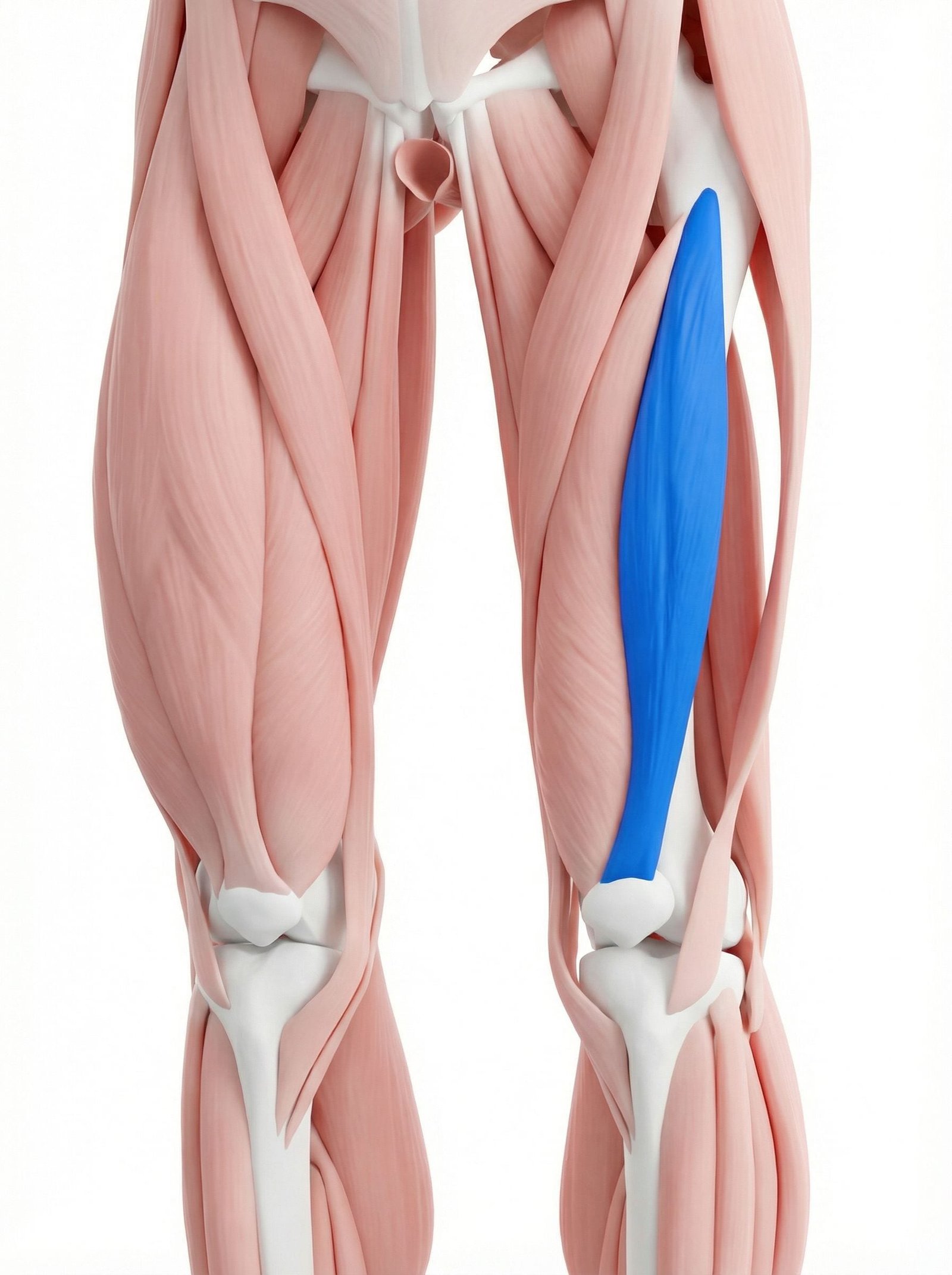
TrP 1
TrP1
Location. Deep middle thigh
Pain referral. Deep front thigh, knee
- Deep front thigh
- Knee
- Mid thigh
Deep anterior thigh aching beneath the rectus femoris from deep quadriceps trigger points
Location. Deep middle thigh
Pain referral. Deep front thigh, knee
Location. Upper deep thigh
Pain referral. Deep upper thigh, knee
Location. Distal fibers near suprapatellar region
Pain referral. Anterior knee and deep anterior thigh
Location. Proximal fibers near femoral shaft
Pain referral. Anterior thigh and deep quad ache
Deep thigh pain. Deep anterior thigh aching beneath the rectus femoris from deep quadriceps trigger points
Knee pain. Suprapatellar aching from deep quadriceps trigger point referral toward the knee joint
Difficulty with knee extension. Reduced extension strength from trigger point inhibition in deep quadriceps layer
Knee discomfort. Referred anterior knee pain from vastus intermedius trigger points affecting patellar tracking
Extension weakness. Diminished knee extension force from trigger point inhibition in this deep quadriceps component
Anterior knee pain. Deep anterior knee ache from distal vastus intermedius trigger point referral to patella region
Difficulty fully extending knee. Taut band in distal vastus intermedius restricts terminal knee extension mechanically
Deep aching in front of knee. Deep retropatellar ache from trigger point referral into the anterior knee joint area
Knee buckling sensation. Inhibited quadriceps firing from trigger points causes transient knee giving-way episodes
Stiffness after prolonged sitting. Sustained knee flexion shortens vastus intermedius creating post-rest anterior knee stiffness
Deep anterior thigh ache. Deep aching within anterior thigh from proximal vastus intermedius trigger points on femoral shaft
Quadriceps stiffness. Restricted quadriceps extensibility from vastus intermedius taut bands limiting knee flexion range
Difficulty with forceful knee extension. Inhibited vastus intermedius contraction from trigger points reduces maximum knee extension force
Mid-thigh heaviness. Perceived heaviness in mid-anterior thigh from deep vastus intermedius trigger point referral
Pain walking upstairs. Stair ascent requires forceful knee extension loading sensitized proximal vastus intermedius fibers
Running. Repetitive knee extension during running stride overloads the deep vastus intermedius layer
Squatting. Heavy loaded knee extension eccentrically overloads vastus intermedius at depth positions
Overuse. Excessive training volume without recovery creates cumulative deep quadriceps muscle fatigue
Weak quadriceps. Insufficient overall quadriceps strength increases demand on individual vastus components
Excessive squats or leg press. High-volume knee extension loading overworks deep quadriceps fibers near suprapatellar region
Running on hard surfaces. Repetitive impact forces transmitted through knee overload distal vastus intermedius eccentrically
Prolonged sitting with knees bent. Sustained knee flexion keeps vastus intermedius shortened promoting ischemic trigger points
Quadriceps contusion. Direct blow to anterior thigh damages deep vastus intermedius fibers creating traumatic trigger points
Post-knee surgery guarding. Protective quadriceps inhibition after surgery leads to compensatory vastus intermedius overload
Excessive squatting or leg press. High-volume knee extension exercises overload deep vastus intermedius on femoral shaft chronically
Running overuse. Repetitive knee extension during running gait cycle creates cumulative vastus intermedius fatigue
Quadriceps contusion (direct blow). Direct impact to anterior thigh damages deep vastus intermedius creating traumatic trigger points
Post-femoral fracture guarding. Protective quadriceps splinting after femoral fracture creates sustained vastus intermedius contraction
Cycling with high resistance. High-resistance pedaling overloads vastus intermedius through sustained forceful knee extension
Lie face down with a foam roller under the front of the affected thigh. Support your upper body on your forearms. Roll slowly from just above the knee to the hip crease, pausing on especially tender spots for 20-30 seconds. Apply moderate pressure — this muscle is deep, so you need enough force to reach it through the overlying rectus femoris.
Stand on one leg (hold a wall for balance) and pull the opposite heel toward your buttock by grasping the ankle. Keep your knees together and your pelvis tucked under to avoid arching the low back. If standing is difficult, lie on your side and perform the same stretch. Hold at the point of comfortable tension without forcing.
Sit on a chair with a rolled towel under the affected knee. Straighten the knee fully by lifting the foot off the floor, squeezing the quadriceps hard at the top for 3 seconds. Lower slowly. This specifically targets the vastus intermedius in the last degrees of knee extension where it is most active.
Start with a low step (15-20 cm). Step up leading with the affected leg, fully straightening the knee at the top. Step down slowly, controlling the descent with the same leg. As strength improves over weeks, gradually increase step height. Keep your trunk upright and avoid pushing off with the trailing leg.
Set a timer to remind you to stand and briefly walk around every 30 minutes during prolonged sitting. When you stand, perform 5 gentle quad squeezes (tighten the front of the thigh for 5 seconds, then relax). This prevents the vastus intermedius from stiffening in a shortened position during desk work or long drives.
See a physiotherapist or sports medicine physician if deep thigh aching or knee buckling does not improve within 3-4 weeks of self-care. A thorough evaluation including strength testing and possibly imaging can rule out quadriceps tendon pathology, femoral stress reactions, or patellofemoral joint issues that may present similarly.
Lie face down with a firm foam roller or lacrosse ball under the front of the mid-thigh. Use your forearms to control pressure and body weight. Because the vastus intermedius is deep, you need more sustained pressure than typical quad rolling. Find a tender spot and hold for 30-60 seconds, breathing deeply, until the tenderness begins to release. Work the entire mid-thigh area.
Lie face down on a firm surface. Bend the affected knee and reach back to grasp your ankle or foot. Gently pull your heel toward your buttock until you feel a deep stretch in the front of the thigh. Keep your hips pressed flat against the surface to prevent arching the lower back. Hold steady without bouncing.
Stand with your back against a wall and slide down to a 45-degree knee bend. Place a small ball or rolled towel between your knees and gently squeeze while holding the wall sit. This activates all four quadriceps components including the deep vastus intermedius. Hold for 15-20 seconds, rest, and repeat.
Using a leg press machine with light to moderate weight, press the platform up, then slowly lower it back over 4-5 seconds, focusing on controlling the descent. This eccentric loading targets the deep quadriceps effectively. Keep feet shoulder-width apart and do not lock the knees at the top.
Temporarily reduce or eliminate heavy barbell squats, deep lunges, and other high-load quadriceps exercises that compress and overload the vastus intermedius. Replace with lighter leg press, wall sits, and step-ups that allow controlled loading. Resume heavier squatting only after deep thigh pain has resolved with lighter exercises.
If deep anterior thigh pain does not respond to quad stretching and foam rolling within 4-6 weeks, consult a musculoskeletal specialist. Deep thigh pain can also originate from femoral stress reactions, referred lumbar pathology, or vascular conditions that require imaging and specialized assessment.