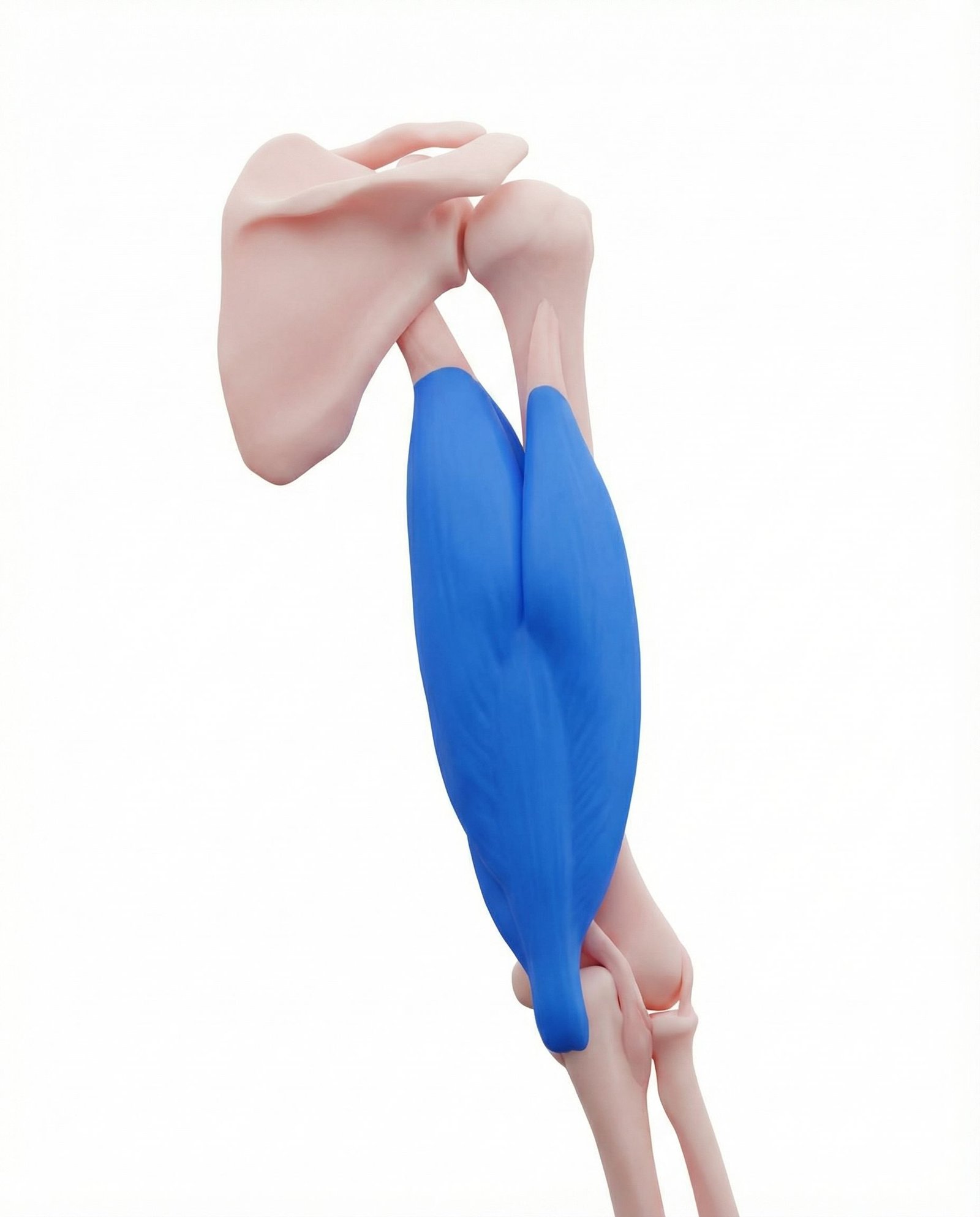
TrP 1
TrP1
Location. Back of upper arm
Pain referral. Back of arm, elbow, shoulder
- Back of arm
- Elbow
- Shoulder
- Upper back
- Fourth and fifth fingers
Posterior upper arm aching that worsens during pushing and elbow extension activities
Location. Back of upper arm
Pain referral. Back of arm, elbow, shoulder
Location. Back of arm, near elbow
Pain referral. Back of elbow, posterior arm
Location. Posterior upper arm near shoulder, originating from infraglenoid tubercle of scapula
Pain referral. Back of upper arm near the shoulder
Location. Medial head of triceps near the elbow
Pain referral. Medial epicondyle and 4th-5th fingers
Location. Lateral head of triceps, mid-arm
Pain referral. Lateral elbow and posterior forearm
Location. Long head near axillary border, proximal attachment
Pain referral. Posterior shoulder and lateral 4th-5th fingers
Back arm pain. Posterior upper arm aching that worsens during pushing and elbow extension activities
Elbow pain. Posterior olecranon aching that intensifies with resisted elbow extension movements
Shoulder pain. Referred posterior shoulder ache from long head triceps trigger point activation
Weakness in pushing. Reduced push strength impairing push-ups, bench press, and overhead pressing activities
Finger symptoms. Ulnar finger paresthesia from distal triceps trigger point compression of ulnar nerve pathway
Back of arm pain near the shoulder. Posterior upper arm aching near the scapular origin of the triceps long head trigger points
Pain with overhead activities. Posterior shoulder pain during overhead movements as long head stabilizes the glenohumeral joint
Difficulty reaching behind the head. Restricted shoulder flexion with elbow flexion from shortened triceps long head taut bands
Elbow pain on the inner side. Referred medial epicondyle pain from triceps long head trigger points mimicking golfers elbow
Weakness in pushing movements. Reduced elbow extension force from long head trigger point inhibition during pushing tasks
Medial elbow pain. Medial triceps trigger point refers pain to medial epicondyle mimicking golfer elbow presentation
Ring and little finger numbness or aching. Referred pain to ulnar distribution from medial triceps through neural convergence pathways
Medial forearm pain. Pain descending along medial forearm from medial triceps trigger point referral pattern
Elbow stiffness. Taut medial triceps band restricts elbow flexion range creating extension bias stiffness
Golfer elbow-like symptoms. Medial epicondyle pain from triceps trigger point closely mimics medial epicondylitis presentation
Lateral elbow pain. Lateral triceps trigger point refers pain to lateral elbow mimicking lateral epicondylitis pattern
Posterior forearm ache. Referred pain descends along posterior forearm from lateral triceps trigger point activation
Weak elbow extension. Lateral head trigger point reduces triceps force output during elbow extension activities
Pain with pushing motions. Pushing demands triceps extension directly loading lateral head trigger point fibers
Difficulty fully extending elbow. Taut lateral triceps band creates restriction approaching terminal elbow extension range
Deep posterior shoulder ache. Long head triceps trigger point refers deep aching to posterior shoulder at infraglenoid origin
Tingling in ring and little fingers. Proximal triceps trigger point irritates ulnar nerve pathway causing distal finger paresthesia
Pain reaching overhead. Overhead reach lengthens long head triceps across trigger point creating shoulder and arm pain
Axillary tenderness. Trigger point proximity to axillary neurovascular bundle creates localized axillary region tenderness
Shoulder impingement-like symptoms. Long head dysfunction alters humeral head mechanics creating impingement-mimicking shoulder pain
Push-ups. Repetitive concentric-eccentric elbow extension under body weight fatigues triceps muscle fibers
Bench press. Heavy resisted elbow extension during pressing overloads triceps beyond recovery capacity
Overhead throwing. Forceful elbow extension during throw acceleration phase strains triceps long head
Repetitive pushing. Sustained pushing activities create cumulative triceps microtrauma and trigger point formation
Sudden heavy lifting. Acute eccentric overload during unexpected heavy lift activates latent triceps trigger points
Push exercises. Repetitive pushing movements like bench press overload distal triceps near elbow insertion
Overhead activities. Sustained overhead arm positions require prolonged triceps contraction for elbow stabilization
Repetitive extension. Repeated elbow straightening activities cumulatively overload distal triceps muscle fibers
Tricep dips. Loaded shoulder extension with elbow extension maximally stresses triceps long head at its origin
Overhead pressing. Heavy overhead press demands sustained triceps long head activation for elbow lock-out phase
Throwing sports. Rapid elbow extension during throwing acceleration maximally activates the triceps long head
Gymnastics. Ring and bar support positions demand sustained isometric triceps contraction beyond normal endurance
Push-ups and bench press. Heavy pressing exercises demand maximal medial triceps force for elbow extension under load
Overhead triceps extensions. Isolated triceps exercises maximally load medial head fibers near elbow attachment
Leaning on elbow (student elbow). Direct olecranon compression during elbow leaning transmits pressure to medial triceps fibers
Repetitive pushing motions. Repeated elbow extension against resistance cyclically loads medial triceps creating trigger points
Hammering or pounding activities. Repetitive impact elbow extension during hammering overloads medial triceps at elbow region
Heavy bench press. Maximal pressing demands high lateral triceps force production creating overuse trigger points
Dips and push-ups. Bodyweight pressing exercises maximally load lateral triceps during extension phase
Repetitive pushing tasks. Repeated pushing motions cyclically load lateral triceps beyond recovery capacity
Prolonged desk work with arms extended. Sustained arm extension at desk maintains lateral triceps in contracted position
Swimming (especially freestyle). Freestyle recovery phase requires repeated long head triceps activation for arm elevation
Crutch use (axillary pressure). Crutch top compresses long head triceps near axillary border creating sustained ischemia
Sleeping with arm overhead. Sustained overhead arm position during sleep maintains long head in stretched position
Pull-ups and lat pulldowns. Pulling exercises require long head triceps co-contraction for shoulder joint stabilization
Stand with your back to a wall and raise the affected arm overhead. Place a tennis ball between the wall and the back of your upper arm (triceps area). Lean into the ball with comfortable pressure and slowly roll it up and down the triceps by bending and straightening your knees. When you find a tender spot, hold sustained pressure for 20-30 seconds. Work from the back of the shoulder down to just above the elbow.
Apply a warm, damp towel or microwavable moist heat pack to the back of the upper arm, covering the entire triceps region from the shoulder to the elbow. Rest your arm in a comfortable position, slightly bent. The moist heat penetrates the muscle tissue to promote blood flow and relaxation. This is especially effective before stretching or self-massage.
Raise the affected arm overhead and bend the elbow so your hand drops behind your head toward the opposite shoulder blade. Use your other hand to gently push the elbow further back until you feel a stretch along the back of the upper arm. Keep your head upright and avoid tilting it forward. Hold the stretch for 20-30 seconds, then release slowly.
Sit or stand with a light weight (2-5 pounds) held in the affected hand overhead with the arm straight. Slowly bend the elbow to lower the weight behind your head over a count of 5 seconds, controlling the descent. Use your other hand to help push the weight back to the starting position so the triceps only works during the lowering phase. This eccentric loading promotes healing of the trigger point.
Avoid resting with your elbows bent in a tight position for extended periods, such as sleeping with arms folded or propping your chin on your hands. At your desk, position your keyboard and mouse so your elbows rest at approximately 90-100 degrees with forearms supported. Use a chair with armrests to reduce sustained triceps tension. When performing pushing exercises, ensure proper form and avoid locking the elbows forcefully at the end of each repetition.
If posterior arm or elbow pain persists for more than 3 weeks despite self-care, or if you notice tingling or numbness in the ring and little fingers, consult a physical therapist or orthopedic specialist. Describe the posterior arm pain and any radiating symptoms toward the hand. These symptoms may indicate ulnar nerve involvement at the elbow that requires specific evaluation and treatment beyond trigger point therapy alone.
Sit with the affected arm resting on a table. Using the thumb of your opposite hand, press into the back of the upper arm about two to three inches above the point of the elbow (olecranon). Search for the most tender spot in the distal triceps muscle belly. Apply sustained, firm pressure for 30-60 seconds while breathing slowly. You can also use a lacrosse ball against a wall: stand with your back to the wall, position the ball on the tender spot, and lean into it with controlled pressure.
Raise the affected arm overhead and bend the elbow so your hand drops behind your head toward the opposite shoulder blade. Use your other hand to gently push the elbow further back and down until you feel a comfortable stretch along the back of your upper arm. Hold for 30 seconds without bouncing. Repeat 3 times. For a deeper stretch, hold a towel in the affected hand and grasp the other end with your opposite hand behind your lower back, gently pulling downward.
Stand facing a wall at arm’s length. Place your hands on the wall at shoulder height with a narrow grip (hands about 6 inches apart) to emphasize the triceps. Slowly bend your elbows, bringing your chest toward the wall over 3 seconds, then push back over 2 seconds. Perform 12-15 repetitions for 3 sets. As this becomes easy, progress to a countertop, then an elevated surface, and eventually the floor. Keep elbows close to your body throughout.
Identify and temporarily reduce activities that heavily load the triceps — bench press, overhead press, push-ups, dips, and pushing heavy objects. When these activities are necessary, warm up the triceps thoroughly first with light stretching and movement. Avoid locking the elbows forcefully at the end of pressing movements. At night, avoid sleeping with the elbow fully bent, which keeps the triceps in a shortened position. Use an elbow extension splint at night if needed.
If posterior elbow pain does not respond to 3-4 weeks of self-care, consult a sports medicine physician or physical therapist. They can differentiate distal triceps trigger points from triceps tendinopathy, olecranon bursitis, posterior impingement syndrome, or ulnar nerve entrapment. Treatment may include dry needling of the distal triceps trigger points, instrument-assisted soft tissue mobilization, or ultrasound-guided evaluation.
Raise the affected arm overhead, then bend the elbow so your hand drops behind your head toward the opposite shoulder blade. Use the opposite hand to gently pull the elbow further behind your head until you feel a stretch along the back of the upper arm. Keep your head upright and avoid arching your lower back. Hold the stretch steadily without bouncing.
Lie on your side with a foam roller positioned under the back of your upper arm. Support your head with your lower hand. Roll slowly from just below the shoulder to just above the elbow, pausing on any tender spots for 20-30 seconds. Apply moderate pressure by adjusting how much body weight you transfer onto the roller. Breathe steadily and allow the muscle to relax into the pressure.
Begin with wall push-ups or chair-assisted dips at a comfortable depth. Lower your body slowly over 3-4 seconds, then push up over 2 seconds. Start with 2 sets of 8-10 repetitions. Gradually increase depth and difficulty as pain allows. The goal is controlled eccentric loading of the triceps long head to promote healing.
Anchor a resistance band overhead (on a door frame hook or pull-up bar). Face away from the anchor, grip the band with the affected hand behind your head, elbow bent. Slowly straighten your arm forward and down until fully extended, then return slowly to the starting position. Perform 12-15 repetitions for 2-3 sets. Choose a band tension that allows completion with only mild effort at the end.
Identify tasks that keep your arms overhead for extended periods — painting ceilings, overhead shelving, sleeping with arms above the head. Break these tasks into shorter intervals with rest periods every 10-15 minutes. When sleeping, keep arms below shoulder level using a body pillow or adjusting sleep position. Use a step stool to bring overhead tasks to a more neutral arm height.
If symptoms persist beyond 4 weeks of self-care, consult a physical therapist or sports medicine physician. They can rule out radial nerve entrapment, cervical radiculopathy (C7), or triceps tendinopathy, and provide targeted treatments such as dry needling, instrument-assisted soft tissue mobilization, or a structured rehabilitation program.