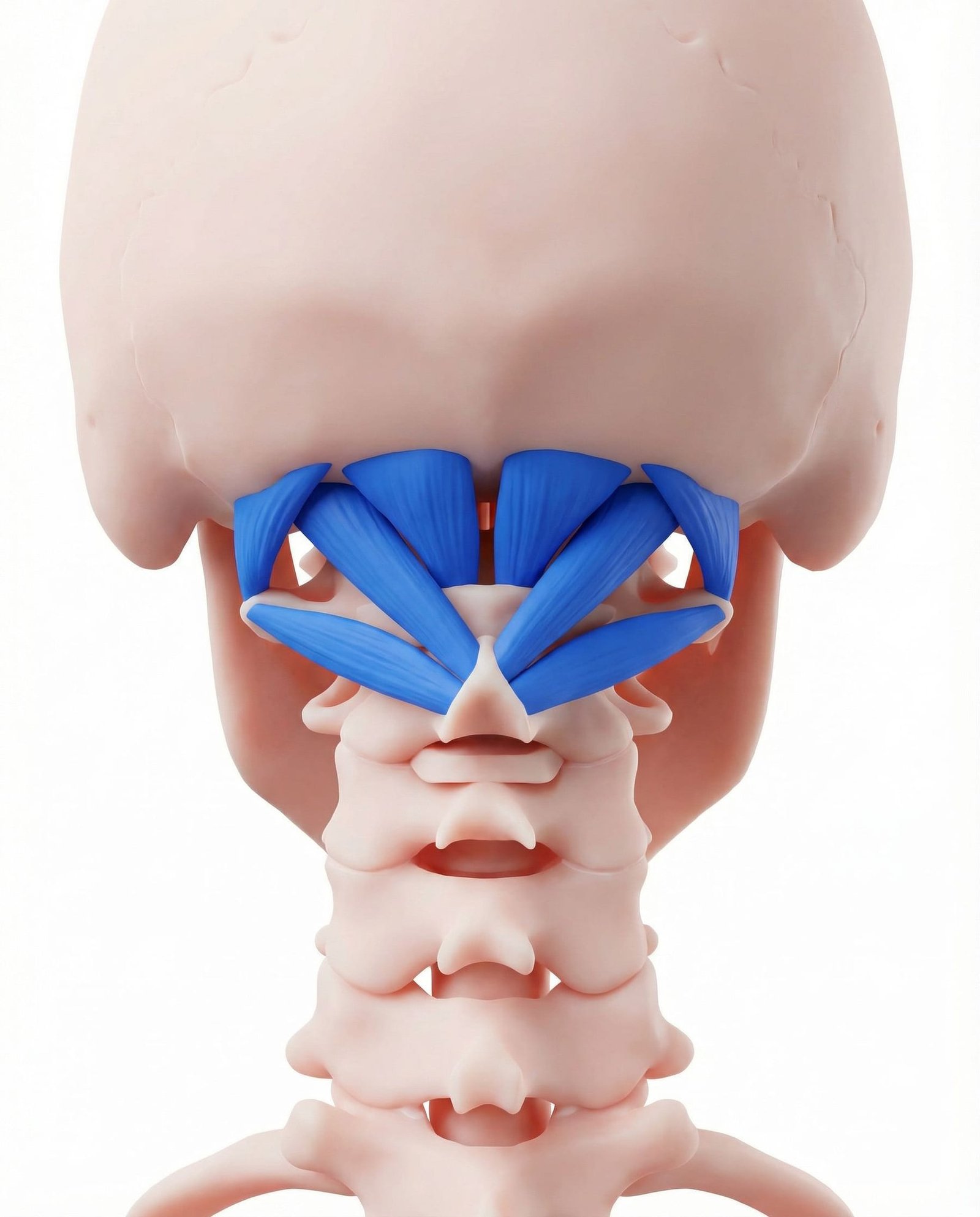
TrP 1
TrP1
Location. Base of skull, deep neck
Pain referral. Back of head, around eye
- Back of head
- Forehead
- Behind eye
- Temple
Deep occipital-to-frontal headache wrapping from skull base toward the forehead
Location. Base of skull, deep neck
Pain referral. Back of head, around eye
Location. Deep at C1-C2 rotation segment
Pain referral. Across occiput and into orbit, causes blurred vision
Location. Deep at occiput, rectus capitis posterior major
Pain referral. Band-like pain around head (hatband headache)
Headache. Deep occipital-to-frontal headache wrapping from skull base toward the forehead
Neck stiffness. Restricted upper cervical movement particularly nodding and fine head rotation
Dizziness. Cervicogenic vertigo from disrupted proprioceptive input at the craniocervical junction
Occipital headache. Obliquus capitis inferior trigger points at C1-C2 refer pain across the occipital region
Blurred vision. Suboccipital trigger points disrupt proprioceptive input to visual tracking centers causing visual blur
Eye fatigue. Impaired cervico-ocular reflex coordination from suboccipital trigger points creates perceived eye fatigue
Headache wrapping from occiput to eye. Referral from C1-C2 follows a trajectory from the occiput through the temporal region to the orbit
Dizziness with head rotation. Suboccipital trigger points disrupt cervical proprioceptive input causing cervicogenic dizziness
Band-like headache around entire head. Rectus capitis posterior major trigger points create bilateral referral encircling the cranium
Hatband headache pattern. Circumferential referral pattern follows the approximate course of a hatband around the skull
Pressure sensation around skull. Bilateral trigger point referral creates a constrictive pressure sensation around the entire cranium
Scalp tenderness. Central sensitization from suboccipital trigger points amplifies pericranial tissue sensitivity diffusely
Headache worsening throughout the day. Cumulative postural stress on suboccipitals progressively intensifies trigger point referral by evening
Forward head posture. Chronic cranial extension on upper cervical spine overloads suboccipital muscles continuously
Whiplash. Sudden craniocervical acceleration-deceleration strains the small suboccipital muscles acutely
Eye strain. Visual tracking demands cause reflexive suboccipital contraction for fine head positioning
Stress. Emotional tension creates sustained suboccipital muscle guarding and chronic ischemia
Upper cervical joint dysfunction. C1-C2 segmental dysfunction reflexively activates protective suboccipital muscle guarding and spasm
Whiplash injury. Rapid cervical acceleration-deceleration traumatically overloads the deep suboccipital rotator muscles
Prolonged computer use. Sustained forward head posture during screen work chronically overloads suboccipital extensors
Stress-related jaw clenching. Jaw clenching reflexively activates cervical extensors including suboccipital muscles via trigeminal-cervical coupling
Poor sleeping position. Improper cervical support during sleep maintains suboccipitals in a compressed or strained position
Chronic forward head posture. Habitual anterior head carriage chronically overloads rectus capitis posterior major for capital extension
Stress and anxiety. Psychogenic cervical muscle tension chronically activates deep suboccipital muscles and their trigger points
Jaw clenching (bruxism). Nocturnal or diurnal bruxism reflexively co-activates suboccipital muscles via trigeminal-cervical pathways
Poor cervical pillow. Inadequate cervical support during sleep fails to allow suboccipital muscle recovery overnight
Upper cervical joint restriction. Segmental hypomobility at C0-C2 causes protective suboccipital muscle guarding and trigger point formation
Tape two tennis balls together or place them side by side in a sock. Lie on your back on a firm surface and position the balls at the base of your skull so they cradle the bony ridge on either side of your spine. Let your head rest fully on the balls and allow gravity to apply gentle pressure into the suboccipital muscles. Breathe deeply and let the muscles soften for several minutes without forcing any movement.
Apply a warm, damp towel or microwavable moist heat pack to the base of your skull and upper neck. Moist heat penetrates deeper than dry heat and helps relax the small suboccipital muscles. Ensure the heat is comfortably warm, not hot enough to burn. Lie on your back with the heat pack under your neck for the best effect, allowing the weight of your head to settle into it.
Sit or stand tall with your shoulders relaxed. Without tilting your head up or down, draw your chin straight back as if making a double chin. Imagine a string pulling the back of your head upward and back. Hold the retracted position for 5 seconds, then relax. You should feel a gentle stretch at the base of your skull and a lengthening sensation along the back of your neck.
Sit comfortably with your head perfectly still. Hold a finger about 12 inches in front of your nose. Slowly track your finger with your eyes only as you move it left to right, then up and down, then in clockwise and counterclockwise circles. Keep your head completely stationary throughout. The suboccipital muscles are closely linked to eye movements, and this exercise helps retrain their coordination and reduce reflexive over-contraction.
Lie on your back with your knees bent and feet flat. Gently nod your chin downward as if saying a small yes, feeling the deep front neck muscles engage. Hold this gentle nod and slowly lift your head just 1-2 centimeters off the surface. Hold for 5-10 seconds, then lower slowly. The movement should be very small and controlled. If you feel strain in the front of your neck or jaw, you are lifting too high.
Position your computer monitor so the top of the screen is at or slightly below eye level, approximately an arm's length away. Avoid looking upward at your monitor, which forces the suboccipitals to contract continuously. When reading, use a book stand or angled surface rather than looking down at a flat desk. At night, choose a pillow that keeps your neck in a neutral position — not too high, which pushes the head forward, or too flat, which lets it fall back.
If headaches originating from the base of your skull persist despite 4-6 weeks of self-care, seek evaluation from a healthcare provider experienced in manual therapy, such as a physical therapist, osteopath, or chiropractor. They can perform specialized suboccipital release techniques, assess upper cervical joint mobility, and rule out occipital neuralgia or other neurological causes of your headaches.