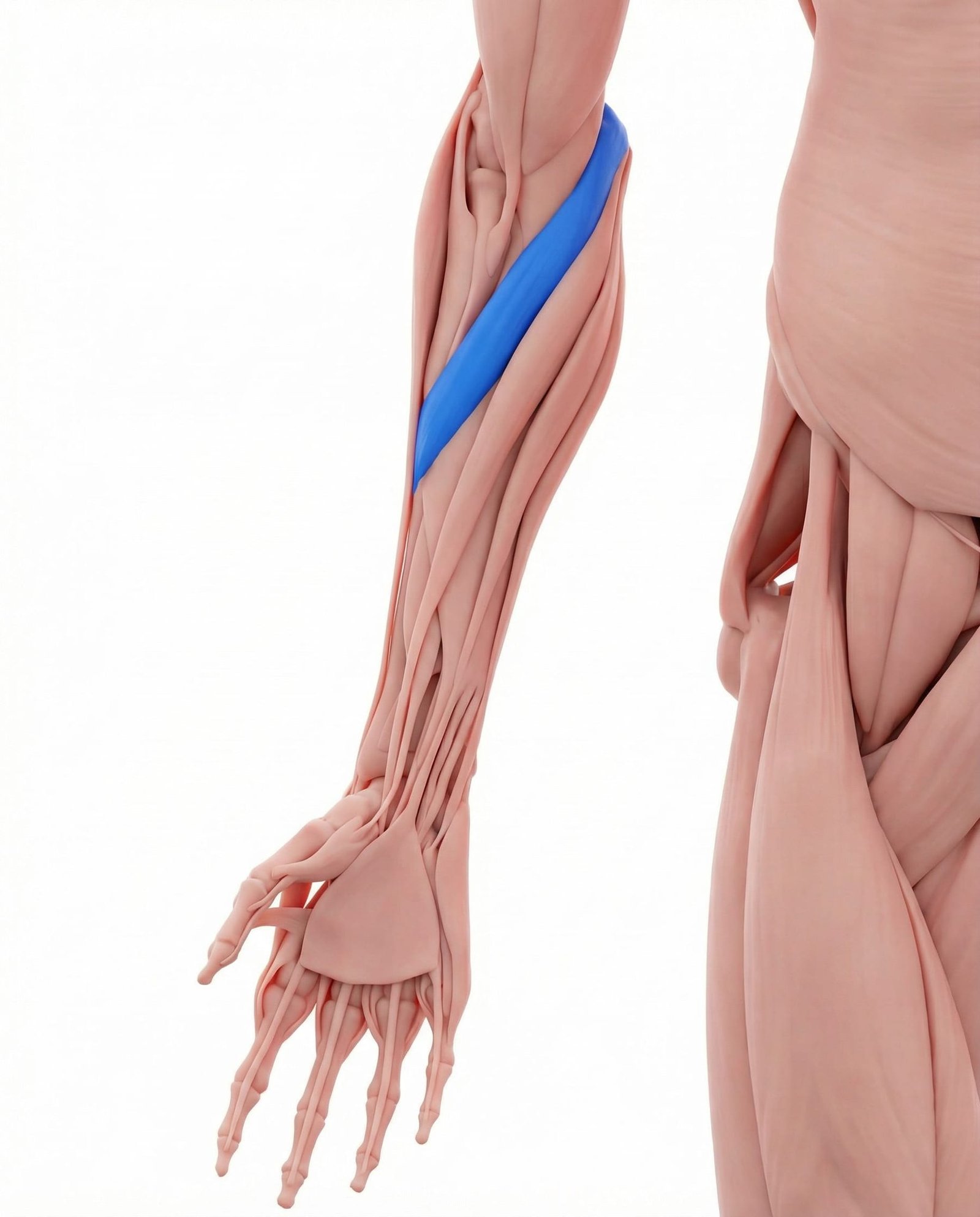
TrP 1
TrP1
Location. Inner forearm, near elbow
Pain referral. Inner elbow, palm side of forearm
- Medial elbow
- Palm side of forearm
- Wrist
Medial antecubital aching that worsens with resisted forearm pronation movements
Location. Inner forearm, near elbow
Pain referral. Inner elbow, palm side of forearm
Location. Near median nerve crossing, mid-pronator teres
Pain referral. Deep forearm ache and palmar wrist pain (mimics carpal tunnel)
Inner elbow pain. Medial antecubital aching that worsens with resisted forearm pronation movements
Pain with pronation. Sharp discomfort during palm-down turning from pronator teres trigger point activation
Forearm ache. Volar forearm aching radiating from elbow toward wrist along pronator teres belly
Deep forearm ache. Pronator teres trigger points create deep anterior forearm aching along the pronator muscle belly
Palmar wrist pain mimicking carpal tunnel. Distal referral to the palmar wrist and thenar area closely mimics carpal tunnel syndrome
Numbness in thumb and index finger. Trigger point compression of the median nerve at pronator teres creates distal paresthesias
Hand weakness. Median nerve compression by taut pronator teres bands reduces thenar muscle activation and grip
Repetitive pronation. Continuous palm-down turning movements chronically overload pronator teres causing ischemia
Typing. Sustained pronated forearm position during keyboard use maintains chronic pronator teres tension
Using tools. Forceful rotational movements with tools repetitively strain the pronator teres muscle
Sports requiring forearm rotation. Racquet sports and throwing demand forceful pronation overloading this muscle repeatedly
Repetitive pronation (turning doorknobs, using screwdriver). Sustained repetitive forearm pronation overloads the pronator teres beyond its recovery capacity
Typing with wrists pronated. Sustained forearm pronation during typing maintains pronator teres in constant isometric contraction
Carrying heavy loads with forearms pronated. Pronated carry position demands sustained pronator teres activation for forearm positioning
Tennis (forehand with pronation). Forehand follow-through involves rapid pronation overloading the pronator teres eccentrically
Assembly line work. Repetitive pronation-supination tasks on assembly lines create cumulative pronator teres overload
Playing stringed instruments. Sustained forearm positioning during string playing maintains chronic pronator teres activation
Place your affected forearm palm-up on a table. Using your opposite thumb, locate the fleshy muscle mass on the inner forearm just below the elbow crease. Apply firm, sustained pressure to tender spots for 20-30 seconds each, then use slow stroking movements along the muscle toward the wrist. Cover the entire inner forearm from elbow to mid-forearm.
Apply a warm, damp towel or microwavable heat pack to the inner forearm near the elbow. Ensure the heat is comfortably warm but not hot enough to burn. Rest the arm in a neutral position with the palm facing up while the heat is applied.
Extend your affected arm straight in front of you with the elbow fully straightened and the palm facing up toward the ceiling. Use your other hand to gently press the fingers and palm further into supination, turning the palm even more upward. Hold when you feel a gentle stretch along the inner forearm near the elbow. Keep the elbow straight throughout.
Hold a hammer or similar weighted object by the handle with your elbow bent at 90 degrees and resting on a table. Slowly rotate the forearm to turn the palm up (supination), then slowly rotate to turn the palm down (pronation). Control the motion in both directions. Start with a light weight and progress gradually as pain allows.
Adjust your keyboard and mouse so that your forearms rest in a neutral position, avoiding sustained pronation. Use an ergonomic vertical mouse that keeps the hand in a handshake position. When using tools that require twisting, choose power tools or ratcheting models to reduce manual forearm rotation. Take breaks every 30 minutes during repetitive forearm activities to stretch and shake out the hands.
Consult a physician or physical therapist if you experience persistent numbness or tingling in the thumb, index, or middle fingers, or if forearm pain does not improve within 4 weeks of self-care. A nerve conduction study or electromyography may be needed to differentiate pronator teres trigger points from true pronator syndrome or median nerve entrapment.