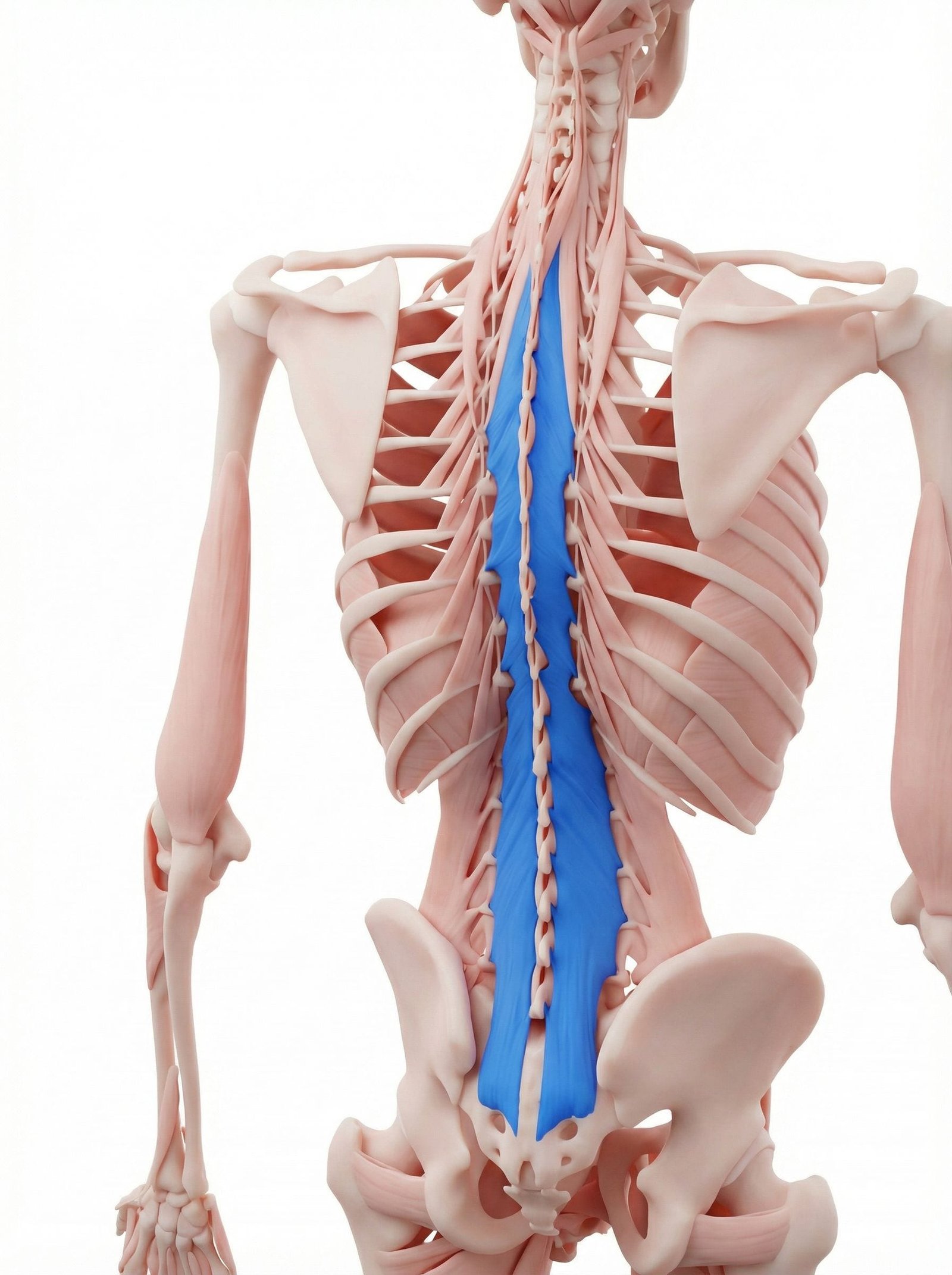
TrP 1
TrP1 (Thoracic)
Location. Deep along thoracic spine
Pain referral. Deep mid back pain
- Deep mid back
- Along spine segments
Localized deep paravertebral aching at specific thoracic segments from multifidus tension
Location. Deep along thoracic spine
Pain referral. Deep mid back pain
Location. Deep lumbar spine
Pain referral. Deep lower back
Location. Deep multifidus near L4-L5 level
Pain referral. Lower abdomen, mimics visceral pain
Location. Deep multifidus near L5-S1 level
Pain referral. Sacrum, coccyx, and deep gluteal region
Location. Mid-thoracic region T5-T8 bilaterally
Pain referral. Mid-thoracic paraspinal and interscapular area
Location. Lower thoracic region T9-T12
Pain referral. Thoracolumbar junction and lower thoracic paraspinals
Deep spinal pain. Localized deep paravertebral aching at specific thoracic segments from multifidus tension
Segmental tenderness. Point-specific spinal sensitivity at the level of affected multifidus muscle fibers
Stiffness. Restricted thoracic segmental mobility from protective multifidus guarding and splinting
Core instability. Sense of lumbar giving way from multifidus inhibition reducing segmental spinal control
Lower abdominal discomfort. Deep multifidus at L4-L5 refers pain anteriorly through shared segmental nerve root pathways
Pseudo-visceral pain. Somatic trigger point referral mimics visceral organ pain via converging spinal cord neurons
Deep low back aching. Sustained deep multifidus contracture creates localized ischemia and deep paraspinal pain
Pain with spinal extension. Extension compresses shortened multifidus fibers against laminae increasing trigger point irritability
Feeling of abdominal fullness. Referred autonomic sensitization from spinal trigger points creates visceral perception disturbance
Tailbone pain (coccydynia-like). L5-S1 multifidus refers caudally to the coccygeal region mimicking true coccydynia
Sacral aching. Deep paraspinal trigger points at the lumbosacral junction project pain across the sacral surface
Deep buttock pain. Referral extends posterolaterally into the deep gluteal region overlapping piriformis pain patterns
Pain with prolonged sitting. Sitting compresses the lumbosacral multifidus against bony structures aggravating trigger points
Difficulty rising from a seated position. Extension loading required for sit-to-stand activates painful shortened multifidus trigger points
Deep mid-back ache. Thoracic multifidus trigger points at T5-T8 create deep paravertebral aching in the mid-back
Interscapular burning. Bilateral trigger point referral between the scapulae creates a characteristic burning interscapular pain
Pain with thoracic rotation. Trunk rotation loads the multifidus segmentally provoking trigger points at the involved thoracic levels
Stiffness in mid-back after sitting. Sustained flexed sitting posture deconditions thoracic multifidus creating post-sitting stiffness
Difficulty with sustained upright posture. Trigger point-mediated multifidus fatigue impairs segmental thoracic stabilization for upright posture
Thoracolumbar junction stiffness. Multifidus trigger points at T9-T12 create segmental stiffness at the thoracolumbar transition zone
Lower thoracic back pain. Deep paraspinal aching at the lower thoracic levels from taut multifidus bands at T9-T12
Flank discomfort mimicking renal pain. Lateral referral from lower thoracic multifidus creates flank pain mimicking kidney pathology
Pain with transitional movements (sit to stand). Sit-to-stand transitions load the thoracolumbar junction provoking multifidus trigger points
Difficulty bending forward at the waist. Forward bending stretches lower thoracic multifidus taut bands creating resistance and pain
Spinal dysfunction. Segmental vertebral dysfunction reflexively activates multifidus guarding at affected levels
Poor posture. Sustained thoracic malalignment overloads deep segmental stabilizers including multifidus
Degenerative changes. Disc and facet degeneration alters segmental mechanics increasing multifidus stabilization demand
Weak spinal stabilizers. Insufficient deep core activation forces multifidus to compensate beyond its capacity
Weak core stabilizers. Insufficient transverse abdominis activation forces multifidus to compensate for spinal stability
Previous back injury. Prior lumbar injury causes persistent multifidus atrophy and compensatory trigger point activation
Disc herniation or degenerative changes at L4-L5. Segmental instability from disc pathology triggers protective multifidus spasm and trigger points
Spinal instability. Insufficient passive restraint demands chronic multifidus guarding leading to ischemic contracture
Post-surgical deconditioning of multifidus. Surgical disruption and disuse atrophy of multifidus creates compensatory overloaded fibers
Chronic flexion posture. Sustained lumbar flexion stretches and weakens multifidus reducing its stabilization capacity
Poor lifting mechanics. Improper spinal alignment during lifting overloads deep segmental stabilizers beyond their capacity
Prolonged bed rest. Extended immobility causes rapid multifidus atrophy and subsequent trigger point formation on reactivation
Fall onto buttock or tailbone. Direct impact trauma at the lumbosacral region creates acute multifidus fiber damage and spasm
Prolonged sitting on hard surfaces. Sustained compressive loading on lumbosacral multifidus creates chronic ischemia and contracture
Post-lumbar surgery deconditioning. Surgical disruption of deep multifidus fibers at L5-S1 leads to persistent weakness and trigger points
L5-S1 disc degeneration. Segmental instability from disc degeneration triggers protective multifidus guarding and spasm
Chronic constipation (straining). Repeated Valsalva maneuver increases intradiscal pressure and reflexive deep paraspinal contraction
Pregnancy and delivery. Hormonal ligamentous laxity and delivery trauma overload lumbosacral stabilizers including multifidus
Prolonged seated desk work. Sustained thoracic flexion during desk work overloads the multifidus as it attempts segmental stabilization
Thoracic kyphosis posture. Excessive thoracic kyphosis maintains the multifidus in a stretched weakened position creating trigger points
Scoliosis with rotational component. Spinal curvature with rotation asymmetrically loads thoracic multifidus on the convex side
Repetitive thoracic rotation (golf, tennis). High-velocity repeated trunk rotation creates cumulative segmental overload of the thoracic multifidus
Thoracic spine segmental dysfunction. Segmental hypomobility triggers protective thoracic multifidus guarding and trigger point formation
Prolonged sitting with poor lumbar support. Inadequate lumbar support shifts mechanical stress superiorly to the thoracolumbar junction multifidus
Heavy lifting with poor mechanics. Improper lifting technique overloads the thoracolumbar multifidus beyond its stabilization capacity
Thoracolumbar scoliosis. Curvature at the thoracolumbar junction asymmetrically loads the multifidus on the convex side
Repetitive bending and twisting. Combined flexion-rotation movements create cumulative segmental overload at the thoracolumbar junction
Post-thoracic surgery compensation. Surgical disruption of thoracic musculature shifts stabilization demands to adjacent thoracolumbar multifidus
Place a foam roller horizontally across the mid-back at the stiff segment. Support your head with your hands and gently extend backward over the roller, opening the chest toward the ceiling. Hold for 5 seconds, then return to neutral. Move the roller up or down one vertebral level and repeat. Perform 5-8 extensions at each level.
Start on hands and knees with a neutral spine. Slowly extend your right arm forward and left leg backward, keeping your hips and shoulders level. Hold for 5-10 seconds, then return to the starting position. Alternate sides. Focus on maintaining a stable, motionless trunk throughout. Perform 10 repetitions per side for 2-3 sets.
Lie face down with your hands beside your shoulders. Gently press up, lifting your chest while keeping your hips on the floor. Only rise to a comfortable height — this should be a gentle mobilization, not a maximal effort. Hold for 5 seconds at the top, then slowly lower. Perform 10-12 repetitions.
Sit upright on a chair with feet flat. Place a broomstick or dowel across your shoulders behind your neck, holding each end with your hands. Slowly rotate your trunk to the left, hold for 3 seconds, return to center, then rotate to the right. Keep your hips facing forward. Perform 15 repetitions to each side.
Alternate between sitting and standing every 30-45 minutes using a sit-stand desk if possible. During sitting periods, use a chair with firm mid-back support. Set a timer to remind yourself to stand, walk, or perform a brief stretch at least once every 30 minutes. Avoid staying in any one position for more than 45 minutes.
If localized thoracic pain persists beyond 4-6 weeks despite self-care, consult a physical therapist or spine specialist. They can assess for underlying segmental dysfunction, disc pathology, or facet joint involvement and provide targeted manual therapy or stabilization programs specific to the affected level.
Lie face down with palms flat beside your shoulders. Gently push your upper body up while keeping your hips on the floor. Rise only as far as comfortable, allowing your low back to extend. Hold briefly at the top, then lower slowly. This decompresses the lumbar segments and can reduce deep multifidus spasm.
Apply a warm heat pack directly over the painful lumbar area, lying on your back with the pack underneath. The deep position of the multifidus means sustained heat is needed to reach the muscle. Breathe deeply and relax completely during application.
On all fours, maintain a neutral spine. Slowly extend one arm and the opposite leg simultaneously. Hold for 5-10 seconds, focusing on keeping your spine stable and level. Lower and switch sides. The key is slow, controlled movement — speed defeats the purpose.
Lie on your back with arms reaching toward the ceiling and knees bent at 90 degrees. Slowly lower your right arm overhead and left leg toward the floor while keeping your low back pressed flat against the ground. Return to start and switch sides. This trains deep core coordination including multifidus.
Before any lifting, bending, or transitional movement, gently brace your core by drawing your belly button slightly inward (about 30% effort). Maintain this light brace during the movement. This activates the multifidus and transverse abdominis together, protecting the spine during functional tasks.
If you experience recurrent episodes of low back pain or your back frequently locks up, consult a physiatrist. Multifidus atrophy is common after back injury and often requires professional rehabilitation. They can use ultrasound imaging to assess multifidus size and activation, and design a targeted stabilization program.