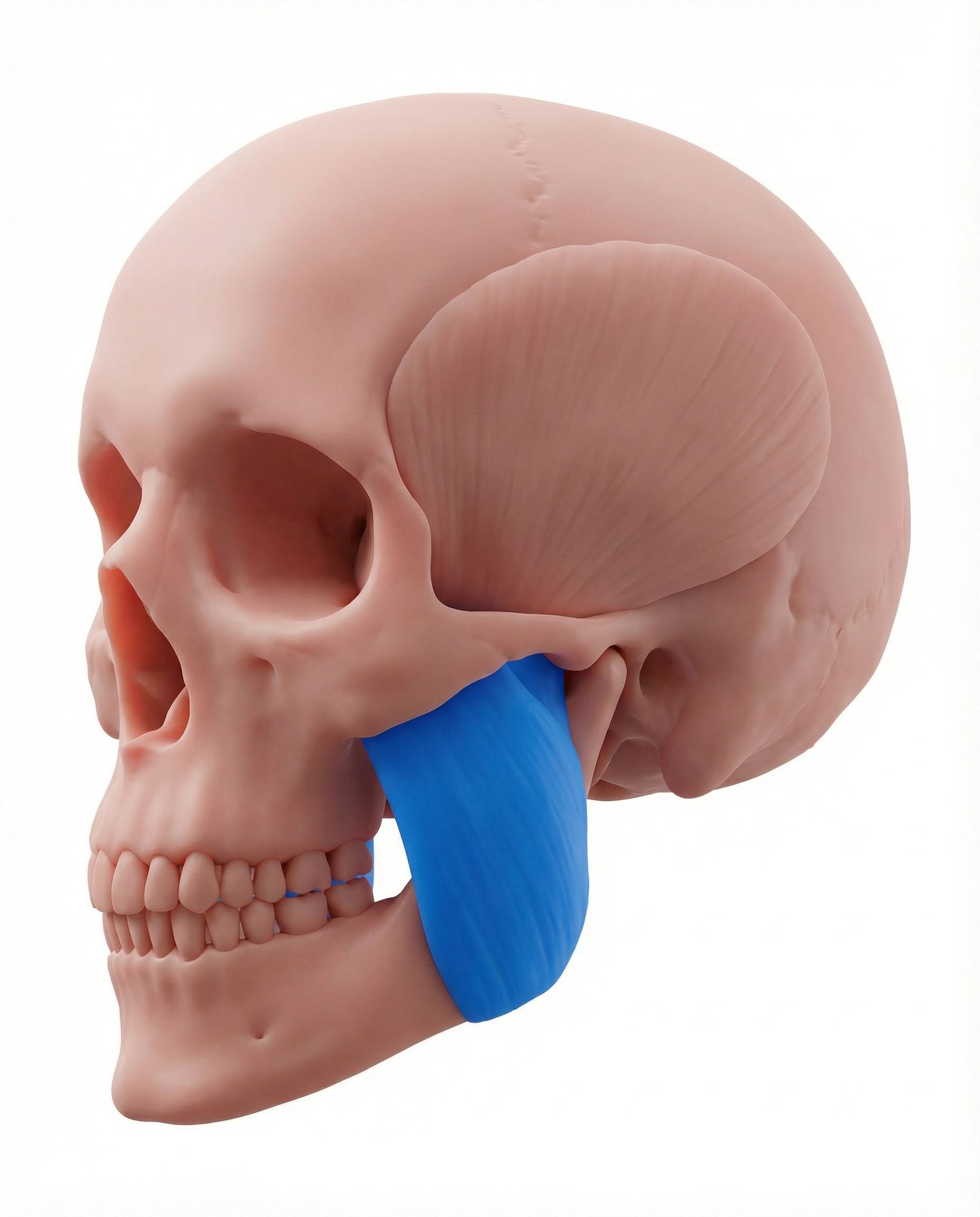
TrP 1
TrP1
Location. Jaw angle, cheek area
Pain referral. Jaw and cheek
- Jaw angle
- Cheek
- Upper and lower teeth
- Temple
- Ear area
Deep aching pain at the jaw angle worsened by clenching or chewing
Location. Jaw angle, cheek area
Pain referral. Jaw and cheek
Location. Deep layer of masseter near TMJ
Pain referral. Deep ear pain, ear stuffiness, and tinnitus
Location. At inferior angle of mandible (jawline)
Pain referral. Lower jaw, lower molars, and submandibular region
Jaw pain. Deep aching pain at the jaw angle worsened by clenching or chewing
Toothache. Referred pain to upper and lower molars mimicking dental pathology
Difficulty chewing. Restricted jaw opening and painful mastication due to taut bands
Ear pain. Referred otalgia from masseter trigger points without ear pathology
Clicking jaw. Altered jaw mechanics from masseter tension causing TMJ clicking
Deep ear pain without infection. Deep masseter trigger point refers pain into ear canal through auriculotemporal nerve convergence
Ear stuffiness or fullness. Masseter tension influences tensor veli palatini creating eustachian tube dysfunction and aural fullness
Tinnitus (ringing in ear). Deep masseter trigger point stimulates auriculotemporal nerve producing subjective tinnitus perception
TMJ clicking or popping. Deep masseter tension alters condylar mechanics causing disc displacement with joint sounds
Difficulty opening mouth wide. Deep masseter trigger point restricts mandibular depression limiting mouth opening range
Lower toothache without dental cause. Inferior masseter trigger point refers pain to lower teeth through mandibular trigeminal V3 pathways
Lower jaw pain. Trigger point at mandibular angle creates localized lower jaw aching along inferior border
Submandibular ache. Referred pain descends from inferior masseter to submandibular and submental regions
Difficulty biting down. Inferior masseter trigger point creates pain with forceful jaw closure during biting
Jaw fatigue after eating. Trigger point reduces masseter endurance causing premature fatigue during prolonged mastication
Teeth grinding. Nocturnal bruxism chronically overloads the masseter muscle fibers
Jaw clenching from stress. Stress-induced sustained contraction creates ischemia and trigger points
Chewing hard foods. Excessive force during mastication overloads masseter muscle fibers
Malocclusion. Improper bite alignment forces compensatory masseter overactivation
TMJ dysfunction. Joint dysfunction leads to guarding and chronic masseter tension
Excessive gum chewing. Prolonged repetitive jaw motion fatigues the masseter muscle
Bruxism. Nocturnal teeth grinding maximally loads deep masseter layer creating trigger points near TMJ
Jaw clenching. Habitual forceful jaw clenching sustains deep masseter isometric contraction beyond tolerance
TMJ disc displacement. Displaced articular disc alters deep masseter mechanics creating compensatory trigger points
Dental procedures. Prolonged mouth opening during dental work eccentrically overloads deep masseter fibers
Stress. Psychological stress drives unconscious jaw clenching activating deep masseter layer chronically
Chewing gum excessively. Repetitive gum chewing fatigues deep masseter fibers through sustained cyclic loading
Teeth grinding at night. Nocturnal bruxism overloads inferior masseter fibers at mandibular angle creating trigger points
Jaw clenching under stress. Stress-induced clenching sustains inferior masseter contraction at mandibular attachment point
Chewing tough meats or bagels. Forceful sustained mastication of resistant foods overloads inferior masseter fibers
Playing wind instruments. Sustained jaw positioning for embouchure chronically loads inferior masseter muscle fibers
Place your fingertips on your cheeks just below the cheekbone, near the jaw angle. Press firmly but gently into the muscle and move in slow, circular motions. When you find a particularly tender knot, hold steady pressure for 30-60 seconds until the tenderness begins to fade. Work the entire muscle from the cheekbone down to the jawline.
Soak a small towel in warm water, wring it out, and drape it over the jaw and cheek on the affected side. Alternatively, use a microwaveable heat pack shaped for the face. Let your jaw hang open slightly while applying the heat to allow the muscle to fully relax.
Place your thumb under your chin for gentle resistance. Slowly open your mouth against this light resistance, hold for 5 seconds, then slowly close. Next, open your mouth without resistance as wide as comfortable and hold for 10 seconds. Repeat 10 times. Keep the motion slow and controlled — never force the jaw open.
With your mouth slightly open, slowly slide your lower jaw to the left as far as comfortable, hold for 5 seconds, then return to center. Repeat to the right. Perform 10 repetitions in each direction. Then practice gentle jaw protrusion — slide the lower jaw forward, hold 5 seconds, and return. Keep all movements smooth and pain-free.
During periods of increased jaw pain, switch to soft foods that require minimal chewing — soups, yogurt, scrambled eggs, mashed potatoes, smoothies, and cooked vegetables. Avoid chewy foods like bagels, steak, raw carrots, and chewing gum. Cut food into small pieces and chew evenly on both sides.
Stop chewing gum entirely — even sugar-free gum overworks the masseter. Avoid biting nails, chewing on pens, or clenching during concentration. Practice keeping lips together but teeth slightly apart throughout the day. Use the resting tongue position (tongue tip on the roof of the mouth) to maintain a relaxed jaw.
If jaw pain persists beyond 3-4 weeks of self-care, consult an orofacial pain specialist or a dentist experienced with TMJ disorders. They can assess for disc displacement, joint degeneration, or severe bruxism. For cases of severe, treatment-resistant clenching, botulinum toxin injections into the masseter can provide 3-6 months of relief by reducing muscle overactivity.