Skip to main content
Atlas · Neck

Longissimus Capitis

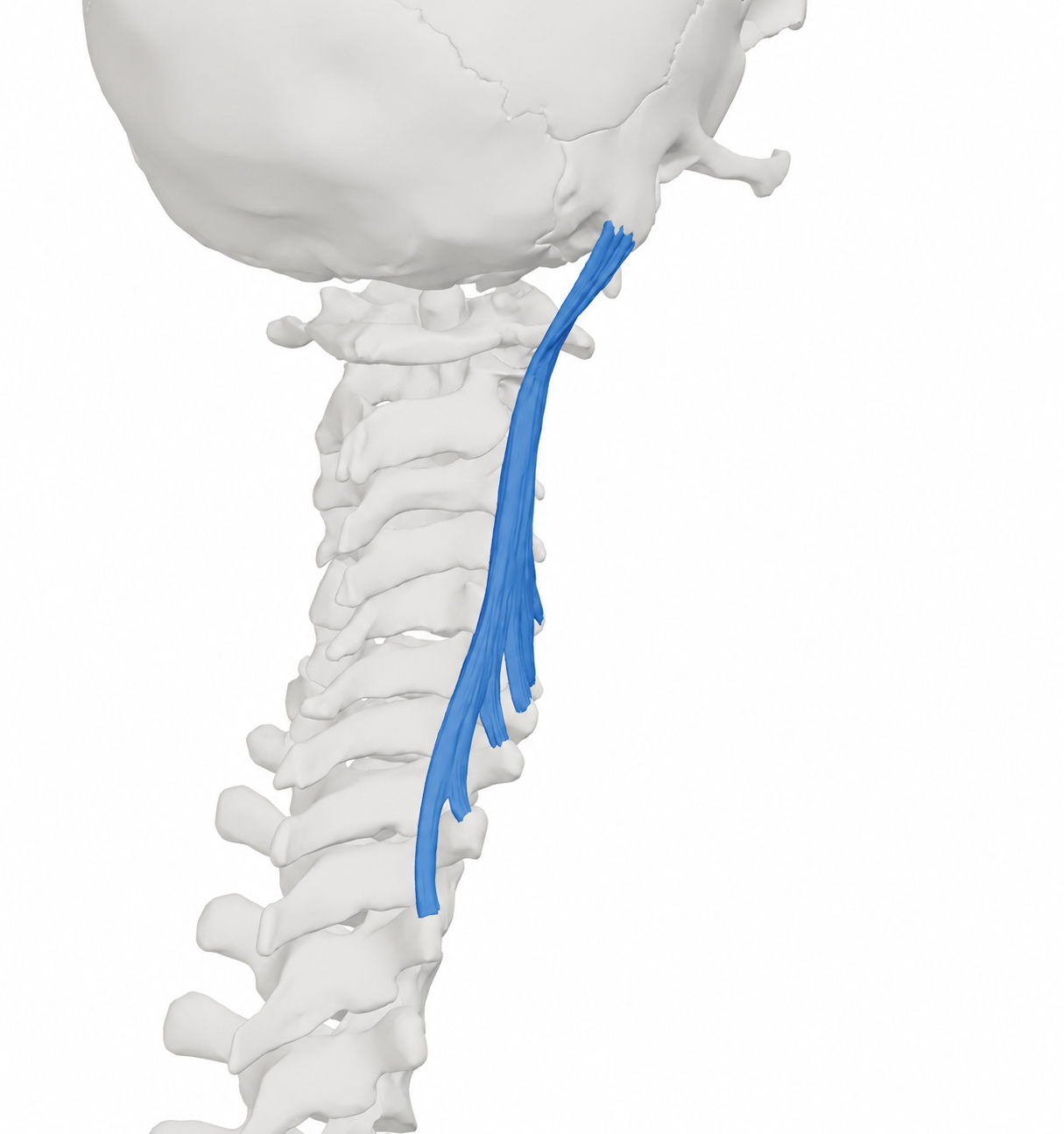
Longissimus capitis runs from the lower neck and upper thoracic spine to the mastoid behind the ear. It contributes to head extension and turning toward the same side, adding cervical anatomy that is not represented by a thoracic longissimus profile.

Longissimus Capitis
Body region
Neck · Head
Reference type
Anatomy & examination
Trigger-point map not yet documented
Common symptoms
2
patterns cataloged
Contributors
2
Factors to assess

Muscle overview

Symptoms and first steps

Practical first steps

  • Vary prolonged head-turning tasks and use comfortable support.
  • Practise gentle movement within tolerance when assessment supports it.
  • Do not press deeply behind the ear to search for a presumed trigger point.

When to seek assessment

  • Progressive arm or gait symptoms need medical assessment.
  • Sudden unusual head/neck pain with neurological symptoms requires urgent care.
  • Persistent involuntary head posturing or tremor warrants clinical assessment.

Pain behind the ear does not identify longissimus capitis. Several muscles attach nearby, and headache or neurological symptoms need their own assessment.

Examination, palpation and treatment evidence

Illustrated overview

Longissimus Capitis · Anatomy

Right longissimus capitis with the source skeletal context. Source model rendered and material restyled; blue identifies the model structure, including its tendon-like continuations.

BodyParts3D, © The Database Center for Life Science. Adapted by MyofascialPain: source model rendered and material restyled. · CC BY-SA 2.1 Japan

Open full-size image
Browse related exercises (1)

Symptoms patients report

Discomfort during head turning or extension Record the direction and the activity that matters; these actions involve several cervical muscles.

Posterolateral neck sensitivity Tenderness near the mastoid or neck does not establish which deep structure contributes.

Contributors to assess

Sustained or repeated head positioning Review task demand and comfortable position changes rather than prescribe a single ideal posture.

Regional neck or movement disorder Persistent involuntary head turning or tremor requires a different assessment from ordinary movement-related discomfort.

For clinicians and supervised training

Clinical reference

Anatomy and regional clinical reference. Anatomical identification research does not validate trigger-point maps or treatment for isolated longissimus-capitis pain.

Anatomy and palpation

Anatomical relationships

Longissimus capitis connects lower cervical and upper thoracic processes to the posterior mastoid process. Attachment descriptions vary in exact levels. Bilateral action contributes to head extension; unilateral action contributes to ipsilateral rotation and side bending. Supply is from posterior rami of cervical and upper thoracic spinal nerves.[1][2]

  • Mastoid process behind the ear.
  • Lower cervical and upper thoracic posterolateral process region.

Nearby structures. It lies among splenius, semispinalis and other deep extensors. Mastoid attachments overlap regionally with other muscles, so surface contact does not isolate it.

Palpation

Patient position. Head comfortably supported, neck near a relaxed mid-position.

Find the landmarks

  • Mastoid region.
  • Posterolateral lower neck.

Examination sequence

  1. Identify the region with light surface contact, avoiding a deep probing approach.
  2. Record location and symptom response without claiming selective muscle palpation.

Document the findings

  • Regional tenderness is not proof of a longissimus lesion or referral pattern.

Limits and precautions

  • Anatomical ultrasound identification is a specialist method, not justification for blind deep treatment.
[1][2]

Examination and tests

2

Active cervical movement and task response[3]

Measure the direction and daily task that are difficult.

Position
Seated with comfortable trunk support.
Technique
Observe comfortable rotation, side bending and flexion/extension, recording range and familiar symptoms with a consistent method. Compare a relevant looking-up or head-turning task.
Positive finding
Repeatable limitation or symptom reproduction is a regional finding.
Interpretation
Provides a baseline for graded movement.
Limitations
Several muscles and joints contribute. Range, posture or tenderness cannot identify an isolated deep-extensor pain source.

Neurological and headache history screen[3][4]

Identify findings that change a routine neck-pain assessment.

Position
History first; clinician-selected upper-limb examination and gait assessment when indicated.
Technique
Ask about symptom onset, arm deficits, hand dexterity, balance and headache features; compare relevant strength, sensation and reflexes.
Positive finding
Progressive neurological change or sudden unusual head/neck pain with neurological symptoms needs medical assessment.
Interpretation
Determines whether regional rehabilitation is appropriate.
Limitations
Normal isolated findings cannot exclude every disorder. This is not a muscle-isolation or vascular-clearance maneuver.

Distinguishing other causes

Regional mechanical neck pain[3]

Findings that matter. Movement-dependent symptoms shared across the posterior cervical region.

Next step. Assess active motion and functional demand rather than infer one affected muscle.

Cervical dystonia or another movement disorder[2]

Findings that matter. Persistent involuntary head posturing, turning or tremor.

Next step. Refer for diagnostic assessment; anatomical injection-target research is not a self-treatment guide.

Neurological or unusual headache/vascular presentation[3][4]

Findings that matter. Progressive limb deficits, balance change or sudden unusual head/neck pain with neurological features.

Next step. Prioritize appropriate medical assessment.

Treatment selection and progression

Self-care and activity

Vary sustained head tasks[3]

Consider when. Assessed mechanical neck discomfort during sustained activity.

Try forearm or head support and alternate positions during the task that becomes uncomfortable.

Dose and review
Use the individual task response rather than a compulsory break interval.
Progression
Gradually build useful task tolerance.
Stop or reassess
Reassess new arm or head symptoms.
Evidence and limits
Regional self-management; no ideal posture or isolated-muscle cure is implied.

Exercise and rehabilitation

Practise comfortable head movement[3][4]

Consider when. A measured movement limitation after assessment.

Practise the relevant head turn or small extension movement at a comfortable speed and range.

Dose and review
Select repetitions with the treating clinician according to irritability; no isolated-muscle dose is established.
Progression
Build range and ordinary task exposure before adding resistance.
Stop or reassess
Stop for dizziness, visual change, unusual headache or new arm symptoms.
Evidence and limits
A regional movement option; pain during a direction does not identify one muscle.

Clinician-delivered care

Build neck strength and endurance when indicated[5][6][3]

Consider when. Persistent neck pain with an assessed capacity limitation.

A physiotherapist selects tolerable neck and shoulder-girdle loading and may add gentle regional mobilization when relevant. Review progress against a useful daily task; specific deep-extensor work is one exercise option.

Dose and review
Individualize load and recovery; the cited six-week studies do not supply a universal home dose.
Progression
Progress only when technique and daily activity tolerance improve.
Stop or reassess
Reassess neurological change or sustained worsening.
Evidence and limits
A 2019 trial favored deep-muscle exercise over usual care; a 2022 trial found comparable pain/disability outcomes from specific and general extensor programs. Neither proves isolated-muscle causation.

Reassessment and follow-up

  • Compare the same comfortable head-turning task.
  • Track activity tolerance and regional disability without attributing improvement to one muscle.
  • Reassess involuntary movement, headache or neurological change through the appropriate pathway.

Evidence and sources

  1. Elsevier Complete Anatomy: Longissimus capitis muscle

    2026 · Publisher anatomy reference

    Undated page accessed 11 October 2026. Lower cervical/upper thoracic processes to mastoid, head extension and ipsilateral turning/side bending. Attachment level ranges vary across anatomical descriptions.

  2. Brumpt et al. Anatomo-sonographic identification of the longissimus capitis and splenius cervicis muscles: principles for possible application to ultrasound-guided botulinum toxin injections in cervical dystonia

    2021 · Primary anatomical identification study

    Two cadavers and one healthy volunteer; anatomical/ultrasound correlation. Supports layer identification, not clinical efficacy for myofascial pain or an injection recommendation.

  3. Blanpied et al. Neck Pain: Revision 2017

    2017 · Clinical practice guideline

    Regional examination and active rehabilitation framework. No test below is claimed to isolate a painful deep extensor.

  4. Rushton et al. International Framework for Examination of the Cervical Region for Potential of Vascular Pathologies of the Neck Prior to Musculoskeletal Intervention: International IFOMPT Cervical Framework

    2023 · International clinical framework

    Online 2022, 2023 issue. History and neurological/vascular differential before intervention; not a clearance test based on neck positioning.

  5. Suvarnnato et al. Effect of specific deep cervical muscle exercises on functional disability, pain intensity, craniovertebral angle, and neck-muscle strength in chronic mechanical neck pain: a randomized controlled trial

    2019 · Randomized controlled trial

    54 participants; six-week deep-extensor or deep-flexor exercise programs compared with usual care. Clinical outcomes support exercise relevance, not proof of an isolated muscle pain generator or a trigger-point map.

  6. Giménez-Costa et al. Specific versus non-specific exercises for the neck extensor muscles in women with chronic idiopathic neck pain: A randomized controlled trial

    2022 · Randomized controlled trial

    43 women, six weeks: specific lower-deep-extensor and general extensor exercise produced comparable pain/disability outcomes. No between-group advantage establishes a need to isolate semispinalis cervicis.