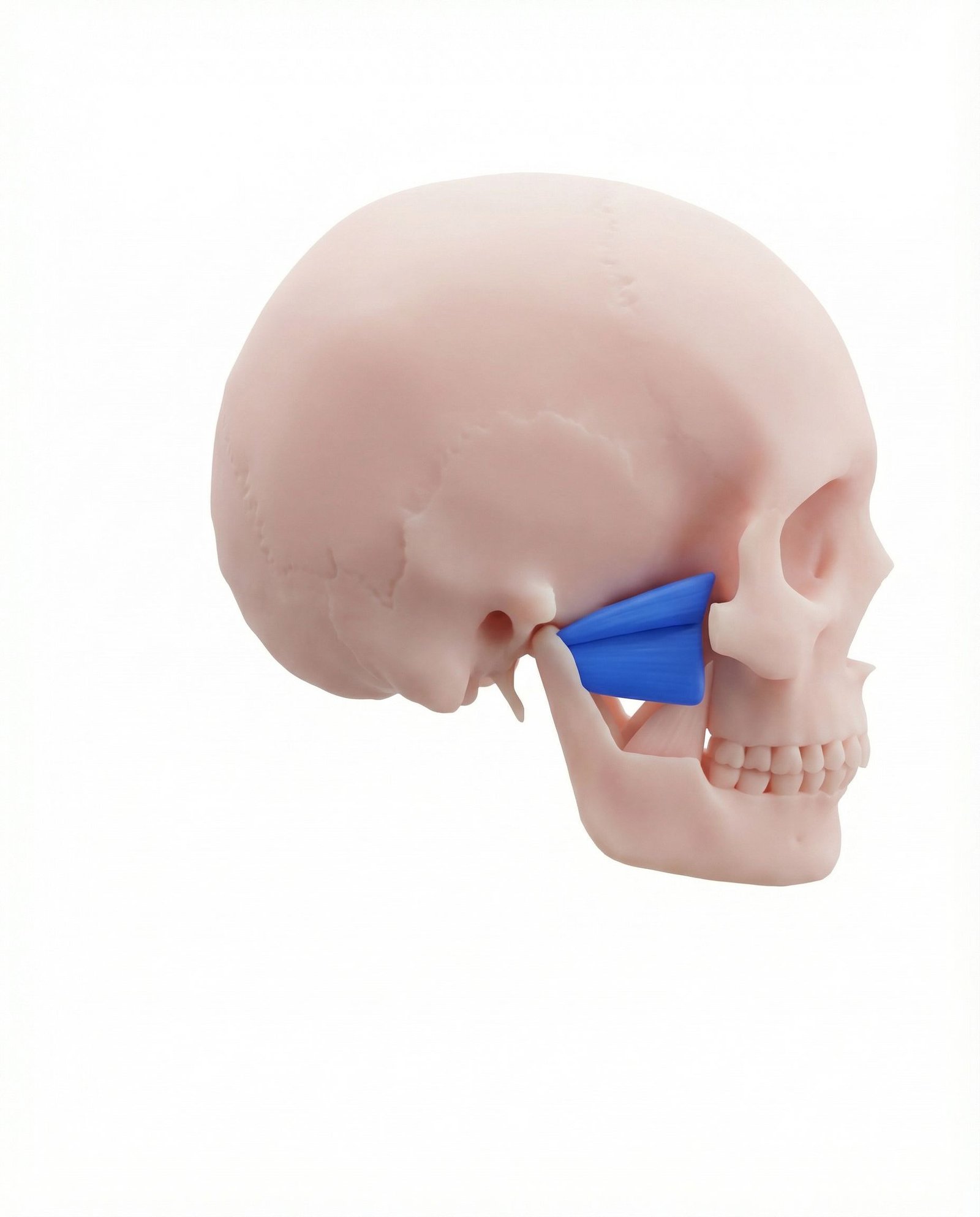
TrP 1
TrP1
Location. Deep jaw muscle, lateral aspect
Pain referral. Jaw, temple, ear, sinuses
- Jaw
- Temple
- Ear
- Sinus area
- Teeth
Deep lateral jaw pain from trigger points in the primary jaw-opening muscle
Location. Deep jaw muscle, lateral aspect
Pain referral. Jaw, temple, ear, sinuses
Location. Inferior head at lateral pterygoid plate
Pain referral. TMJ region and deep maxillary area
Jaw pain. Deep lateral jaw pain from trigger points in the primary jaw-opening muscle
Clicking jaw. Disc displacement from lateral pterygoid dysfunction pulling articular disc anteriorly
Sinus pain. Referred pain to maxillary sinus region mimicking sinusitis from pterygoid trigger points
Ear pain. Deep ear pain from lateral pterygoid referral to auricular and preauricular region
Difficulty opening mouth. Limited mandibular depression from lateral pterygoid trigger point inhibition and spasm
TMJ clicking and popping. Lateral pterygoid trigger points create disc-condyle incoordination producing TMJ clicking sounds
Jaw deviation on opening. Unilateral lateral pterygoid dysfunction causes the mandible to deviate toward the affected side
Deep facial ache. Referral from the inferior head projects deep aching into the maxillary and zygomatic regions
Sensation of sinus pressure. Deep facial referral to the maxillary sinus area mimics sinusitis pressure and congestion
Limited mouth opening with pain. Trigger point shortening restricts lateral pterygoid excursion limiting condylar translation and opening
TMJ dysfunction. Joint mechanical abnormality alters lateral pterygoid loading creating chronic muscle overwork
Teeth grinding. Nocturnal lateral jaw movements repeatedly overload lateral pterygoid muscle fibers
Jaw clenching. Sustained isometric contraction during clenching creates lateral pterygoid ischemia and fatigue
Stress. Emotional tension causes involuntary jaw muscle bracing overloading lateral pterygoid chronically
Malocclusion. Dental misalignment forces compensatory lateral pterygoid activity to achieve proper occlusion
Chronic jaw clenching. Sustained jaw clenching chronically activates lateral pterygoid for mandibular positioning creating trigger points
Excessive gum chewing. Repetitive lateral excursion during gum chewing overloads the lateral pterygoid inferior head
Prolonged dental work. Extended mouth opening during dental procedures strains the lateral pterygoid beyond its endurance
Trauma to the jaw. Direct mandibular impact can traumatically activate lateral pterygoid trigger points at its insertion
Mouth breathing. Chronic mouth breathing alters mandibular resting position increasing lateral pterygoid baseline tension
Wash your hands thoroughly. Open your mouth slightly and place your index finger inside your mouth along the upper gum line, reaching toward the back of the upper jaw behind the last molar. Press gently outward and upward into the tissue — you are reaching toward the lateral pterygoid in the space behind the upper jaw. When you find a tender spot, hold gentle sustained pressure for 15-20 seconds. Work slowly and carefully, as this area is very sensitive.
Place the tip of your tongue gently on the roof of your mouth just behind your upper front teeth. Allow your jaw to drop open slightly while keeping your tongue in position — this naturally relaxes the jaw muscles and prevents clenching. Hold this position for 30 seconds, breathing slowly through your nose. Practice this position whenever you notice yourself clenching, grinding, or holding tension in your jaw.
Place your fist gently under your chin. Slowly open your mouth against the light resistance of your fist — do not push hard, use only about 20% of your maximum effort. Hold the open position for 5 seconds, then slowly close. Repeat 10 times. This isometric exercise helps retrain the jaw-opening muscles to work smoothly without triggering clicking or catching.
During periods of increased jaw pain or clicking, switch to soft foods that require minimal chewing — soups, smoothies, scrambled eggs, pasta, mashed vegetables, and yogurt. Avoid hard, crunchy, or chewy foods such as raw carrots, bagels, steak, gum, and hard candy. Cut food into small pieces and chew using both sides of the mouth evenly. Avoid opening the mouth excessively wide for biting.
Set reminder alarms on your phone every 1-2 hours throughout the day. Each time the alarm sounds, do a jaw check: Are your teeth touching? Is your jaw clenched? Are your jaw muscles tight? If so, separate your teeth slightly, relax your jaw, and place your tongue on the roof of your mouth. Keep a brief journal noting when you catch yourself clenching — this builds awareness of your personal stress-clenching patterns.
If jaw clicking, locking, or deep jaw pain persists beyond 3-4 weeks of self-care, seek evaluation from a dentist specializing in TMJ disorders or an orofacial pain specialist. They can assess disc position, joint mechanics, and occlusion. Imaging such as MRI may be recommended to evaluate the articular disc. A physical therapist experienced in TMJ rehabilitation can provide targeted manual therapy and neuromuscular retraining.