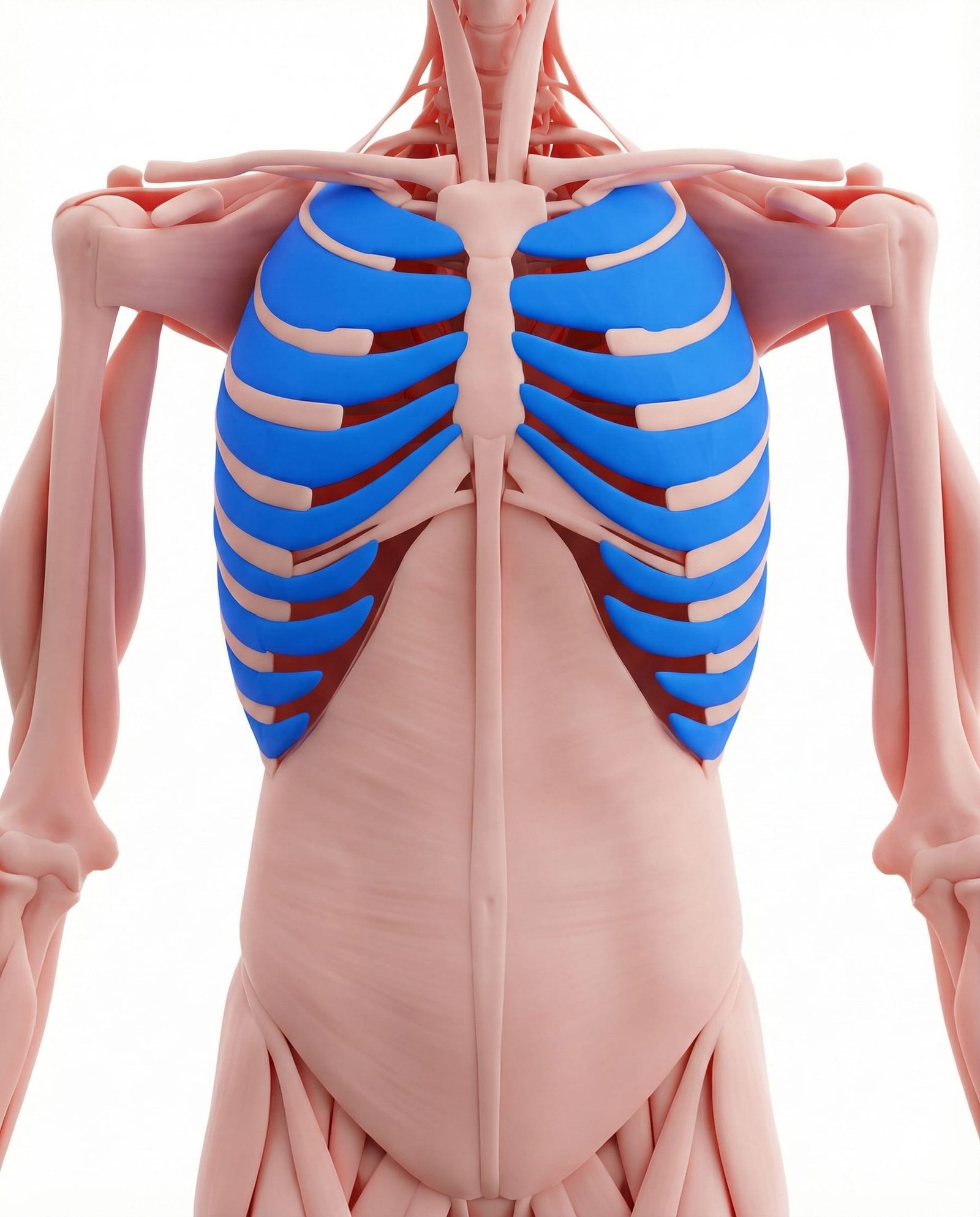
TrP 1
TrP1
Location. Between ribs
Pain referral. Rib area, side of chest
- Rib area
- Side of chest
- Chest
- Upper abdomen
Sharp localized pain between ribs from intercostal trigger point activation in rib spaces
Location. Between ribs
Pain referral. Rib area, side of chest
Location. Between ribs posteriorly, near costovertebral and costotransverse joints
Pain referral. Between the ribs on the back
Location. Anterior intercostals near sternum
Pain referral. Across anterior chest (mimics cardiac pain)
Location. Lateral intercostals at mid-axillary line
Pain referral. Pain along rib to anterior chest, sharp pain with deep breath
Rib pain. Sharp localized pain between ribs from intercostal trigger point activation in rib spaces
Pain when breathing. Inspiratory chest pain from trigger points stretching during rib cage expansion
Side chest pain. Lateral thoracic wall pain from intercostal trigger points in lateral rib spaces
Pain with twisting. Rotational thoracic movement stretches and compresses intercostal trigger point taut bands
Sharp pain between ribs in the back. Acute intercostal aching posteriorly between adjacent ribs near the costovertebral junction
Pain with breathing. Inspiratory posterior rib pain as intercostal expansion stretches taut bands between ribs
Pain with trunk rotation. Posterior intercostal pain during twisting as rotation alters rib spacing mechanically
Localized tenderness between ribs. Palpable point tenderness in the posterior intercostal space from active trigger point nidus
Stabbing pain with coughing. Acute lancinating posterior rib pain during coughing from intercostal trigger point compression
Chest pain mimicking cardiac pain. Anterior intercostal trigger points create parasternal pain indistinguishable from angina pectoris
Sternal area aching. Referral concentrates near the sternocostal junctions creating deep anterior chest wall aching
Pain with deep breathing. Rib expansion during inspiration stretches taut intercostal bands provoking anterior chest pain
Chest tightness. Bilateral intercostal trigger points restrict rib expansion creating a sensation of chest constriction
Anxiety about chest pain. Persistent anterior chest pain triggers health anxiety reinforcing psychogenic muscle tension
Sharp rib pain with breathing. Lateral intercostal trigger points create sharp pain along the rib during respiratory excursion
Lateral chest wall ache. Taut bands at the mid-axillary line create localized lateral chest wall aching
Pain radiating along rib. Referral follows the intercostal nerve pathway from lateral to anterior along the rib course
Splinting (guarding) with breathing. Sharp intercostal pain triggers protective guarding limiting rib cage excursion on the affected side
Coughing. Forceful repetitive coughing creates ballistic loading on intercostal muscles each episode
Sneezing. Sudden explosive thoracic contraction overloads intercostal muscles during violent sneezing
Twisting. Repetitive or forceful trunk rotation creates shearing forces across intercostal muscle fibers
Heavy lifting. Breath-holding during exertion creates high intrathoracic pressures straining intercostal muscles
Shallow breathing. Restricted chest wall movement creates chronic intercostal shortening and trigger point formation
Rib dysfunction. Costovertebral or costochondral joint restriction alters intercostal mechanical loading patterns
Rib dysfunction or subluxation. Costovertebral joint hypomobility creates compensatory intercostal overload and chronic guarding
Chronic coughing. Repetitive forceful coughing overloads posterior intercostals through sustained rib compression forces
Forceful twisting. Rapid trunk rotation creates shearing forces between adjacent ribs straining posterior intercostals
Heavy lifting with rotation. Combined lifting and rotation loads posterior intercostals through multidirectional rib cage forces
Direct trauma. Impact to the posterior rib cage directly traumatizes intercostal muscles between affected ribs
Prolonged poor posture. Sustained thoracic flexion alters posterior rib spacing creating chronic intercostal tension asymmetry
Chronic cough. Repetitive forceful coughing creates sustained intercostal contraction and subsequent trigger point formation
Forceful sneezing. Explosive intercostal contraction during sneezing can traumatically activate anterior intercostal trigger points
Chest trauma (seatbelt injury). Seatbelt compression during deceleration injury traumatically activates anterior intercostal trigger points
Heavy bench pressing. Maximal bench press loading generates high intercostal strain during rib cage stabilization
Anxiety-related hyperventilation. Chronic hyperventilation overworks intercostal muscles as accessory respiratory muscles creating trigger points
Rib fracture history. Healed rib fracture creates secondary intercostal guarding and persistent compensatory trigger points
Rib trauma or contusion. Direct lateral rib impact traumatically activates intercostal trigger points at the contusion site
Forceful coughing (bronchitis, pneumonia). Prolonged violent coughing creates cumulative intercostal muscle damage and trigger point activation
Rowing sports. Repetitive thoracic rotation during rowing stresses lateral intercostal muscles at mid-axillary line
Sleeping on one side on hard surface. Sustained lateral compression of intercostal muscles against a hard surface creates ischemic trigger points
Scoliosis. Spinal curvature creates asymmetric intercostal loading with concave-side shortening and trigger points
Violent sneezing. Explosive intercostal contraction during violent sneezing traumatically activates lateral trigger points
Using your fingertips, gently press into the space between two ribs where you feel the most tenderness. Apply moderate sustained pressure for 20-30 seconds, then release. Work along the rib space from the side of your chest toward the front. Breathe slowly and steadily throughout the treatment.
Lie on the unaffected side with a pillow under your waist. Extend the top arm overhead to open the rib spaces on the affected side. Hold for 20-30 seconds, breathing deeply to encourage rib expansion. You should feel a gentle stretch between the ribs on the upper side.
Lie on your back with knees bent and one hand on your chest, the other on your abdomen. Breathe in slowly through your nose, directing the breath into your belly so the lower hand rises while the upper hand stays relatively still. Exhale slowly through pursed lips. Focus on expanding the ribcage fully with each breath.
Sit upright in a chair with feet flat on the floor. Cross your arms over your chest. Slowly rotate your trunk to one side as far as comfortable, hold for 5 seconds, then rotate to the other side. Keep your hips facing forward throughout. Perform the movement slowly and breathe normally.
Become aware of unconscious breath-holding during stressful moments. Set hourly reminders to check your breathing pattern. When you notice shallow breathing or breath-holding, take three slow diaphragmatic breaths. Consider progressive muscle relaxation or guided breathing apps to reduce habitual chest tension.
Consult a physician or emergency department if intercostal pain is new, severe, or accompanied by other symptoms. A thorough evaluation including physical exam, ECG, and possibly chest imaging can rule out serious causes. Once cleared, a physiotherapist can provide targeted manual therapy including rib mobilization and intercostal myofascial release.
Lie on the unaffected side with a pillow under your head for comfort. Place your top hand on the painful intercostal area. Breathe in slowly through your nose, directing the breath into the hand on your ribs — you should feel the ribs gently pushing outward against your hand. Hold for 2-3 seconds at the top, then exhale slowly through pursed lips. Perform 10-15 slow breath cycles. This gently mobilizes the restricted intercostal space and encourages rib cage expansion on the affected side.
Place a foam roller horizontally on the floor and lie on it so it is positioned across the mid-back at the level of the painful ribs. Support your head with your hands and keep your knees bent with feet flat. Gently extend backward over the roller, opening the chest toward the ceiling for 3-5 seconds, then return to neutral. Roll the foam roller up or down one rib level and repeat. Perform 5-8 extensions at each level, spending extra time at the stiffest segment.
Sit upright on a chair with feet flat on the floor. Cross your arms over your chest. Slowly rotate your trunk to one side, turning as far as comfortable without forcing. Hold the end position for 5 seconds, then return to center and rotate to the other side. Keep your hips facing forward throughout. Perform 10-12 repetitions per side. Focus on smooth, controlled movement and breathe normally — do not hold your breath during rotation.
Stand with feet shoulder-width apart. Raise the arm on the affected side overhead and gently lean away from that side, creating a long stretch through the lateral rib cage and posterior intercostals. Hold for 15-20 seconds while breathing slowly and deeply into the stretched side. Return to upright and repeat 5-8 times. This actively opens the intercostal space on the painful side and encourages fascial release between ribs.
Temporarily reduce or eliminate heavy lifting, carrying heavy bags, and exercises that load the rib cage (deadlifts, rows, overhead press) until the sharp intercostal pain has resolved. When you need to lift objects, keep them close to your body and avoid twisting while lifting. Substitute with lighter resistance exercises that do not provoke rib pain. Gradually reintroduce heavier loading once pain-free breathing has been maintained for at least one week.
If posterior rib pain persists beyond 3-4 weeks, worsens despite self-care, or is accompanied by shortness of breath, fever, or history of trauma, seek evaluation from a physiotherapist, osteopath, or physician. They can perform targeted assessment of costovertebral joint mobility, intercostal muscle integrity, and order imaging (chest X-ray) if needed. Manual therapy techniques including rib mobilization and dry needling of posterior intercostals can provide rapid relief for cases that do not respond to self-care.