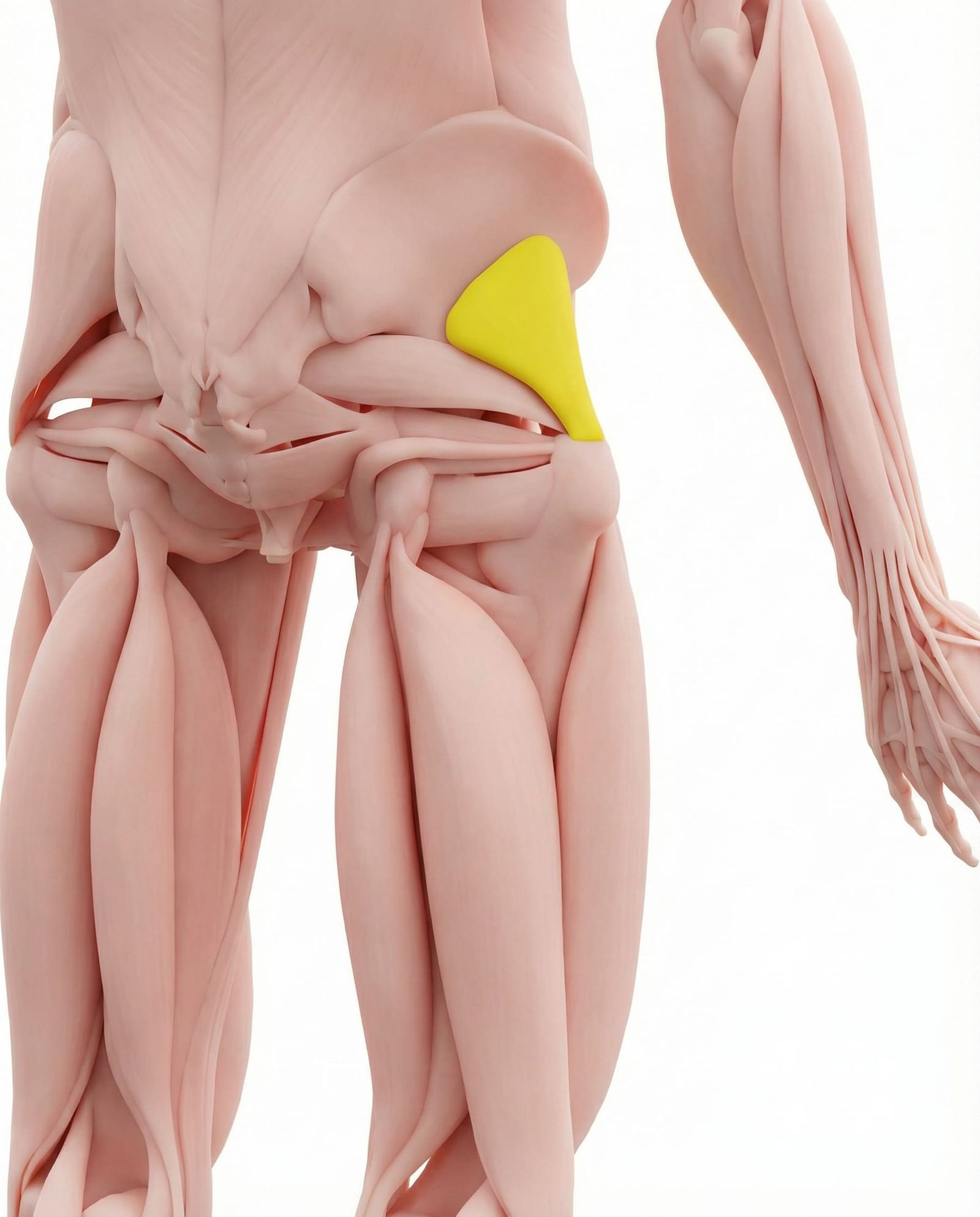
TrP 1
TrP1
Location. Deep side of hip, under gluteus medius
Pain referral. Side of hip, outer thigh, lower leg
- Side of hip
- Outer thigh
- Outer knee
- Outer lower leg
- Ankle
- Buttock
Deep lateral hip aching beneath the greater trochanter from deep gluteal trigger points
Location. Deep side of hip, under gluteus medius
Pain referral. Side of hip, outer thigh, lower leg
Location. Front of side hip
Pain referral. Front of hip, outer thigh
Location. Back of side hip
Pain referral. Buttock, posterior thigh
Location. Posterior portion of gluteus minimus
Pain referral. Posterior thigh, calf, and ankle
Location. Anterior portion of gluteus minimus
Pain referral. Lower buttock and lateral thigh to knee
Hip pain. Deep lateral hip aching beneath the greater trochanter from deep gluteal trigger points
Outer thigh pain. Referred ache extending down the entire lateral thigh mimicking nerve root compression
Pseudo-sciatica. Leg pain pattern mimicking lumbar radiculopathy from gluteus minimus trigger referral
Difficulty walking. Antalgic gait from lateral hip pain and weakness during single-leg stance phase
Night pain. Persistent deep hip aching that disturbs sleep especially when lying on affected side
Anterior hip pain. Deep aching at the anterior greater trochanter region mimicking hip joint pathology
Pseudo-radiculopathy. Leg pain pattern mimicking lumbar nerve root compression extending to lateral knee area
Buttock pain. Deep gluteal aching that persists at rest and worsens with weight-bearing activities
Back of thigh pain. Referred pain down posterior thigh mimicking sciatic nerve irritation from lumbar origin
Pseudo-sciatica down back of leg. Posterior gluteus minimus trigger point refers pain along entire posterior leg mimicking sciatic nerve
Calf pain. Distant referral from posterior gluteus minimus extends to posterior calf musculature region
Ankle ache. Distal referred pain reaches lateral ankle from posterior gluteus minimus trigger point
Night pain in posterior leg. Nocturnal posterior leg aching from sustained trigger point activity during recumbent position
Limping. Antalgic gait pattern adopted to reduce loading on painful posterior gluteus minimus trigger point
Lateral thigh pain. Anterior gluteus minimus trigger point refers pain along lateral thigh following IT band territory
Knee pain on outer side. Distal lateral referral from anterior gluteus minimus extends to lateral knee joint region
IT band-like symptoms. Lateral thigh pain pattern closely mimics iliotibial band syndrome presentation and distribution
Hip pain with walking. Gait-cycle loading activates anterior gluteus minimus trigger point with each stance phase
Difficulty climbing stairs. Stair climbing demands concentric gluteus minimus activation directly loading anterior fiber trigger point
Weak hip muscles. Deconditioned hip abductors develop trigger points from inability to meet daily demands
Running. Repetitive hip abduction demand during running stride overloads deep gluteus minimus fibers
Walking. Prolonged walking fatigues gluteus minimus during its stabilization role at midstance phase
Prolonged standing. Extended weight bearing creates sustained gluteus minimus contraction causing ischemic trigger points
Poor biomechanics. Faulty lower extremity alignment increases compensatory gluteus minimus workload during gait
Sitting. Prolonged compression of posterior gluteus minimus against chair creates ischemic trigger points
Walking on uneven terrain. Irregular surface walking demands continuous posterior gluteus minimus adjustment for pelvic stability
Weak hip abductors. Deficient abductor strength overworks posterior gluteus minimus fibers as compensatory stabilizers
Leg length discrepancy. Asymmetric pelvic mechanics from unequal leg lengths chronically overloads shorter-side gluteus minimus
Post-hip surgery deconditioning. Surgical deconditioning weakens gluteus minimus causing overload when resuming weight-bearing activities
Cycling. Sustained hip flexion with repetitive pedaling loads anterior gluteus minimus in shortened position
Weak hip stabilizers. Insufficient hip stabilization forces anterior gluteus minimus to compensate beyond capacity
Standing on one leg frequently. Repeated unilateral stance overloads anterior gluteus minimus for frontal plane pelvic stabilization
Walking on banked surfaces. Cambered walking surfaces create asymmetric hip loading overworking downhill gluteus minimus
Hip arthritis compensation. Hip joint pathology alters biomechanics forcing anterior gluteus minimus compensatory overactivation
Lie on the affected side on the floor with a tennis ball under the outer hip, just below the bony prominence at the side of the pelvis. Roll slowly forward and backward to cover the gluteus minimus area. When you find an intensely tender spot, hold pressure for 30-60 seconds.
Apply a warm, damp towel or heat pack over the lateral hip and upper buttock area. Lie on the non-affected side with the heat pack on the top hip. Allow 15-20 minutes of sustained warmth to penetrate the deep gluteus minimus muscle.
Lie on your non-painful side with legs stacked. Slowly lift the top leg about 30 degrees, keeping the leg straight and toes pointing slightly downward. Hold for 3 seconds, then lower slowly. This strengthens the gluteus minimus in its primary function as a hip stabilizer.
Stand on the affected leg near a wall for safety. Hold for 30 seconds, focusing on keeping your pelvis level (do not let the opposite hip drop). Progress to doing this on an unstable surface like a pillow. This retrains the gluteus minimus as a pelvic stabilizer during walking.
Avoid sleeping on the affected side — use a pillow between your knees when sleeping on the opposite side. Wear supportive footwear with good cushioning. Avoid prolonged standing on one leg. When walking long distances, take breaks to stretch the hip.
Gluteus minimus trigger points are frequently misdiagnosed as sciatica or lumbar radiculopathy. If leg-length pain persists, consult a physiatrist who can differentiate between nerve root compression and trigger point referred pain. Targeted trigger point treatment for gluteus minimus often provides dramatic relief.
Lie on your unaffected side with knees bent. Cross the affected leg over and let gravity pull the knee toward the floor, stretching the outer hip. You can use your bottom foot to gently press the top knee further down. Hold at the point of comfortable stretch, breathing deeply to allow the muscle to release.
Lie on your affected side with a foam roller under the outer hip, just below the bony prominence of the greater trochanter. Support yourself with your forearm and slowly roll from the hip down to mid-thigh, pausing on tender spots for 15-20 seconds. Keep the pressure firm but tolerable. You can stack or stagger your legs to control the amount of body weight on the roller.
Lie on your unaffected side with legs straight. Slowly raise the top leg about 30-40 degrees, keeping the toes pointed slightly downward to isolate the gluteus minimus. Hold 2 seconds at the top, then lower slowly over 3 seconds. Progress by adding an ankle weight (start with 1-2 lbs). Focus on control rather than height.
Stand on the affected leg near a wall or counter for safety. Hold for 30 seconds with good pelvic alignment — keep hips level without dropping on either side. Progress by closing your eyes, then standing on a folded towel. This retrains gluteus minimus to function as a dynamic hip stabilizer during walking.
Place a firm pillow between your knees when side-lying to keep the hips aligned and reduce tension on the gluteus minimus. If sleeping on the affected side is painful, sleep on the opposite side with the pillow support. A body pillow can help maintain proper alignment throughout the night. Avoid sleeping on your stomach which rotates the hips.
Consult an orthopedic specialist or sports physiotherapist if lateral thigh pain persists despite 4-6 weeks of self-care. They can differentiate between gluteus minimus trigger points, hip joint osteoarthritis, greater trochanteric bursitis, and L4-L5 lumbar radiculopathy — conditions that all present with similar thigh pain patterns but require different treatments.
Lie on your back and cross the affected ankle over the opposite knee, creating a figure-four shape. Reach through and grasp the back of the uncrossed thigh, pulling it gently toward your chest until you feel a deep stretch in the buttock of the crossed leg. Keep your head and shoulders relaxed on the floor. To increase the stretch, gently press the crossed knee away from your body with your elbow while pulling the thigh closer.
Sit on a firm surface and place a lacrosse ball under the affected buttock, positioning it just behind and below the bony point of the greater trochanter where the posterior gluteus minimus lies. Lean into the ball, adjusting your weight to create firm but tolerable pressure. Hold on each tender spot for 30-60 seconds, allowing the deep muscle to release. Slowly shift your weight to explore the area between the greater trochanter and the ischial tuberosity.
Lie on your unaffected side with hips and knees bent at about 45 degrees, feet together. Keeping your feet in contact, slowly rotate the top knee upward like a clamshell opening, without rolling your pelvis backward. Hold 2 seconds at the top, then lower slowly over 3 seconds. This targets the posterior gluteus minimus fibers as hip external rotators. Progress by adding a resistance band around the knees once you can perform 15 repetitions pain-free.
Stand on the affected leg with a slight knee bend, holding a light dumbbell or water bottle in the opposite hand. Slowly hinge forward at the hip, extending the free leg behind you for balance while lowering the weight toward the floor. Keep your back straight and hips level throughout the movement. Return to standing by squeezing the gluteal muscles. This eccentrically loads the posterior gluteus minimus through its functional hip stabilization role.
Use a firm cushion or specialized seat pad when sitting for extended periods to reduce direct compression on the posterior gluteus minimus. Avoid sitting on wallets or hard objects in your back pocket. Stand and walk for 2-3 minutes every 30 minutes of sitting. When driving, position the seat so your hips are slightly higher than your knees and use lumbar support to maintain a neutral pelvic position that reduces posterior gluteal compression.
Consult an orthopedic specialist or sports physiotherapist if buttock and posterior leg pain persists beyond 4-6 weeks of self-care. They can differentiate between posterior gluteus minimus trigger points, piriformis syndrome, true lumbar radiculopathy, and sacroiliac joint dysfunction, all of which produce similar buttock-to-leg pain patterns. Targeted diagnostic tests including prone hip rotation assessment and specific trigger point palpation can identify the muscular source without unnecessary imaging.