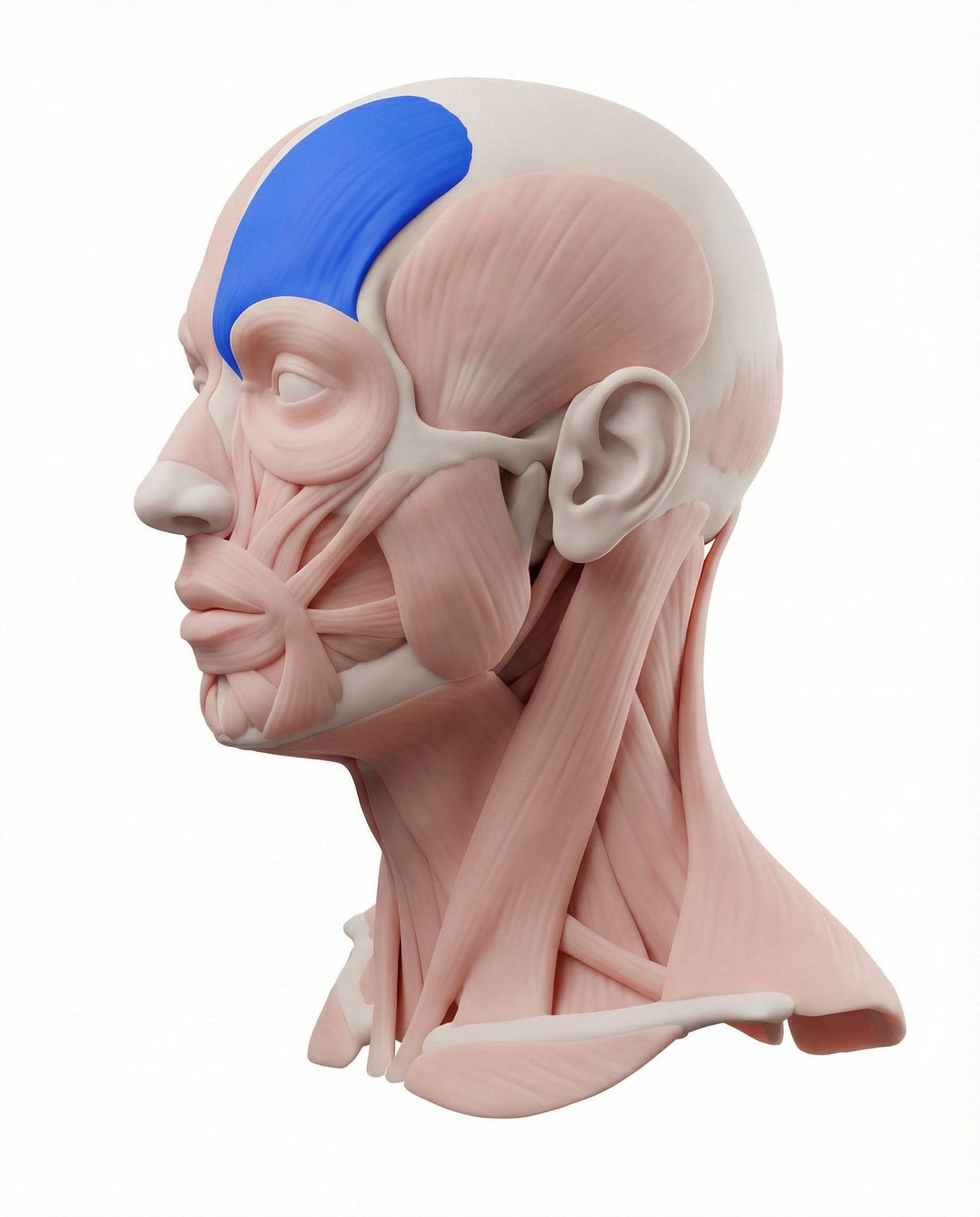
TrP 1
TrP1
Location. Forehead
Pain referral. Forehead and frontal head
- Forehead
- Across frontal region
- Behind eyes
Dull pressing pain across the forehead from sustained frontalis muscle tension
Location. Forehead
Pain referral. Forehead and frontal head
Location. Lateral fibers near temporal line
Pain referral. Lateral forehead and supraorbital ridge
Forehead headache. Dull pressing pain across the forehead from sustained frontalis muscle tension
Tension in brow. Persistent tightness and heaviness above the eyebrows from taut muscle bands
Eye strain sensation. Referred discomfort behind the eyes caused by frontalis trigger point radiation
Unilateral forehead headache. Lateral frontalis trigger points refer pain to the ipsilateral forehead above the eyebrow
Brow heaviness laterally. Trigger point-mediated frontalis fatigue creates a sensation of heaviness at the lateral brow
Periorbital ache. Referral extends inferiorly to the supraorbital ridge and upper periorbital region
Difficulty raising lateral eyebrow. Taut bands in lateral frontalis fibers restrict independent lateral brow elevation
Frontotemporal pressure. Trigger point referral spans the forehead-temple junction creating a localized pressure sensation
Frowning. Habitual brow furrowing sustains frontalis contraction leading to ischemic trigger points
Squinting. Repeated squinting recruits frontalis fibers causing cumulative contractile fatigue
Eyestrain. Prolonged visual focus causes reflexive forehead tensing and frontalis overactivation
Stress. Emotional tension produces unconscious sustained frontalis contraction and facial guarding
Bright light exposure. Photosensitivity triggers protective squinting that overworks the frontalis muscle
Reading for long periods. Extended visual concentration causes sustained brow tension and frontalis fatigue
Chronic frowning or squinting. Habitual facial expressions sustain frontalis contraction creating ischemic trigger points in lateral fibers
Computer screen glare. Squinting from screen glare chronically activates lateral frontalis and corrugator muscles
Asymmetric forehead tension from habitual expressions. One-sided brow raising creates asymmetric lateral frontalis overload and unilateral trigger points
Unilateral eyebrow strain from monocle/eyepiece use. Sustained unilateral brow elevation to hold an eyepiece chronically overloads lateral frontalis fibers
Post-surgical brow ptosis compensation. Compensatory frontalis contraction to elevate a ptotic brow creates chronic overload trigger points
Place your fingertips on your forehead and make small circular motions, moving slowly from the center outward toward the temples. Apply moderate pressure for comfort. Repeat several passes, covering the entire forehead from the hairline down to the brow ridge.
Soak a washcloth in comfortably warm water, wring it out, and drape it across your forehead and brow area. Lie down in a quiet, dimly lit room and relax while the warmth penetrates. Re-warm the cloth as needed to maintain a consistent temperature.
Raise your eyebrows as high as possible, hold the contraction for five seconds, then consciously relax your entire forehead and let your brows drop completely. Focus on the contrast between tension and relaxation. This teaches the frontalis muscle to release fully.
Using your fingertips, start at the forehead and slowly work your way over the top of the head toward the crown, using firm circular pressure. Spend extra time on any spots that feel particularly tight or tender. This technique stretches the frontalis and its connection to the galea aponeurotica.
Every 20 minutes of screen work, look at something at least 20 feet away for at least 20 seconds. Also ensure your screen brightness matches the ambient lighting, and position your monitor at arm's length with the top at eye level. Avoid squinting or furrowing your brows while concentrating.
If frontal headaches persist despite self-care for two to three weeks, see your physician to rule out sinusitis, chronic tension-type headache, or other causes. Mention the location and pattern of your headaches, any associated symptoms like nasal congestion or visual changes, and what makes the pain better or worse.