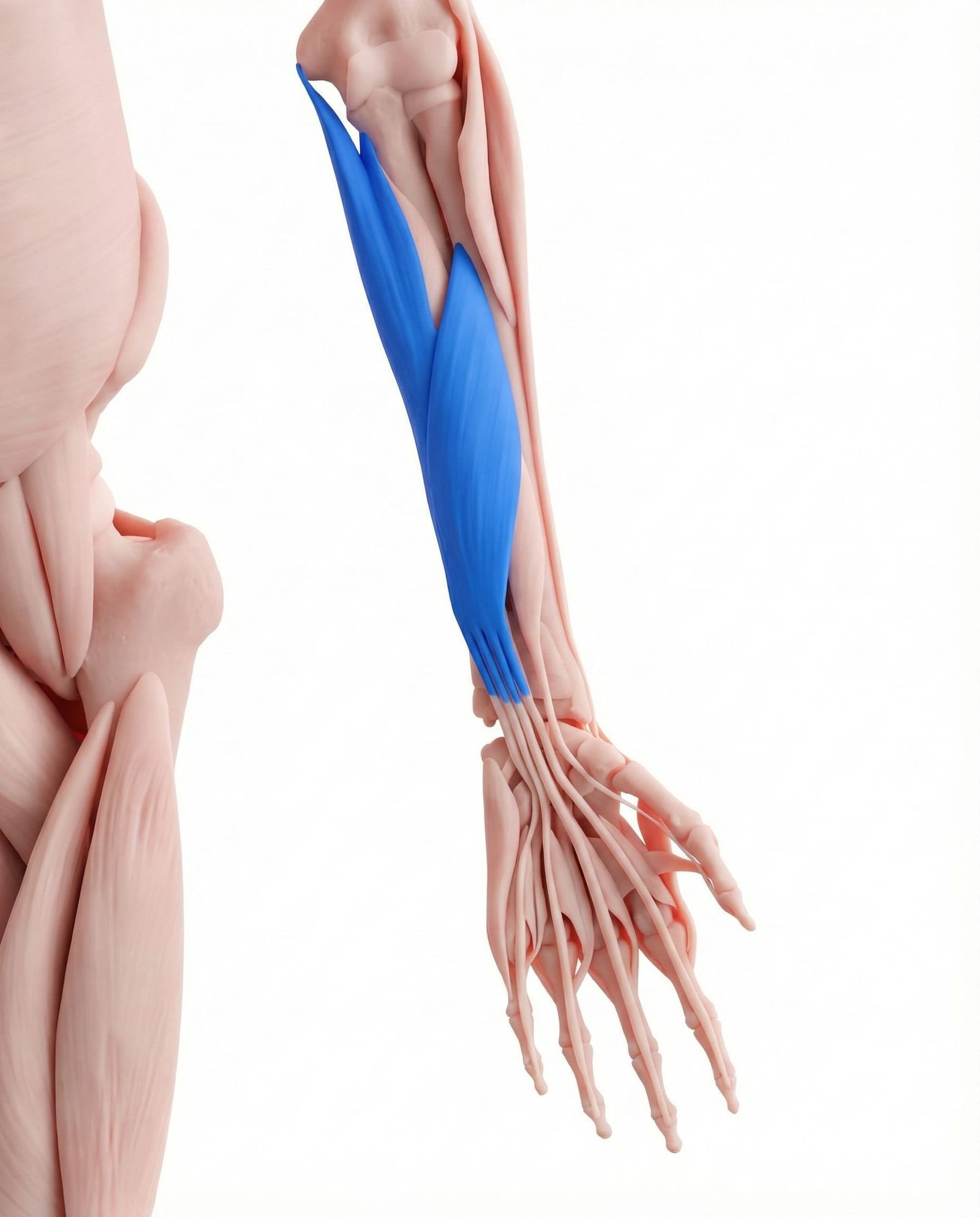
Prolonged mouse use.Sustained finger flexion posture holding mouse button fatigues FDS in static shortened position
Knitting or crocheting.Fine repetitive finger movements with sustained grip on needles overloads FDS motor units
Repetitive finger flexion (typing, gripping).High-volume finger flexion tasks overload FDS ring finger slip through repetitive concentric work
Rock climbing.Sustained finger flexion during climbing maximally loads FDS through isometric grip demands
Musical instruments (guitar, piano).Repetitive precise finger movements during instrument playing overload individual FDS slips
Trigger finger compensation.Altered mechanics around triggering digit shifts load to FDS creating compensatory trigger points
Prolonged tool use.Sustained gripping during tool use creates isometric FDS overload in ring finger muscle slip
04.Treatment & self-care
immediate
Forearm flexor stretch with fingers extended
Extend the affected arm in front of you with the palm facing up. Using the opposite hand, gently pull the fingers and hand backward (into extension) until you feel a stretch along the inner forearm. Keep the elbow straight. Hold the stretch steadily and breathe normally.
Duration
30 seconds per stretch, 3 repetitions
Frequency
4-5 times per day, especially after gripping or typing activities
Expect
Reduced forearm tightness and decreased finger stiffness within 5-7 days of consistent stretching
immediate
Cross-friction massage on volar forearm
Rest the affected forearm on a table, palm facing up. Using the thumb of the opposite hand, press firmly into the fleshy muscle of the inner forearm, starting about three inches below the elbow crease. Work across the muscle fibers (side to side, perpendicular to the forearm) in short strokes. When you find a particularly tender band or nodule, hold sustained pressure for 30-60 seconds until the tenderness decreases. Cover the entire flexor belly from below the elbow to mid-forearm.
Duration
3-5 minutes per session
Frequency
2 times per day
Expect
Decreased forearm tenderness and reduced finger catching sensation within 1-2 weeks
exercise
Finger flexion and extension exercises against putty
Take a ball of therapy putty (medium resistance to start). Press all five fingers into the putty and squeeze into a fist, hold 3 seconds, then extend all fingers fully. Repeat 15-20 times. Next, pinch the putty between each individual finger and the thumb, 10 times per finger. The putty provides graduated resistance that strengthens the flexors through their full range.
Duration
5-8 minutes per session
Frequency
Daily
Expect
Improved grip endurance and reduced finger stiffness within 2-3 weeks
exercise
Grip strengthening with stress ball
Hold a soft stress ball in the affected hand. Squeeze slowly and firmly for 3-5 seconds, then release slowly over 3 seconds. Perform 15-20 repetitions for 2-3 sets. As grip strength improves, progress to a firmer ball. Focus on controlled squeezes rather than rapid pumping to build endurance in the flexor muscles.
Duration
5 minutes per session
Frequency
Every other day
Expect
Increased grip strength and reduced pain with gripping tasks within 3-4 weeks
lifestyle
Ergonomic grip modifications
Build up the handles of frequently used tools (pens, kitchen utensils, toothbrush) with foam grips or tape to reduce the force needed to hold them. Use ergonomic keyboards with a split design and light key action. When carrying bags, use handles that distribute weight across the palm rather than concentrating it on the fingers. Take a 30-second stretch break every 20 minutes during repetitive hand tasks.
Duration
Ongoing modification
Frequency
Continuous during daily activities
Expect
Reduced forearm fatigue and less finger stiffness within 1-2 weeks of consistent ergonomic adjustments
professional
Professional evaluation for trigger finger or median nerve involvement
If finger catching, locking, or numbness persists beyond 3-4 weeks of self-care, consult a hand surgeon or hand therapist. They can distinguish between FDS trigger points, true trigger finger (stenosing tenosynovitis), carpal tunnel syndrome, and pronator teres syndrome. Treatment may include corticosteroid injection for true trigger finger, nerve conduction studies for suspected carpal tunnel, or targeted dry needling for myofascial trigger points.
Duration
Initial evaluation: 30-45 minutes
Frequency
Follow-ups every 2-4 weeks as needed
Expect
Accurate diagnosis and targeted treatment leading to significant improvement within 4-8 weeks
Key Takeaways
01Anterior forearm myalgia from sustained contraction of superficial finger flexor trigger point
02Taut band in FDS restricts full finger extension producing morning stiffness at PIP joints