Skip to main content
Atlas · Hand

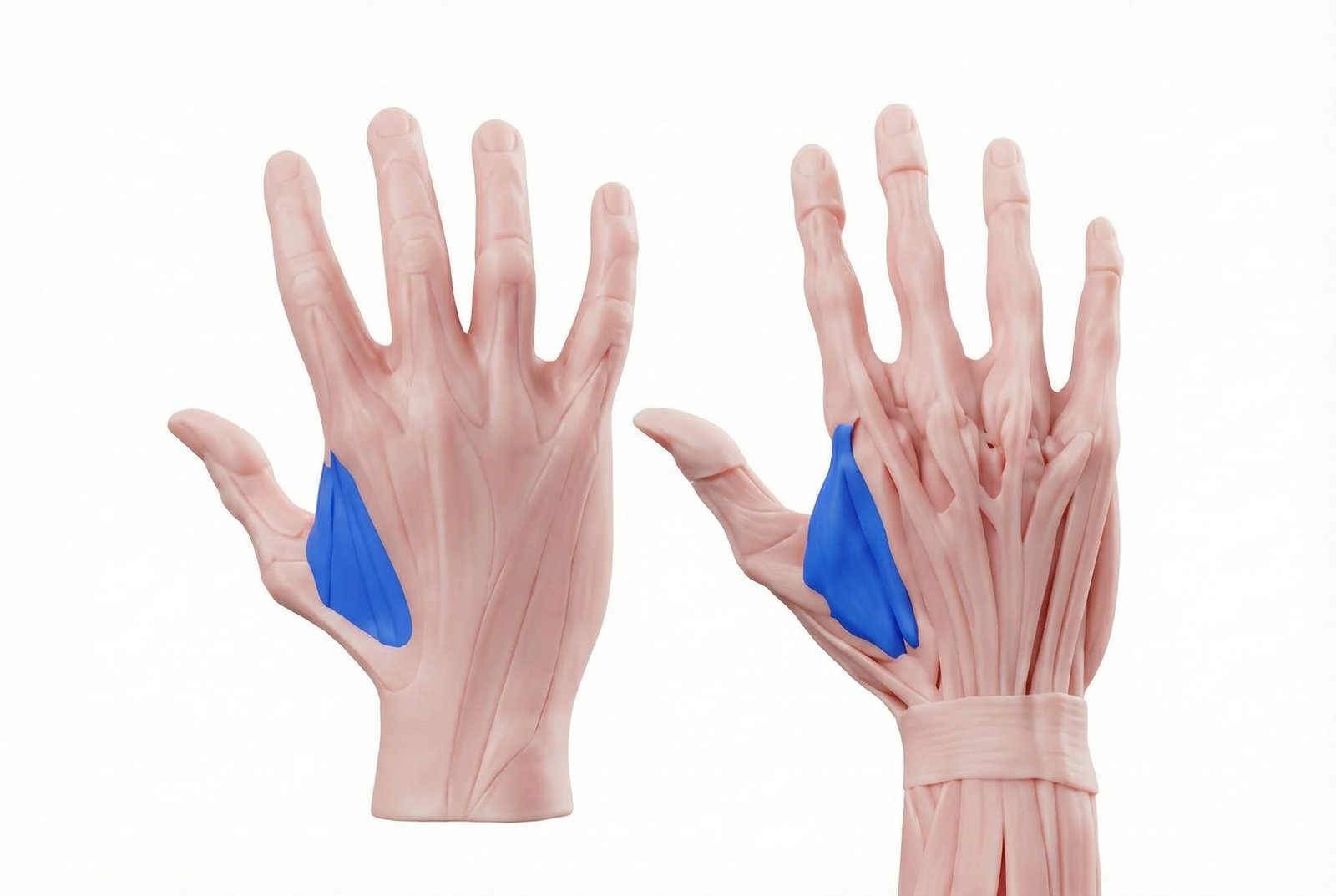
First Dorsal Interosseous

First dorsal interosseous trigger point produces localized deep aching in thenar web space

Body region
Hand
Trigger points
1
documented in this muscle
Common symptoms
5
patterns cataloged
Common causes
6
contributory factors

Trigger points

TrP 1

First Dorsal Interosseous

Location. Web space between thumb and index finger, dorsal surface of hand

Pain referral. Web space of thumb and index finger, and dorsal side of index finger

  • Dorsal web space
  • Palmar web space
  • Index finger (dorsal and palmar)
  • Thumb (radial side)
  • Dorsal first metacarpal area

Symptoms patients report

Aching in the thumb web space. First dorsal interosseous trigger point produces localized deep aching in thenar web space

Index finger pain. Referred pain along index finger from trigger point in first dorsal interosseous belly

Weakness in pinch grip. Trigger point inhibits first dorsal interosseous reducing lateral pinch force production

Pain with writing. Sustained pen grip requires isometric first dorsal interosseous contraction loading trigger point

Difficulty with fine motor tasks. Impaired index finger abduction and precision from trigger point weakening fine motor control

Common causes

Prolonged writing or drawing. Sustained pen grip demands continuous first dorsal interosseous isometric contraction causing fatigue

Repetitive pinch grip activities. Repeated lateral pinch overloads first dorsal interosseous fibers beyond recovery capacity

Typing. Repeated index finger extension and abduction during keystroke fatigues interosseous motor units

Texting. Sustained thumb opposition with index finger stabilization overworks first dorsal interosseous

Playing instruments. Complex finger movements requiring precise interosseous control create cumulative muscle fatigue

Using tools with sustained pinch. Prolonged pinch grip on tools maintains first dorsal interosseous in sustained contraction

Treatment & self-care

immediate

Thumb Web Space Stretch

Place your hand flat on a table with fingers together. Using your other hand, gently spread your thumb away from your index finger until you feel a comfortable stretch in the web space. Hold the stretch without forcing. Alternatively, press the web space against the edge of a table to deepen the stretch gently.

Duration
20-30 seconds per stretch, 3-5 repetitions
Frequency
4-5 times daily, especially during writing or computer work breaks
Expect
Reduced web space tightness and decreased pinching pain within 1-2 weeks
immediate

Deep Massage of Thumb Web Space

Use the thumb of your opposite hand to press firmly into the fleshy web space between the thumb and index finger of the affected hand. Apply sustained pressure on the most tender spot for several seconds, then use small circular motions to work through the tissue. Move systematically through the entire web space.

Duration
1-2 minutes per hand
Frequency
2-3 times daily
Expect
Decreased point tenderness and improved comfort with gripping within 1-2 weeks
exercise

Pinch Grip Strengthening with Therapy Putty

Take a small piece of therapy putty and pinch it between your thumb and index finger, squeezing it flat. Release and reshape the putty, then repeat. Progress the resistance by using firmer putty as strength improves. Focus on smooth, controlled pinches rather than quick squeezes.

Duration
10-15 repetitions, 2-3 sets
Frequency
Once daily, 5 days per week
Expect
Improved pinch grip strength and reduced fatigue with fine motor tasks within 4-6 weeks
lifestyle

Pen Grip Modification with Wider Barrel

Switch to pens and pencils with wider barrel grips, or add a foam grip sleeve to your existing pens. This reduces the force needed from the first dorsal interosseous to stabilize the pen. When typing, keep wrists in a neutral position and avoid excessive index finger abduction.

Duration
Use consistently during all writing tasks
Frequency
Ongoing
Expect
Reduced writing-related pain and less fatigue during prolonged writing sessions
lifestyle

Scheduled Rest Breaks During Fine Motor Tasks

Set a timer to take a 1-2 minute break every 20-30 minutes during writing, typing, texting, or other fine motor activities. During the break, gently stretch and shake out your hands, open and close your fists several times, and let your hands rest in a relaxed position.

Duration
1-2 minutes per break
Frequency
Every 20-30 minutes during sustained hand use
Expect
Prevention of cumulative overload and reduced end-of-day hand pain within 1-2 weeks
professional

Professional Hand Therapy Evaluation

Consult a certified hand therapist or occupational therapist specializing in upper extremity conditions. They can perform detailed assessment of intrinsic hand muscle function, differentiate trigger point pain from joint or nerve pathology, and provide custom splinting or targeted manual therapy.

Duration
30-45 minute sessions
Frequency
1-2 times per week for 4-6 weeks
Expect
Accurate diagnosis, targeted treatment plan, and measurable improvement in hand function within 4-8 sessions
Key Takeaways
  1. First dorsal interosseous trigger point produces localized deep aching in thenar web space
  2. Referred pain along index finger from trigger point in first dorsal interosseous belly
  3. Trigger point inhibits first dorsal interosseous reducing lateral pinch force production
  4. Sustained pen grip requires isometric first dorsal interosseous contraction loading trigger point
  5. Impaired index finger abduction and precision from trigger point weakening fine motor control