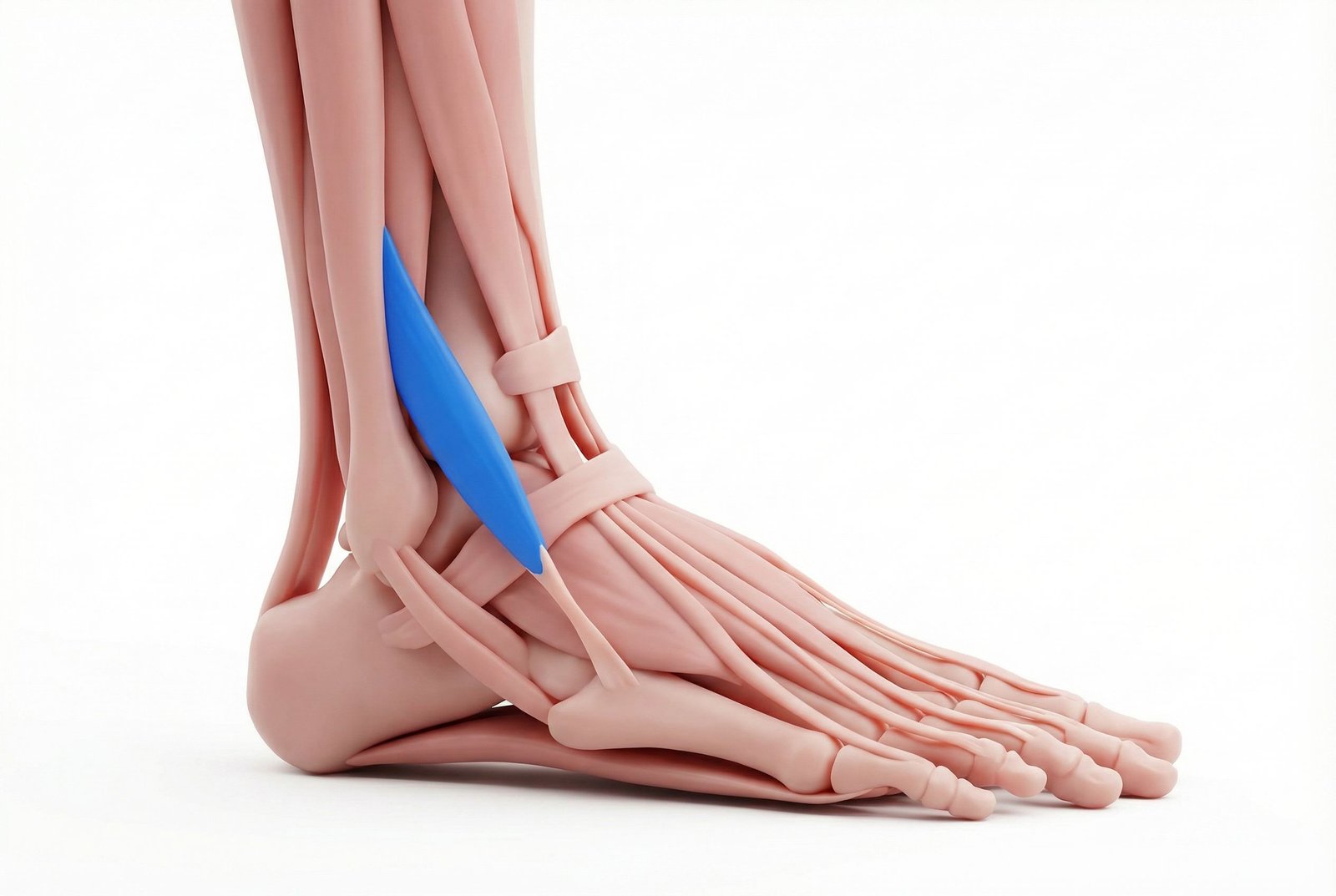
TrP 1
Fibularis Tertius
Location. Front-outer lower leg
Pain referral. Outer ankle, top of foot
- Outer ankle
- Top of foot
- Anterolateral leg
Anterolateral ankle pain from fibularis tertius trigger point near lateral malleolus area
Location. Front-outer lower leg
Pain referral. Outer ankle, top of foot
Outer ankle pain. Anterolateral ankle pain from fibularis tertius trigger point near lateral malleolus area
Top of foot pain. Dorsal foot pain from distal fibularis tertius trigger point referral along tendon
Pain with dorsiflexion. Ankle dorsiflexion with eversion directly loads compromised fibularis tertius trigger points
Running. Repetitive ankle dorsiflexion and eversion during gait cumulatively overloads fibularis tertius
Ankle sprains. Lateral ankle injury strains fibularis tertius initiating protective trigger point formation
Overuse. Exceeding anterolateral compartment recovery capacity creates persistent fibularis tertius dysfunction
Poor footwear. Inadequate lateral support increases compensatory fibularis tertius stabilization demand during activity
Sit with the affected leg crossed over the opposite knee. Locate the tender point on the front-outer aspect of the lower leg, roughly in the lower third of the shin between the tibialis anterior and the fibula. Using your thumb or a small massage ball, apply firm sustained pressure to the trigger point for 20-30 seconds until you feel the tissue soften. Release slowly and reposition on adjacent tender spots. Work the area from mid-shin down toward the ankle.
Wrap a few ice cubes in a thin towel or use a cold gel pack. Apply it over the outer ankle and lower anterolateral shin where the fibularis tertius tendon runs. Keep the ice in place for 10-15 minutes, ensuring a cloth barrier between the ice and skin. This is especially helpful after activities that aggravate the pain such as running or prolonged walking.
Stand facing a wall with the affected foot behind you, toes pointing forward. Keeping the heel on the ground, gently bend the front knee and lean forward to stretch the front of the rear ankle. Then, while seated, use a resistance band looped around the forefoot to gently resist as you pull the foot upward and outward into dorsiflexion with eversion. Hold each stretch for 20-30 seconds. Perform 3 repetitions of each variation.
Sit with legs extended and loop a resistance band around the forefoot, anchoring the other end to a fixed point on the inner side. Slowly turn the foot outward (evert) against the band resistance, hold for 3 seconds at end range, then return slowly. Perform 3 sets of 12 repetitions. Progress to a heavier band as strength improves. Keep the movement controlled and avoid compensating with hip rotation.
Examine your current shoes for wear patterns along the outer sole edge, which indicates excessive lateral loading. Replace worn-out shoes and select footwear with firm heel counters and adequate lateral support. If you overpronate or supinate, consider semi-rigid orthotics that stabilize the subtalar joint. Avoid flat, unsupportive shoes such as flip-flops or worn-out sneakers, which force the fibularis tertius to compensate for poor lateral stability.
If outer ankle and dorsal foot pain persists beyond 4-6 weeks despite self-care, or if you experience repeated ankle giving way, consult an orthopedic specialist or sports medicine physician. They can perform stress tests, ultrasound, or MRI to rule out chronic lateral ligament instability, peroneal tendon subluxation, anterolateral impingement syndrome, or stress fracture. A physical therapist can provide specific proprioceptive training and manual therapy targeting the anterolateral compartment.