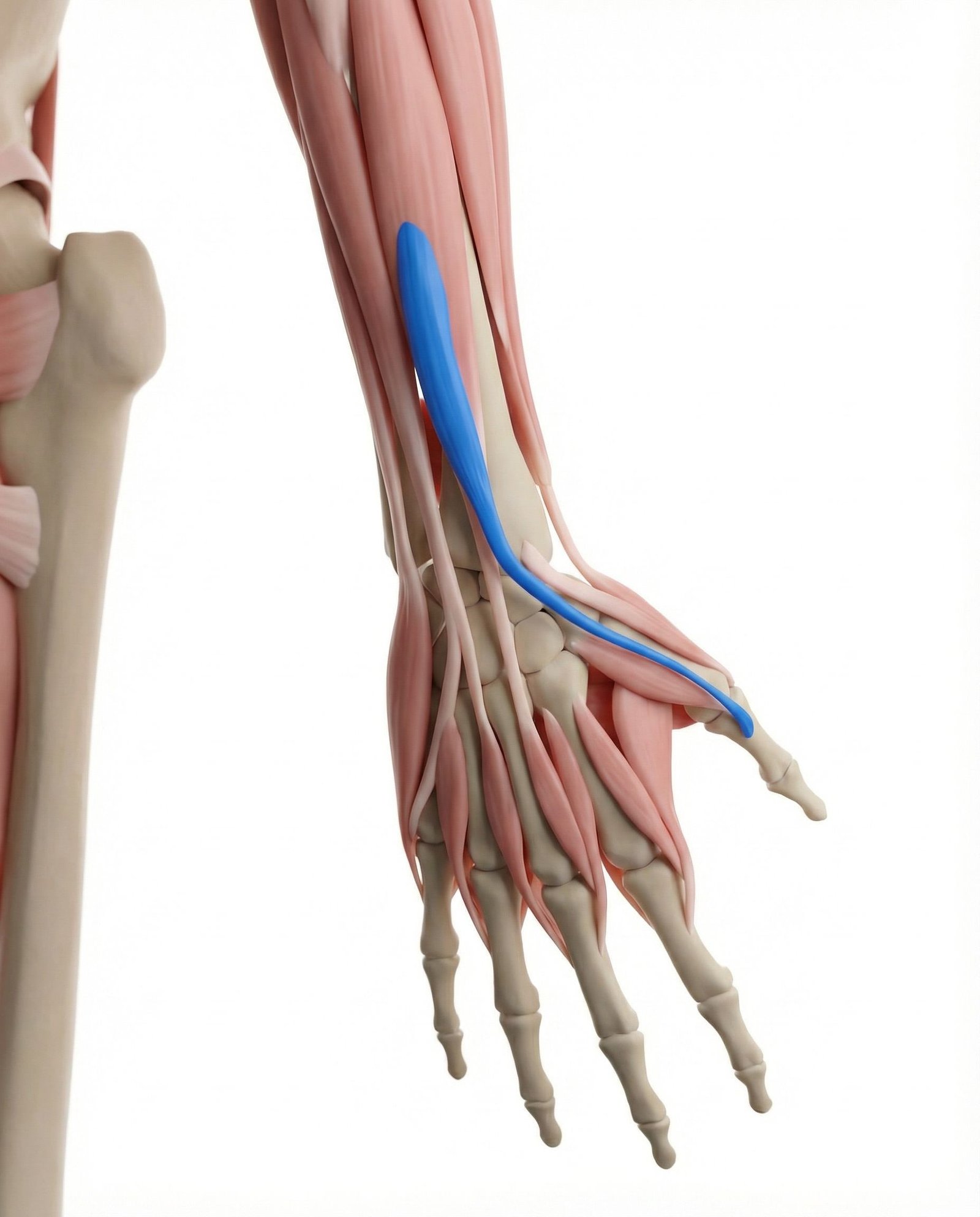
TrP 1
Extensor Pollicis Brevis
Location. Back of forearm, thumb side
Pain referral. Back of wrist, thumb
- Back of wrist
- Thumb
- Posterior forearm
Dorsal radial wrist aching from extensor pollicis brevis trigger point referral pathway
Location. Back of forearm, thumb side
Pain referral. Back of wrist, thumb
Wrist pain. Dorsal radial wrist aching from extensor pollicis brevis trigger point referral pathway
Thumb pain. Pain along dorsal thumb from trigger point referral along extensor pollicis tendon route
Difficulty extending thumb. Impaired thumb extension from trigger point inhibition of extensor pollicis brevis function
Repetitive thumb extension. Sustained or repeated thumb straightening overloads extensor pollicis brevis muscle fibers
Typing. Keyboard use with frequent thumb extension creates cumulative extensor pollicis microtrauma
Tool use. Sustained tool manipulation requiring thumb positioning overloads extensor pollicis brevis
Sports. Racket and ball sports requiring thumb control overload extensor pollicis brevis repeatedly
Locate the muscle belly on the back of the forearm about 4-5 centimeters below the wrist, slightly toward the thumb side. With the thumb of the opposite hand, apply firm pressure perpendicular to the muscle fiber direction (across the forearm rather than along it). Use short, firm strokes back and forth over the tender area. Hold sustained pressure on any nodule for 20-30 seconds until the tenderness diminishes.
Gently fold your thumb across the palm toward the base of the little finger. Wrap your other fingers over the thumb to hold it in place. You should feel a comfortable stretch along the back of the thumb and the radial side of the wrist. Hold without forcing, as the extensor pollicis brevis is a small muscle that responds to gentle, sustained stretching. Avoid bouncing or pulling aggressively.
Place a small rubber band around all five fingertips. Spread your fingers and thumb outward against the resistance of the band, focusing on pushing the thumb away from the palm. Hold the spread position for 3-5 seconds, then slowly relax. Start with a thin band and progress to thicker ones as strength improves. This directly strengthens the extensor pollicis brevis in a controlled, low-load manner.
Hold a light hammer or weighted stick by the handle with your forearm resting on a table and hand hanging off the edge, thumb pointing up. Slowly tilt the weight upward (radial deviation) and then slowly lower it (ulnar deviation). This exercise strengthens the wrist and thumb stabilizers in the pattern they work during daily activities. Perform slowly over 3-4 seconds in each direction.
When gripping tools, mugs, or objects, consciously distribute force across all fingers rather than relying heavily on the thumb. Use full-hand power grips instead of thumb-and-finger pinch grips when possible. Switch to ergonomic pens with wider barrels for writing. When using a smartphone, support it with both hands rather than using single-thumb scrolling. Consider a thumb spica splint for rest periods during flare-ups.
If radial wrist and thumb pain persists beyond 3-4 weeks of self-care, consult a hand therapist or orthopedic hand specialist. They can perform Finkelstein's test and other clinical examinations to differentiate extensor pollicis brevis trigger points from true De Quervain's tenosynovitis, thumb CMC arthritis, or scaphoid pathology. Targeted manual therapy, dry needling, or a custom thumb splint may be recommended. Corticosteroid injection is appropriate for confirmed De Quervain's but not for trigger points alone.