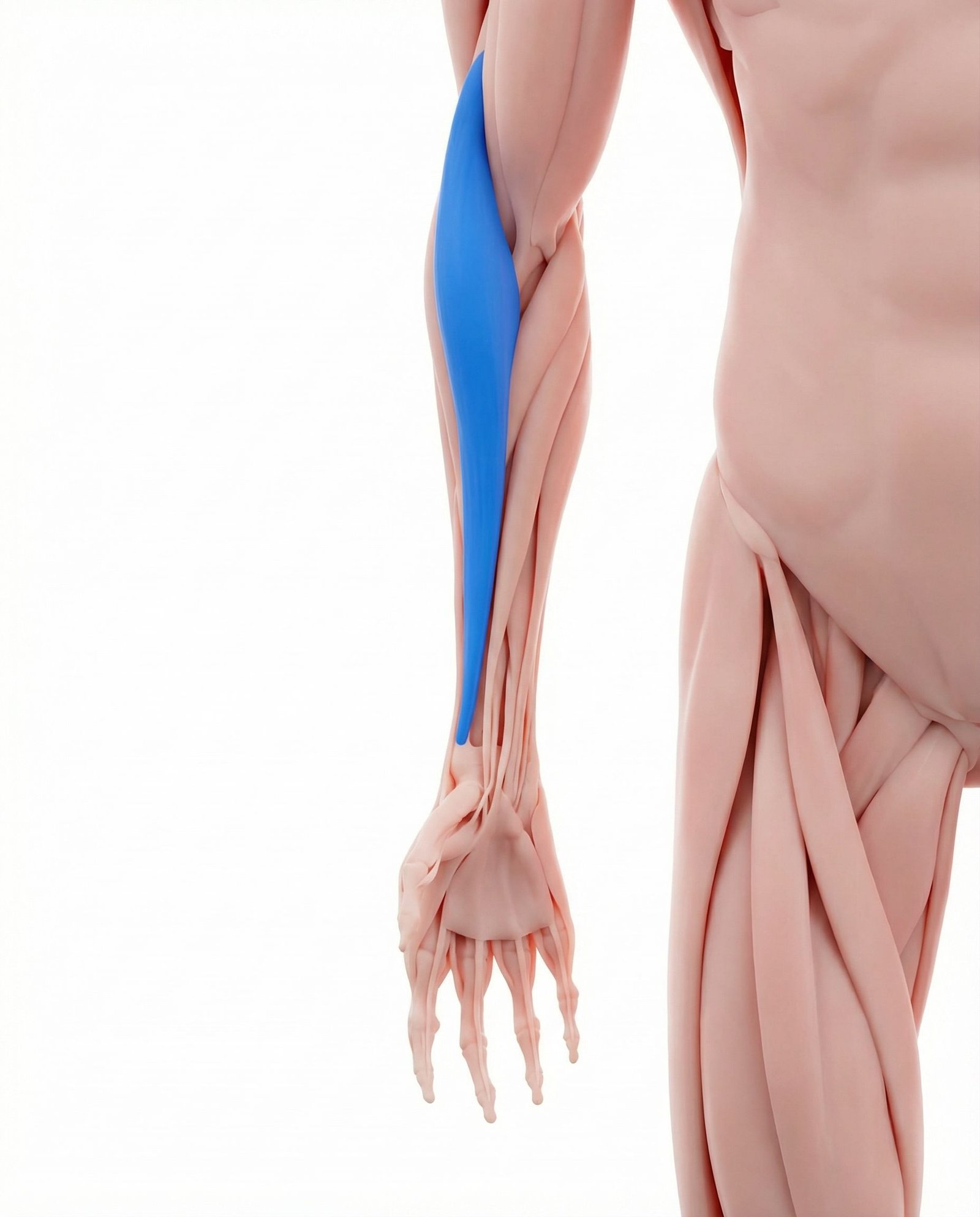
TrP 1
TrP1
Location. Outer forearm, near elbow
Pain referral. Outer elbow, thumb side of wrist
- Lateral elbow
- Thumb side of forearm
- Base of thumb
- Wrist
Lateral epicondylar aching that mimics tennis elbow from brachioradialis trigger referral
Location. Outer forearm, near elbow
Pain referral. Outer elbow, thumb side of wrist
Location. Mid-forearm near radial styloid, distal brachioradialis
Pain referral. Lateral epicondyle and web space of thumb
Tennis elbow pain. Lateral epicondylar aching that mimics tennis elbow from brachioradialis trigger referral
Forearm pain. Aching along the radial forearm worsened by gripping and wrist extension tasks
Thumb side wrist pain. Referred discomfort at the radial wrist and thumb base from forearm trigger points
Weakness in grip. Reduced grip strength due to pain inhibition from active brachioradialis trigger points
Lateral elbow aching. Distal brachioradialis trigger points refer proximally to the lateral epicondyle region
Thumb web space pain. Referral extends distally to the dorsal first web space between thumb and index finger
Weak grip. Trigger point-mediated brachioradialis inhibition reduces forearm stabilization diminishing grip force
Pain with forearm rotation. Brachioradialis assists in returning the forearm to neutral provoking trigger points during rotation
Wrist pain on radial side. Distal trigger points near the radial styloid create localized radial wrist aching
Repetitive wrist extension. Sustained wrist extension activities chronically overload the brachioradialis muscle fibers
Hammering. Repetitive forceful gripping and forearm rotation during hammering fatigues brachioradialis
Tennis backhand. Eccentric brachioradialis loading during backhand stroke creates cumulative muscle strain
Typing. Sustained wrist extension during keyboard use maintains chronic brachioradialis contraction
Using tools. Forceful gripping and turning of tools overloads brachioradialis repetitively during work
Screwdriver use. Repetitive forearm rotation with gripping force fatigues brachioradialis muscle progressively
Repetitive elbow flexion with forearm neutral (hammering). Hammering demands brachioradialis for elbow flexion in neutral forearm creating cumulative overload
Tennis (forehand). Forehand stroke requires brachioradialis for wrist stabilization during impact generating overload
Handshaking. Repeated firm handshakes demand brachioradialis contraction in neutral forearm position
Carrying heavy bags. Sustained elbow flexion in neutral forearm position to carry bags overloads brachioradialis isometrically
Using a manual screwdriver. Repetitive rotation around neutral forearm position fatigues brachioradialis as a mid-range stabilizer
Heavy bicep curls. Hammer curl position maximally loads brachioradialis throughout the elbow flexion range of motion
Using your opposite thumb, press firmly along the outer forearm from the elbow toward the wrist. When you find a tender spot, hold steady pressure for 20-30 seconds until the tenderness decreases. Repeat on all tender areas, spending about 5 minutes total.
Extend your arm straight in front of you with the palm facing down. Use your other hand to gently pull your fingers and wrist downward until you feel a stretch along the outer forearm. Hold for 30 seconds and repeat 3 times on each side.
Rest your forearm on a table with your wrist hanging off the edge, palm facing down, holding a light weight (1-2 lbs). Use your other hand to help lift the weight up, then slowly lower it over 5 seconds using only the working forearm. Perform 3 sets of 10 repetitions.
Hold a light hammer or weighted object at the end of its handle with your elbow bent at 90 degrees. Slowly rotate your forearm palm-up then palm-down in a controlled motion. Perform 3 sets of 15 rotations in each direction.
Switch to a vertical or ergonomic mouse that keeps your forearm in a neutral handshake position. Position your keyboard so your wrists remain flat and neutral, not angled upward. Avoid gripping your mouse tightly and take micro-breaks every 20-30 minutes.
If lateral elbow pain persists beyond 4-6 weeks despite self-care, see a sports medicine physician or orthopedist. They can rule out lateral epicondylitis (tennis elbow), radial nerve entrapment, or cervical radiculopathy. Diagnostic ultrasound or MRI may be recommended.