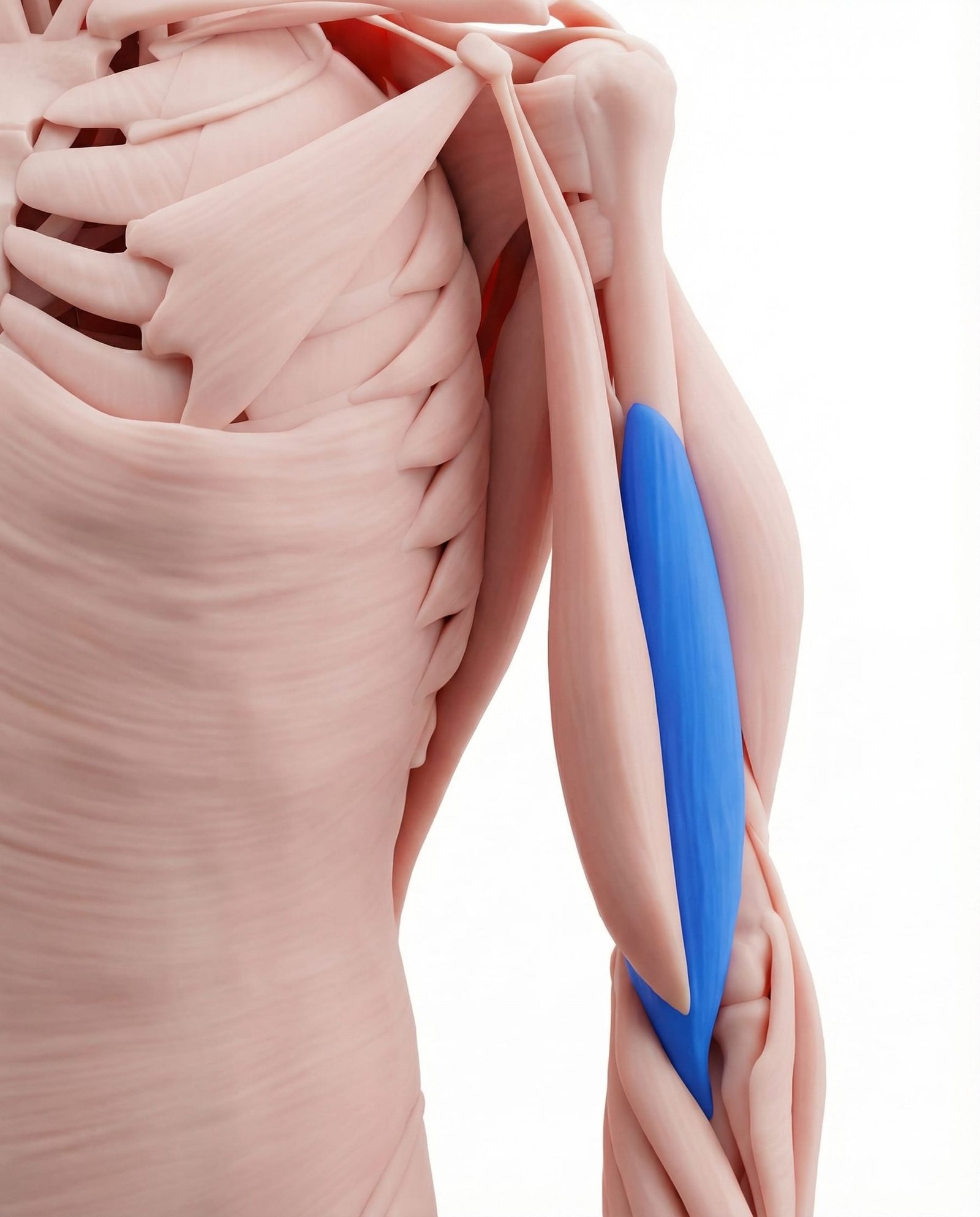
TrP 1
TrP1
Location. Deep to biceps, front of arm
Pain referral. Front of arm, thumb side of hand
- Front of arm
- Thumb side of forearm
- Base of thumb
- Front of elbow
Deep antecubital aching worsened by resisted elbow flexion and carrying activities
Location. Deep to biceps, front of arm
Pain referral. Front of arm, thumb side of hand
Location. Lower front arm, near elbow
Pain referral. Front of elbow, forearm
Location. Distal fibers near elbow crease
Pain referral. Anterior elbow and proximal forearm
Elbow pain. Deep antecubital aching worsened by resisted elbow flexion and carrying activities
Forearm pain. Referred ache along the radial forearm from brachialis trigger point activation
Thumb pain. Referred discomfort at the base of the thumb mimicking de Quervain tendinopathy
Weakness in elbow flexion. Reduced flexion strength especially during neutral forearm gripping and lifting tasks
Forearm discomfort. Proximal forearm pain from distal brachialis trigger point referral into forearm region
Weakness in flexion. Impaired elbow flexion strength from brachialis trigger point inhibition of force production
Anterior elbow pain with gripping. Distal brachialis trigger points at the elbow crease refer pain during gripping activities
Thumb base aching (referred). Brachialis trigger points create a characteristic distal referral to the base of the thumb
Pain with resisted elbow flexion. Elbow flexion against resistance maximally loads the brachialis provoking distal trigger point pain
Difficulty lifting objects. Trigger point-mediated brachialis weakness impairs elbow flexion force for lifting tasks
Elbow stiffness after rest. Post-rest trigger point contracture creates anterior elbow stiffness requiring gradual warm-up
Repetitive lifting. Sustained elbow flexion under load chronically overworks the brachialis muscle fibers
Hammering. Repetitive forceful elbow flexion-extension during hammering fatigues the brachialis muscle
Chin-ups. Sustained concentric loading in neutral grip position heavily demands brachialis activation
Carrying heavy items. Prolonged isometric elbow flexion while carrying creates brachialis ischemia and trigger points
Playing musical instruments. Sustained elbow flexion during instrument play fatigues the brachialis over extended sessions
Lifting. Repetitive or heavy elbow flexion under load overloads brachialis primary flexor fibers
Repetitive flexion. Sustained or repeated elbow bending activities overload brachialis muscle fiber capacity
Carrying. Prolonged carrying with flexed elbows creates sustained isometric brachialis loading
Repetitive elbow flexion-extension (hammering). Repeated forceful elbow flexion during hammering creates cumulative brachialis overload at its distal fibers
Carrying heavy bags with elbow bent. Sustained isometric brachialis contraction to carry loads with bent elbows creates ischemic trigger points
Rock climbing. Intense sustained elbow flexion during climbing maximally loads the brachialis as the primary flexor
Excessive bicep curls. High-volume elbow flexion exercises overload both the biceps and underlying brachialis muscle
Prolonged elbow flexion (holding phone to ear). Sustained elbow flexion during phone calls maintains brachialis in chronic isometric contraction
Sit with your affected arm resting on a table, elbow slightly bent and palm facing up. Using the thumb of your opposite hand, press firmly into the front of your arm just below the elbow crease, slightly to the outer side of the biceps tendon. You are pressing through the biceps to reach the brachialis underneath. When you find a tender spot, hold sustained pressure for 20-30 seconds. Gradually increase pressure as the tenderness diminishes. Work methodically across the area from the inner to the outer forearm just below the elbow.
Stand with your affected arm at your side. Fully straighten your elbow and then gently extend it further by pressing down on the front of the forearm with your opposite hand, or by pressing the back of the hand against a wall with the arm straight behind you. You should feel a gentle stretch across the front of the elbow and upper forearm. The stretch targets the brachialis by lengthening it from its contracted, shortened state. Hold for 20-30 seconds.
Sit with your forearm resting on a table, elbow bent to 90 degrees, and hold a light hammer or weighted object by the handle (not in the middle). Slowly rotate your forearm so your palm faces down (pronation), then rotate it back so your palm faces up (supination). Perform the rotation in a slow, controlled manner over 3 seconds in each direction. The weight of the hammer provides gentle resistance to strengthen the muscles around the brachialis.
Hold a light dumbbell (2-5 pounds) with your palm facing down (pronated grip), which emphasizes the brachialis over the biceps. Use your other hand to help curl the weight up to the top position. Then slowly lower the weight over 5 seconds using only the affected arm, controlling the descent. The eccentric lowering phase is the therapeutic part of this exercise. If the pronated grip causes pain, use a neutral (thumbs-up) grip instead.
Distribute heavy loads between both arms rather than carrying everything on one side. Use bags with padded handles or switch to a backpack to reduce the sustained elbow flexion demand on the brachialis. When carrying grocery bags, use a forearm carry position with the bag handles over the forearm rather than gripped in the hand. Take multiple trips rather than overloading one carry. Consider using a rolling cart for heavy grocery or shopping loads.
If front-of-elbow pain and thumb symptoms persist beyond 3-4 weeks of self-care, consult a physical therapist or orthopedic specialist. A professional can differentiate brachialis trigger points from biceps tendinitis, pronator teres syndrome, or median nerve entrapment through specific clinical tests. They can perform targeted deep tissue massage, instrument-assisted soft tissue mobilization, or dry needling directly to the brachialis. If thumb numbness is prominent, nerve conduction studies may be recommended to rule out carpal tunnel syndrome.
Stand next to a wall or doorframe. Place your palm flat against the surface at shoulder height with fingers pointing down and elbow fully straight. Gently lean your body away until you feel a comfortable stretch across the front of your elbow and lower biceps area. Hold without bouncing.
Sit comfortably with the affected arm supported. Using the thumb of your opposite hand, press firmly into the front of the upper arm about two to three inches above the elbow crease. Search for the most tender spot — you will feel it deep beneath the biceps. Apply sustained pressure for 30-60 seconds, breathing slowly, until the tenderness begins to decrease. Repeat on any additional tender areas.
Hold a light dumbbell (2-5 pounds to start) with your wrist in a neutral position (thumb facing up, as if holding a hammer). Slowly curl the weight up toward your shoulder over 3 seconds, then lower it back down over 4 seconds. Keep your upper arm still and elbow at your side. Perform 10-12 repetitions for 2-3 sets.
Sit with your arm at your side. Slowly bend your elbow fully, then straighten it completely. At the end of each direction, hold for 2-3 seconds. Perform 15-20 repetitions. You can add gentle overpressure with the opposite hand at end-range extension to improve flexibility.
Identify activities that require sustained or repetitive elbow bending — carrying heavy bags, prolonged hammering, bicep-heavy workouts. Take breaks every 20-30 minutes during these activities. When carrying items, use a wheeled cart or divide loads. Alternate between arms when possible and avoid holding heavy objects in a flexed elbow position for extended periods.
If self-care does not meaningfully improve symptoms within 3-4 weeks, consult a sports medicine physician or physical therapist experienced with upper extremity myofascial pain. They can differentiate brachialis trigger points from biceps tendinitis, anterior interosseous syndrome, or elbow joint pathology and provide targeted manual therapy or dry needling.