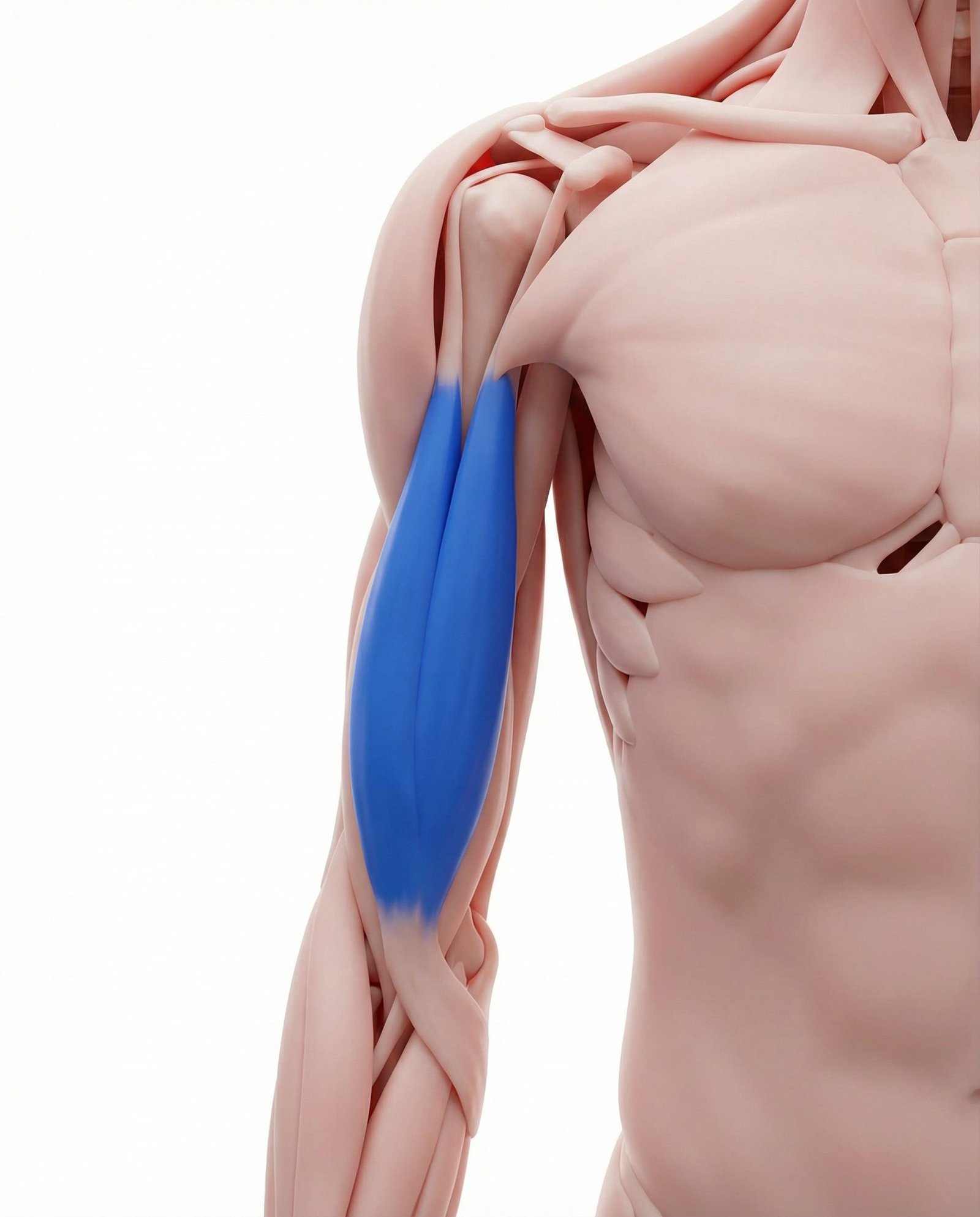
TrP 1
TrP1
Location. Front of upper arm
Pain referral. Front of shoulder, elbow
- Front of shoulder
- Biceps area
- Front of elbow
- Base of thumb
Superficial aching along anterior upper arm worsening with elbow flexion activities
Location. Front of upper arm
Pain referral. Front of shoulder, elbow
Location. Distal belly of biceps brachii near elbow crease
Pain referral. Antecubital fossa and superficial forearm ache
Location. Short head proximal near coracoid process
Pain referral. Anterior shoulder and bicipital groove
Front arm pain. Superficial aching along anterior upper arm worsening with elbow flexion activities
Shoulder pain. Referred pain to anterior shoulder mimicking bicipital tendinitis or groove irritation
Elbow pain. Antecubital fossa aching during elbow flexion and forearm supination tasks
Weakness in flexion. Reduced elbow flexion strength impairing lifting and carrying capacity noticeably
Elbow crease pain. Distal biceps trigger point refers pain to antecubital fossa at musculotendinous junction region
Forearm ache. Referred pain from distal biceps descends to superficial anterior forearm along muscle territory
Pain with elbow extension. Straightening elbow stretches distal biceps across trigger point creating extension pain
Weakness in supination. Trigger point inhibits distal biceps reducing forearm supination force production capacity
Difficulty straightening elbow fully. Taut distal biceps band resists terminal elbow extension creating flexion contracture tendency
Anterior shoulder pain mimicking biceps tendinopathy. Anterior shoulder ache from short head trigger point simulating biceps tendon inflammation
Pain with overhead reaching. Overhead arm elevation stretches shortened biceps short head aggravating proximal trigger points
Bicipital groove tenderness. Referred tenderness at bicipital groove from proximal biceps trigger point tension transmission
Difficulty with supination. Inhibited biceps function from trigger points reduces forearm supination force production
Anterior arm weakness sensation. Perceived anterior arm weakness from trigger point motor inhibition of biceps contraction
Lifting heavy objects. Sustained elbow flexion under heavy load overworks biceps long and short heads
Repetitive elbow flexion. Continuous curling motions cause cumulative microtrauma to biceps brachii muscle fibers
Throwing. Forceful supination and flexion during throwing stresses biceps at musculotendinous junction
Swimming. Repetitive pulling strokes require sustained biceps activation during propulsion phases continuously
Carrying children. Prolonged elbow flexion while holding children fatigues biceps beyond recovery capacity
Sudden heavy lifting. Acute overload from unexpected weight can activate latent biceps trigger points immediately
Bicep curls with excessive weight. Heavy bicep curl overloads distal biceps fibers at musculotendinous junction creating trigger points
Pull-ups and chin-ups. Bodyweight pulling demands maximal distal biceps force production during elbow flexion
Carrying heavy loads with elbow bent. Sustained isometric biceps contraction carrying loads fatigues distal muscle fibers
Repetitive supination tasks (using screwdriver). Repeated forearm rotation loads distal biceps as primary supinator muscle
Rock climbing. Sustained pulling grip demands prolonged distal biceps isometric contraction on holds
Sudden eccentric loading of biceps. Unexpected arm extension force eccentrically overloads distal biceps beyond prepared capacity
Biceps curl overload. Excessive biceps curl volume creates concentric overload of proximal biceps short head fibers
Overhead lifting. Overhead lifting loads biceps as a shoulder stabilizer creating sustained proximal fiber tension
Chin-ups and pull-ups. Repetitive pull-up movements maximally load biceps short head through combined flexion and supination
Carrying heavy bags. Sustained elbow flexion under load creates isometric biceps overload promoting trigger points
Post-biceps tenodesis guarding. Protective muscle splinting after biceps tendon surgery creates secondary proximal trigger points
Sit comfortably with your affected arm resting on a table or your lap with the palm facing up. Using the thumb and fingers of your opposite hand, gently squeeze and knead the biceps muscle from the front of the shoulder down to the elbow crease. When you find a particularly tender spot, hold sustained pressure for 20-30 seconds until you feel the tension release. Work slowly and methodically along the entire muscle belly.
Wrap an ice pack or bag of frozen peas in a thin towel and apply it to the front of the upper arm where the pain is most intense. If pain is at the front of the shoulder, apply the ice there as well. Hold the ice pack in place for 10-15 minutes. Ice is especially helpful after activities that aggravate the pain, such as lifting or carrying.
Stand in a doorway and place the palm of your affected arm flat against the door frame at shoulder height with your arm straight and fingers pointing backward. Slowly turn your body away from the arm until you feel a stretch along the front of the upper arm and shoulder. Keep your elbow straight and your shoulder down. Hold for 20-30 seconds, then release slowly.
Hold a light weight (2-5 pounds) in the affected hand with your palm facing up. Use your other hand to help lift the weight to the fully curled position. Then slowly lower the weight over a count of 5 seconds, controlling the descent with the biceps. The slow lowering phase strengthens the muscle eccentrically and promotes trigger point healing. Repeat for the prescribed number of repetitions.
When lifting or carrying objects, alternate between palm-up (supinated) and palm-down (pronated) grips to distribute the workload across different forearm and arm muscles. Avoid prolonged carrying of heavy bags with the elbow bent. When possible, use both hands to carry heavy items and keep objects close to your body to reduce the lever arm on the biceps.
If pain at the front of the shoulder or elbow persists for more than 3-4 weeks despite self-care, consult a physical therapist or sports medicine specialist. Describe the pain location along the front of the arm and any activities that worsen it. A professional can evaluate whether the pain is from biceps trigger points, biceps tendinopathy, or a rotator cuff issue, and provide targeted manual therapy and a progressive rehabilitation program.