Overview
Vagus Nerve
Overview IllustrationThe vagus nerve is the main parasympathetic nerve linking brain and body. It plays an important role in heart-rate regulation, breathing, digestion, inflammation, and stress recovery.
Vagus nerve stimulation (VNS) refers to several ways of influencing vagal signaling, ranging from implanted devices to non-invasive electrical approaches to simpler autonomic-regulation strategies such as slow breathing.
The most defensible clinical role of vagal work in myofascial pain is not “fixing trigger points directly,” but helping reduce autonomic overload and improve recovery conditions.
The appeal of vagal approaches in chronic pain is understandable: many chronic pain patients show poor autonomic flexibility, poor sleep, elevated stress load, and heightened nervous-system reactivity — all domains in which vagal regulation may matter.
For myofascial pain specifically, the rationale is interesting but the evidence is still limited. Vagal approaches are best treated as complementary strategies that may help some patients as part of a broader plan, not as replacements for established myofascial treatment.
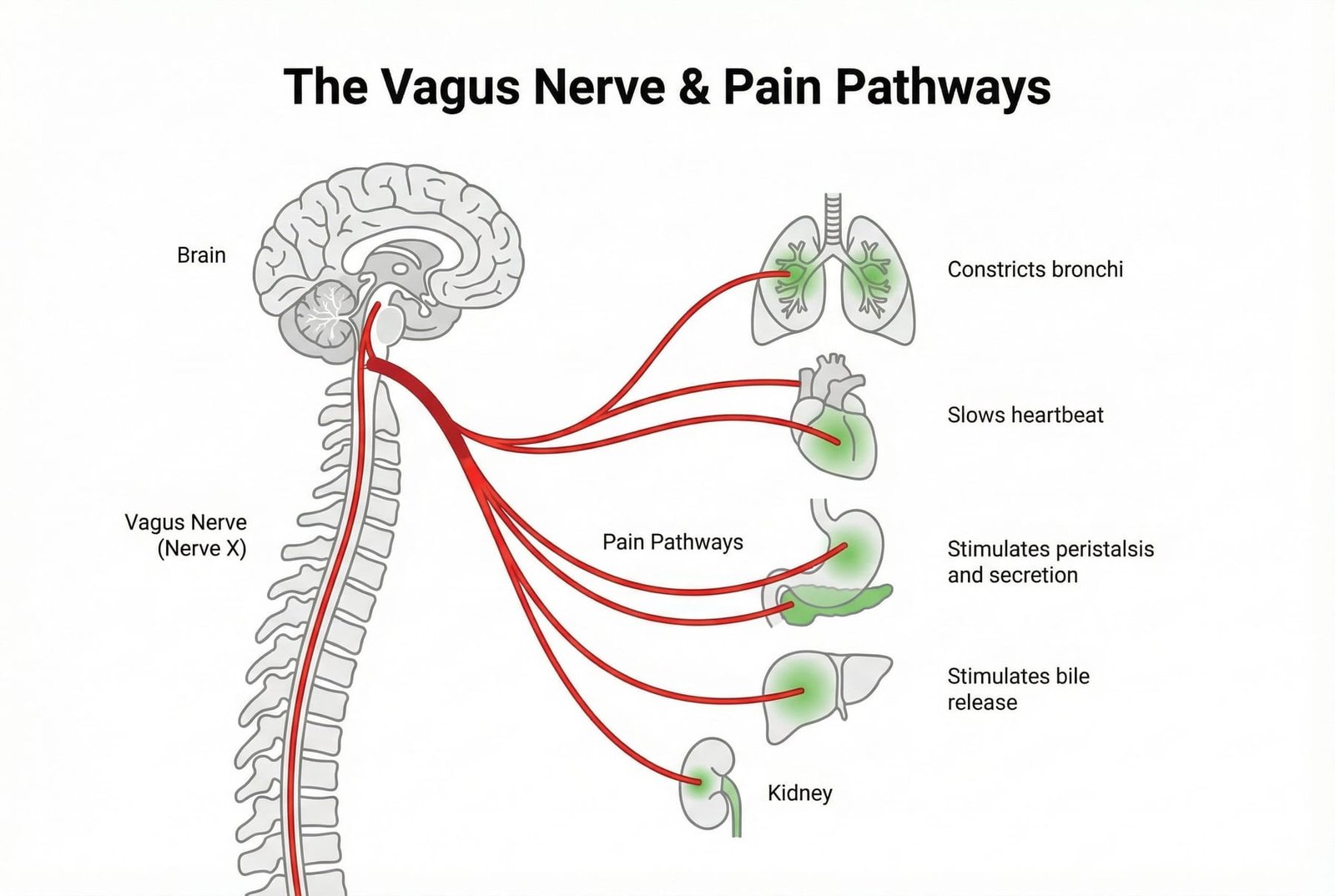
The Vagus Nerve & Pain Pathways
Vagal approaches are interesting in pain medicine because they intersect with central pain-modulation systems, autonomic regulation, and stress recovery. The clinical effect is likely indirect and system-wide rather than a simple local muscle effect.
Vagus Nerve
Vagal Afferents to the Brainstem
A large proportion of vagal fibers carry sensory information from the body to the brainstem. This is important because vagus-based interventions are often thought to work mainly by influencing central regulatory networks rather than by “relaxing a muscle directly.”
Connections With Descending Pain Systems
Vagal input interacts with brainstem systems involved in descending pain modulation, including noradrenergic and serotonergic pathways. This is one reason vagal therapies are discussed in chronic pain research, although the exact clinical significance varies by condition.
Connections With Mood, Attention, and Threat Processing
Vagal signaling is also linked to networks involved in mood, vigilance, stress reactivity, and interoception. In chronic pain, these domains often matter because they influence how pain is amplified, interpreted, and tolerated.
Inflammatory Reflex / Cholinergic Pathway
The vagus nerve is often discussed as part of the “inflammatory reflex,” a neural route by which the body may regulate inflammatory signaling. This is a compelling research area, but it should not be oversold as a direct or proven treatment pathway for myofascial pain.
Autonomic Rebalancing
The most practical clinical idea is that vagal strategies may help shift patients away from persistent sympathetic overactivation and toward better autonomic flexibility. This is relevant because chronic pain often coexists with poor sleep, shallow breathing, hypervigilance, and stress-related muscular guarding.
Heart Rate Variability (HRV) as a Marker
Heart-rate variability is often used as a rough marker of autonomic flexibility and vagal influence. It can be useful for tracking trends, but it should not be treated as a precise stand-alone measure of pain recovery.
Types of Vagus Nerve Stimulation
Vagal approaches range from implanted devices to non-invasive stimulation to breathing-based regulation practices. For myofascial pain patients, the lowest-risk and most accessible approaches are usually the most appropriate starting point.
Vagus Nerve
Invasive VNS (iVNS)
SurgicalInvasive vagus nerve stimulation uses an implanted device connected to the cervical vagus nerve. It is an established medical therapy in selected neurological and psychiatric conditions, but it involves surgery and specialist follow-up.
Transcutaneous Auricular VNS (taVNS)
Non-Invasive / EarAuricular approaches aim to stimulate the ear region supplied in part by vagal sensory fibers. These approaches are actively researched because they are non-invasive and easier to study in chronic pain populations than implanted devices.
Transcutaneous Cervical VNS (tcVNS)
Clinical DeviceExternal cervical vagus nerve stimulation devices are used clinically in some headache disorders and other selected indications. They are prescription-style medical devices rather than general self-care tools.
Respiratory Vagal Regulation
Accessible / Low RiskSlow, diaphragmatic breathing can increase parasympathetic influence and improve heart-rate variability in many people. It does not “stimulate the vagus nerve” in the same way a medical device does, but it is one of the safest and most practical ways to work with autonomic regulation.
Clinical Evidence for Pain
The evidence base remains mixed and indirect. Some chronic pain studies are promising, but direct evidence for myofascial trigger point pain is still sparse.
Chronic Pain & Neuromodulation Literature
Clinical OverviewNon-invasive vagal approaches are being studied across chronic pain conditions, but the evidence remains heterogeneous. Benefits appear plausible in some settings, but most data are still indirect or condition-specific rather than clearly transferable to myofascial pain.
Fibromyalgia / Widespread Pain Research
Clinical Trial / Pilot DataSome small studies suggest that vagal or autonomic-focused interventions may help subsets of patients with fibromyalgia or widespread pain, particularly in areas such as pain severity, stress, sleep, or well-being. These results should not be treated as direct proof for MPS.
Headache and Neuromodulation Research
Condition-Specific EvidenceDevice-based vagus-related stimulation has clearer evidence in some headache disorders than in myofascial pain. This is relevant mainly because cervical and headache syndromes often overlap with myofascial complaints, not because the evidence transfers cleanly.
Inflammation and Mechanistic Research
MechanisticMechanistic work supports a role for vagal pathways in inflammatory regulation, but moving from laboratory mechanism to meaningful clinical pain treatment remains a major leap.
Autonomic Dysfunction in Chronic Pain
Physiology / ObservationalChronic pain populations often show reduced autonomic flexibility and lower heart-rate variability compared with pain-free controls. This supports the idea that autonomic regulation is clinically relevant, even if it does not prove that VNS is the solution.
Current Bottom Line
Clinical SummaryFor myofascial pain specifically, the direct evidence is still limited. Vagal approaches are best framed as emerging adjunctive strategies rather than established frontline treatments.
Evidence Gap for myofascial pain
There are currently no large, definitive randomized trials establishing vagus nerve stimulation as a standard treatment for myofascial pain syndrome. The rationale is biologically plausible, but the clinical proof remains limited.
Practical Self-Regulation Techniques
Low-risk autonomic regulation practices can be reasonable additions to a broader pain plan. The goal is not to create a DIY neuromodulation experiment, but to support regulation, sleep, recovery, and symptom tolerance.
Slow Diaphragmatic Breathing
Practice slow, comfortable diaphragmatic breathing with a longer, unhurried exhalation. The goal is steady, calm breathing that reduces upper-chest tension and promotes a more settled autonomic state.
Practical use: Short, regular sessions once or twice daily are often more realistic than very long sessions.
Evidence: Good evidence supports breathing-based autonomic regulation and heart-rate variability improvement, even though it should not be confused with medical-device VNS.
Extended Exhalation Breathing
Some patients find it helpful to use a slightly longer exhalation than inhalation. The focus should remain on comfort and rhythm rather than on breath-holding contests or rigid counting.
Practical use: Best used gently, especially in anxious, dizzy, or highly sensitized patients.
Evidence: Physiologically plausible and clinically useful in many stress-amplified pain presentations.
Cooling the Face Briefly
Some clinicians use gentle face cooling or brief cold exposure as a way to shift autonomic state, but this should be conservative and comfortable rather than extreme.
Practical use: Use only brief, well-tolerated exposure and stop if it causes distress, dizziness, or symptom worsening.
Evidence: The physiological rationale is real, but this is best viewed as a short-term regulation tool rather than a core treatment.
Humming, Gargling, and Voice-Based Vagal Cues
Some low-risk voice and throat-based activities may help certain people feel calmer or more regulated. The likely value is modest and practical rather than dramatic.
Practical use: These work best as low-pressure habits, not as “must-do” medical protocols.
Evidence: Anatomically plausible, but formal outcome evidence is limited.
Device-Based taVNS
If an auricular vagal device is being considered, it should be selected and supervised in a proper clinical or research context rather than improvised at home.
Practical use: Follow clinician or manufacturer guidance only. Do not improvise settings or use unrelated devices for ear stimulation.
Evidence: Emerging evidence exists, but MPS-specific benefit remains unproven.
Meditation, Yoga, and Downregulation Practices
Mindfulness-based practices, yoga, and other parasympathetic-supportive routines may improve vagal tone indirectly by reducing arousal, improving breathing, and increasing autonomic flexibility.
Practical use: Regular practice matters more than intensity. Short, consistent sessions are often enough to be useful.
Evidence: There is good evidence that these practices can improve stress physiology and heart-rate variability in many patients.
The Autonomic Connection to Trigger Points
The autonomic nervous system is relevant to myofascial pain because chronic pain often coexists with sympathetic overactivation, poor sleep, shallow breathing, hypervigilance, and stress-related muscular bracing.
Why this matters: when the nervous system stays in a threat-biased state, muscles may remain more guarded, pain may feel more widespread, and flares may be easier to trigger. This does not mean the pain is “just stress.” It means autonomic state can amplify a real musculoskeletal problem.
The practical takeaway: interventions that improve parasympathetic flexibility — breathing, pacing, sleep support, stress regulation, and in selected cases neuromodulation — may help make the pain system less reactive overall.
The stress-pain loop: poor sleep, stress, shallow breathing, and pain often reinforce one another. This is one reason autonomic regulation deserves attention in chronic pain care even when the primary complaint is muscular.
Where VNS fits: device-based VNS should currently be viewed as an emerging area, while simple autonomic-supportive practices remain the most practical and lowest-risk way to apply this concept in everyday myofascial care.
The Stress–Autonomic–Pain Cycle
Stress / Poor Sleep
Higher overall arousal
Autonomic Shift
More sympathetic dominance
More Guarding / Pain
Muscles feel more reactive
Reduced Recovery
Cycle reinforces itself
Key Takeaways
- 1
The vagus nerve is central to parasympathetic regulation and is relevant to pain, stress, inflammation, and recovery.
- 2
Vagus-related interventions may help chronic pain by influencing autonomic balance, descending pain modulation, stress reactivity, and inflammatory signaling.
- 3
For myofascial pain syndrome specifically, the direct evidence remains limited and mostly indirect.
- 4
Non-invasive and low-risk approaches — especially slow breathing and broader autonomic regulation practices — are the most practical starting point for most patients.
- 5
Device-based vagus nerve stimulation should be treated as an emerging adjunctive area, not as a proven standard treatment for trigger points.
- 6
Heart-rate variability can be a useful marker of autonomic state, but it should be interpreted cautiously and in context rather than treated as a complete score of recovery.
Autonomic Regulation
The vagus nerve is central to parasympathetic tone and recovery physiology.
Stress Interaction
Vagal state may influence how strongly stress amplifies pain and guarding.
Pain Modulation
Vagal pathways interact indirectly with descending pain-control systems.
Inflammatory Signaling
Vagal pathways are relevant to neural regulation of inflammation, though the clinical translation remains incomplete.