Why Organization Helps
Treatment Framework
Overview IllustrationMyofascial pain treatment often works better when it is organized, rather than applied as a series of disconnected interventions. Many patients experience temporary relief from a useful treatment, only to have symptoms return because the broader picture was never addressed.
One practical way to think about care is in three stages: first, reduce trigger point irritability and calm the pain; second, work on movement, strength, and functional contributors; and third, decide what longer-term maintenance — if any — is actually needed. This is a way of organizing care, not a formal clinical pathway.
Treatment is often more effective when it addresses both the immediate pain and the broader factors that may be helping it persist.
In real practice, these stages often overlap. Some patients begin movement work almost immediately. Others need more time focused on symptom reduction first. Some need substantial attention to sleep, stress, and daily habits; others do not.
The key is using the framework to guide priorities, not to force care into a rigid timetable.
A Three-Stage Framework
Reduce Trigger Point Activity
Aim: Meaningful symptom improvement
- Manual Therapy
- Dry Needling
- Trigger Point Injections
- Shockwave (ESWT)
Work on Function
Aim: Better movement and tolerance for activity
- Movement & Motor Control
- Identifying Broader Contributors
- Gradual Return to Activity
Maintain and Adjust
Aim: Fewer and less severe recurrences
- Ongoing Strength & Movement
- Daily Habit Adjustments
- Attending to Contributing Factors
Stage 1 — Reducing Trigger Point Activity
Variable timing • Aim: Meaningful symptom improvement
The initial focus is often reducing the pain and irritability coming from active trigger points. Several treatment approaches may be used for this, and the choice depends on the patient’s preferences, the clinician’s training, symptom irritability, and what is realistically available.
For some patients, combining direct treatment with education about pain and symptom patterns is helpful — especially when the pain has become frightening, confusing, or recurrent.
Dry Needling
Insertion of thin needles into the trigger point area. Proposed mechanisms include local mechanical stimulation and changes in the local tissue environment, though the exact mechanism is still debated. It is commonly used for well-localized trigger points and may help some patients more than others depending on the muscle, irritability, and overall clinical context.
Shockwave Therapy (ESWT)
Acoustic energy delivered to the affected region. Proposed effects include mechanical stimulation and local biological signaling changes, though the exact mechanisms remain uncertain. It may be considered in selected chronic or treatment-resistant presentations, especially when the patient prefers a non-needle option.
Manual Therapy
Hands-on approaches such as sustained trigger point pressure, myofascial release, and selected massage-based techniques. Manual therapy is widely used as an early treatment option because it is accessible and often well tolerated. It can be useful for symptom reduction, but the exact technique, intensity, and frequency vary between clinicians and patients.
Trigger Point Injection
Injection of local anesthetic into a trigger point region. In some cases this is used when other direct approaches have not been enough, when several painful areas need treatment, or when deeper muscles are difficult to reach with simpler methods. The relative importance of the needle effect versus the medication effect is still debated.
Signs That May Suggest a Shift in Emphasis
Note: Some patients benefit from beginning gentle movement early; others need a slower ramp. The key is adjusting to the person’s irritability rather than forcing exercise simply because it is “time” to progress.
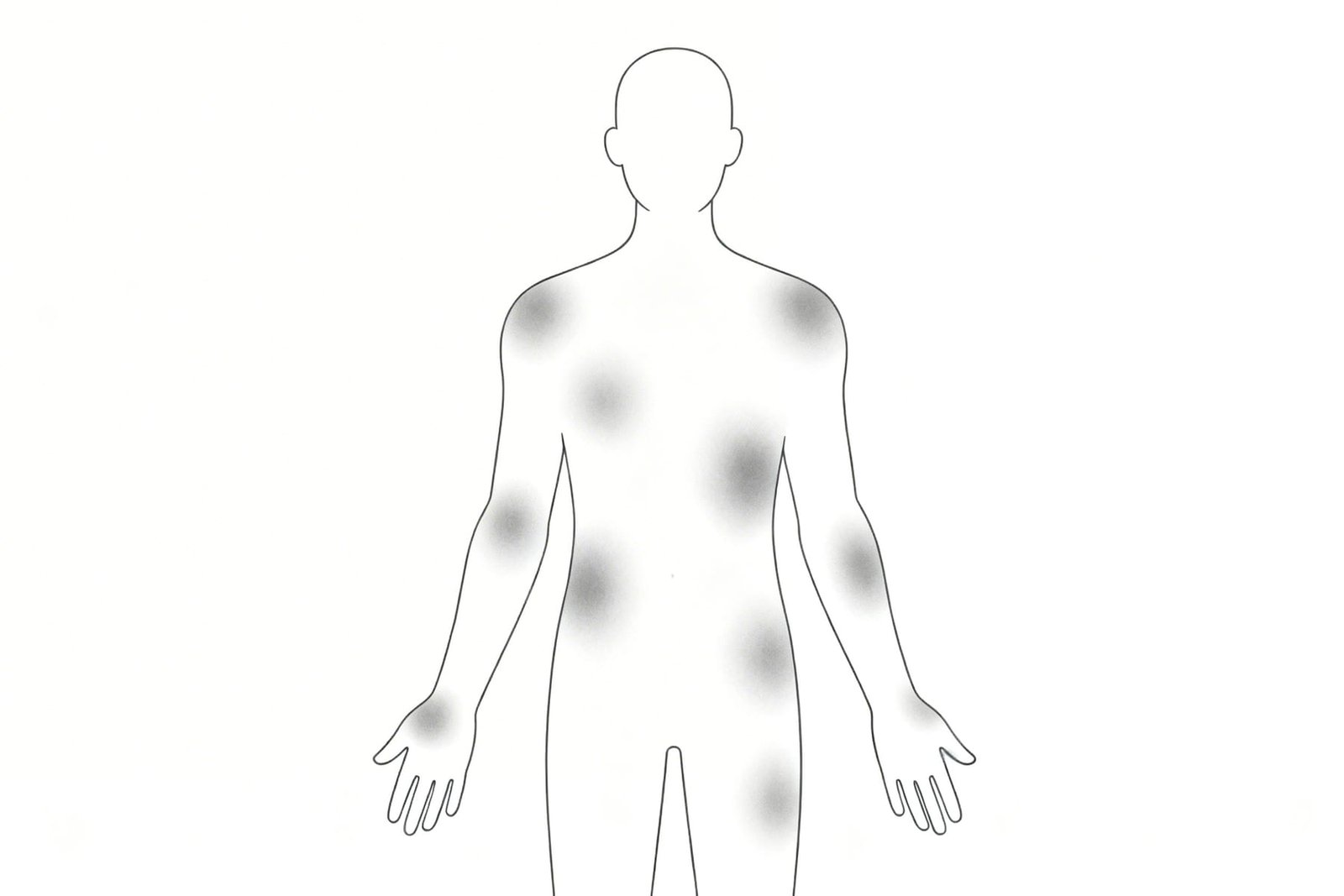
Three Phase Treatment Model
Stage 2 — Restoring Function
Variable timing • Aim: Functional movement, better tolerance for activity
As symptoms become more manageable, treatment often shifts toward restoring function. This may include movement retraining, strengthening, graded exposure to activity, and identifying why the painful muscles were overloaded in the first place.
This stage usually asks more active participation from the patient, but it should still be scaled to what the person can tolerate. The right pace depends on symptom behavior, confidence, and context.
Movement and Motor Control
Once symptoms are more manageable, treatment often shifts toward how muscles and body regions coordinate during movement. The aim is not “perfect movement,” but more efficient, less threatening, and more sustainable movement patterns. This can include specific exercises, breathing strategies, and graded exposure to activity.
Identifying Broader Contributors
Trigger points are often influenced by factors beyond the painful muscle itself: stiffness in nearby joints, weakness elsewhere in the chain, repetitive load, breathing patterns, or habitual movement strategies. Looking beyond the immediate pain site can help explain why symptoms keep returning.
Gradual Return to Activity
Many patients do best with a gradual return to normal movement and activity rather than a sudden jump back to full load. The appropriate pace depends on irritability, duration of symptoms, conditioning, and confidence in movement.
Signs That May Suggest More Long-Term Focus
Stage 3 — Longer-Term Maintenance
Ongoing as needed • Aim: Fewer and less severe recurrences
For some people, once pain settles and movement improves, no special ongoing maintenance is needed. For others — especially if symptoms have been recurrent or tied to obvious perpetuating factors — it helps to continue some amount of exercise, self-care, or habit adjustment.
Longer-term management is not about doing everything forever. It is about keeping the few things that clearly help, and dropping the rest.
Ongoing Strength and Movement
Muscles and patterns that have been prone to trigger points often benefit from continued strengthening, endurance work, and general physical activity. The exact balance of targeted exercises and general conditioning varies between individuals.
Adjusting Daily Habits
Workstation setup, sleep position, movement variety, repetitive tasks, and daily load distribution can all matter in recurrence. Not every patient needs large lifestyle changes, but these factors are often worth reviewing when symptoms keep returning.
Attending to Contributing Factors
Sleep quality, stress load, physical conditioning, and nutritional status are often discussed as contributors to symptom persistence. Their relative importance varies between patients, and the evidence for each factor differs in strength and specificity. Still, they are often worth considering, especially in recurrent or stubborn cases.
Indicators of Good Longer-Term Management
Moving Between Stages
Moving between stages is guided by response, not by a fixed calendar. It is normal to move forward gradually, overlap stages, or temporarily shift attention back to symptom reduction if pain flares.
That does not mean the plan failed. It usually means the emphasis needs adjusting.
- Symptoms are less reactive overall
- Gentle exercise is becoming more tolerable
- The patient can participate actively without major flare
- Pain is no longer the only priority
- There is enough stability to start building function
- Daily activity is more manageable
- Progressive movement work is tolerated reasonably well
- The patient has a clearer sense of recurring triggers
- Symptoms are less dependent on repeated passive rescue care
- The focus can shift more toward prevention and maintenance
Signs That May Suggest Adjusting the Pace
Treatment Transition Criteria
Common Patterns to Watch For
Stopping after initial relief
Initial symptom relief is important, but for some patients it is only the beginning. If symptoms were longstanding, recurrent, or clearly linked to movement and habit factors, stopping too early may increase the chance of recurrence.
Loading too aggressively too early
Some patients improve quickly with graded movement; others flare if load is increased too fast. Matching the pace to the person’s actual tolerance usually works better than following a rigid schedule.
Not considering contributing factors
When trigger points improve temporarily but keep coming back, it is often worth reassessing posture, sleep, stress, work demands, or movement habits rather than repeating the same local treatment indefinitely.
Relying only on passive treatments long-term
Passive treatments can be very helpful, especially early on. But for many patients, lasting improvement depends at least partly on active strategies such as movement, strength, pacing, and self-management. The exact balance varies by individual.
Key Takeaways
Summary
Myofascial pain treatment is often easier to navigate when symptoms, function, and longer-term contributors are considered together rather than in isolation. This three-stage framework is one useful way to think about that process. It is not fixed, not universal, and not required in every case — but it can help organize priorities and expectations in a more practical way.