Understanding the Proprioceptive-MPS Cycle
Proprioceptive Training
The MPS Cycle OverviewProprioception is the body’s ability to sense position, movement, and load without needing to look. It depends on receptors in muscles, joints, tendons, and skin, as well as the nervous system’s ability to interpret those signals accurately.
Myofascial pain can disturb that system. Trigger points, guarding, stiffness, and altered movement patterns change how the body interprets position and load. In response, the nervous system often recruits more muscle activity to protect the area — which may further overload tissues and reactivate trigger points.
This helps explain why a patient may feel better after manual therapy or needling, yet have the same problem return. If the movement strategy and body-position sense do not improve, the same overload pattern often comes back.
Proprioceptive training matters because it helps the patient rebuild confidence, control, and more accurate movement. In many cases, that is what makes the benefits of other treatments last longer.
Key Training Regions
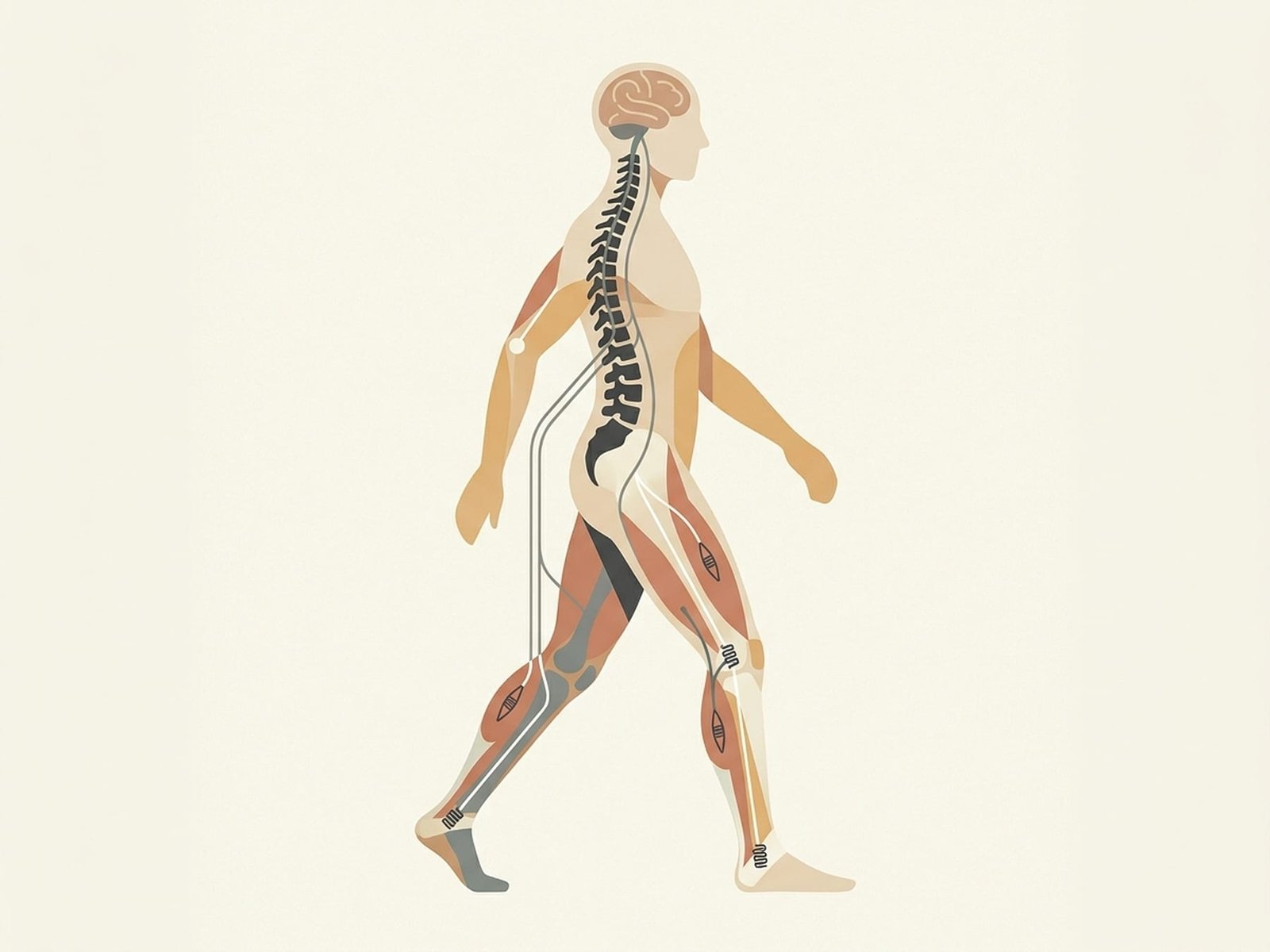
The most important proprioceptive targets in MPS are usually the regions that stabilize the neck, trunk, shoulder, hip, ankle, and lower limb during everyday movement.
Key Proprioceptive Training Regions
Body MapDeep Cervical Flexors & Cervical Proprioception
Ankle & Foot Stabilizers
Lumbar Multifidus & Trunk Stabilizers
Hip Stabilizers & Pelvic Control
Rotator Cuff & Scapular Proprioception
Better Position Sense
The body becomes more accurate at sensing where the joint or region is in space.
Less Protective Overactivation
The nervous system may rely less on constant guarding and co-contraction.
Improved Movement Quality
Movement becomes more efficient, controlled, and repeatable.
Lower Recurrence Risk
When the movement pattern improves, the same tissues are less likely to be overloaded again.
How Proprioceptive Deficits Perpetuate Trigger Points
When proprioception is impaired, the body often increases co-contraction and protective muscle activity. That extra muscular work may be exactly what keeps trigger points active.
This is why recurrent MPS is often less about “tight muscles” alone and more about repeated stabilization demand in the wrong tissues at the wrong time.
A trigger point often returns because the body still does not trust the movement pattern around it.
Cervical Control
important in recurrent neck MPS
Single-Leg Balance
high-yield lower-chain screen
Trunk & Hip Stability
often central to low-back and gluteal recurrence
Assessment & Screening
Balance and position-sense screening should be practical, safe, and matched to the patient’s age, symptoms, and fall risk.
Single-Leg Stance Test
Cervical Joint Position Error Test
Star Excursion Balance Test
Romberg Progression
Training Protocols
Proprioceptive training usually works best when it progresses from simple and safe toward more dynamic and task-specific, rather than jumping directly to unstable surfaces or difficult drills.

Exercise Progressions
Difficulty Continuum DiagramCervical Joint Position Training
In selected neck-pain patients, cervical repositioning work can help improve head-position awareness, reduce guarding, and support deeper neck control.
- Use simple head-repositioning drills when cervical proprioception seems impaired
- Start with easier, low-threat motions and short sets
- Use feedback when possible rather than guessing
- Progress by reducing visual input or adding small challenges only when tolerated
- Combine with deep neck flexor and postural work rather than using it alone
Single-Leg & Ankle Stability Progression
Ankle and balance retraining can reduce compensatory overuse farther up the chain, especially in patients with old sprains, plantar pain, or lower-limb instability.
- Start on stable surfaces before using foam or unstable surfaces
- Progress from eyes open to reduced visual input only when safe
- Track asymmetry rather than only chasing arbitrary time targets
- Use perturbations later, not as the starting point
- Pair balance work with strength and walking mechanics when relevant
Lumbar Stabilization & Deep Trunk Activation
When low-back trigger points keep returning, rebuilding trunk control can be as important as local treatment. The aim is to reduce the stabilizing burden on overworked global muscles.
- Use bird-dog, dead bug, anti-rotation, and similar low-threat trunk control drills
- Prioritize neutral control and repeatability over complexity
- Add unstable surfaces only if they clearly improve training quality
- Do not assume instability tools are always superior to solid-floor work
- Measure progress by function and symptom behavior, not novelty
Hip & Shoulder Proprioceptive Circuit
Hip and shoulder proprioceptive exercises are often useful when patients have recurrent upper- or lower-chain trigger points driven by poor positional control rather than simple weakness alone.
- Use single-leg hip control drills for gluteal and pelvic stability
- Use shoulder joint-position and scapular control work when upper-quarter symptoms recur
- Combine proprioception with strengthening rather than separating them too rigidly
- Progress toward task-specific movement rather than endless basic drills
- Stop advancing if form breaks down or symptoms escalate
- 01Early Phase
Stable-surface drills, supported single-leg work, and simple joint-position practice.
- 02Middle Phase
Reduced visual input, longer holds, and more dynamic reach or limb movement.
- 03Advanced Phase
Unstable surfaces, perturbations, and more task-specific challenge where appropriate.
- 04Return-to-Function Phase
Integrate balance and proprioception into sport, work, gait, and real-world movement.
Red Flags — When to See a Doctor
Most balance and proprioceptive training is low-risk, but significant neurological signs, severe dizziness, or unsafe fall risk must change the plan immediately.
Trigger points and proprioceptive deficits can reinforce each other: pain changes movement, and poor movement keeps reloading the same tissues.
Proprioceptive training is often one of the missing pieces in patients whose trigger points keep returning after short-term relief.
Single-leg balance, cervical joint-position sense, trunk control, and shoulder or hip proprioception are common clinical targets.
The best programs progress from simple to complex based on safety, tolerance, and movement quality — not on novelty alone.
Proprioceptive work usually creates the best results when combined with strength, mobility, and manual treatment rather than used in isolation.