Is This for Me?
Pilates is not automatically right for every person at every stage. The timing depends on pain irritability, diagnosis, and whether the body is ready for controlled movement work.
People with posture-related myofascial pain
Desk workers and sedentary individuals
People with poor trunk or hip control
Patients in the “restore function” phase
Phase 1: Deactivation / Symptom Control — Early phase
Phase 2: Early Movement — As irritability settles
Phase 3: Foundation Building — Progressive phase
Phase 4: Integration / Maintenance — Longer-term phase

Pilates Treatment Timeline
Deactivation to IntegrationWhy Pilates Can Help in MPS
Pilates often works well in myofascial pain because it combines breathing, mobility, alignment, trunk control, and low-to-moderate progressive loading in a single system.
Pilates is often most useful not because it is magical, but because it combines breathing, control, mobility, and stability in one coherent practice.
Core stability can reduce compensatory loading
Controlled movement restores motor patterns
Breathing work may reduce upper-quarter tension
Mobility work complements release therapy
It addresses common perpetuating factors
Integrating Release Work with Pilates
A useful principle is: release first, then move, then build strength. Releasing a region and then moving it well often works better than either approach alone.
The Release-Move-Strengthen Sequence
A short period of self-release before Pilates can help reduce local irritability and make movement feel easier, but it should stay brief and conservative.
Release · Short pre-session preparation
Many people do best when they start with a brief period of self-release or tissue preparation before Pilates. This can reduce local irritability and make movement feel safer.
Key Points
- Use self-release conservatively, not aggressively
- Focus on the areas that are most relevant to the session
- The goal is calmer tissue, not bruised tissue
- A few minutes is often enough
- This works best when followed by movement rather than used alone
Move · The main Pilates session
Pilates then uses controlled movement to reinforce better range, sequencing, and muscular coordination while the body is in a less guarded state.
Key Points
- Start the movement session while symptoms feel calmer
- Emphasize quality over quantity
- Choose exercises that match the current pain stage
- Stop short of sharp or clearly escalating pain
- Movement is the bridge between symptom relief and function
Strengthen · Progressive loading over time
The long-term goal is not just mobility — it is better capacity. Pilates can help build the endurance, control, and tolerance needed to reduce recurrence.
Key Points
- Progress slowly
- Endurance often matters as much as raw strength
- Use progressively harder variations only when the basics are tolerated
- Long-term resilience depends on capacity, not just short-term relief
- This phase often blends with broader strengthening outside Pilates too
Release-Move-Strengthen Sequence Diagram
Key Exercises for MPS
The following exercises are commonly useful because they target the movement deficits and guarded patterns often seen in myofascial pain. They still need to be modified to the individual.
Props That Enhance Therapy
Props can reduce load, add feedback, improve support, or increase challenge in a more controlled way.
Pilates Ring (Magic Circle)
The ring can provide low-load feedback and resistance for adductor, abductor, chest, and postural activation work.
How to Use
- Gentle adductor or abductor activation
- Postural awareness drills
- Light resistance for upper-body control work
- Feedback for alignment and muscle engagement
Foam Roller
A foam roller can be used both for self-release before Pilates and as an unstable surface during selected exercises.
How to Use
- Pre-session self-release
- Thoracic extension support
- Balance challenge in simple supine work
- Support or positioning aid in modifications
Massage Balls
Massage balls allow more focused self-release than a foam roller and are often used before Pilates sessions.
How to Use
- Upper back and shoulder-girdle self-release
- Gluteal and hip self-release
- Chest-wall work when appropriate
- More focal work than a roller allows
Resistance Bands
Resistance bands can make exercises more accessible or more challenging while keeping the load gradual.
How to Use
- Glute and hip activation
- Assisted mobility or roll-up variations
- Rotator cuff or scapular control work
- Breathing or ribcage awareness cues
Stability Ball (Swiss Ball)
A stability ball adds instability and can be used for trunk control, supported strength work, and lower-load movement exploration.
How to Use
- Supported trunk and hip work
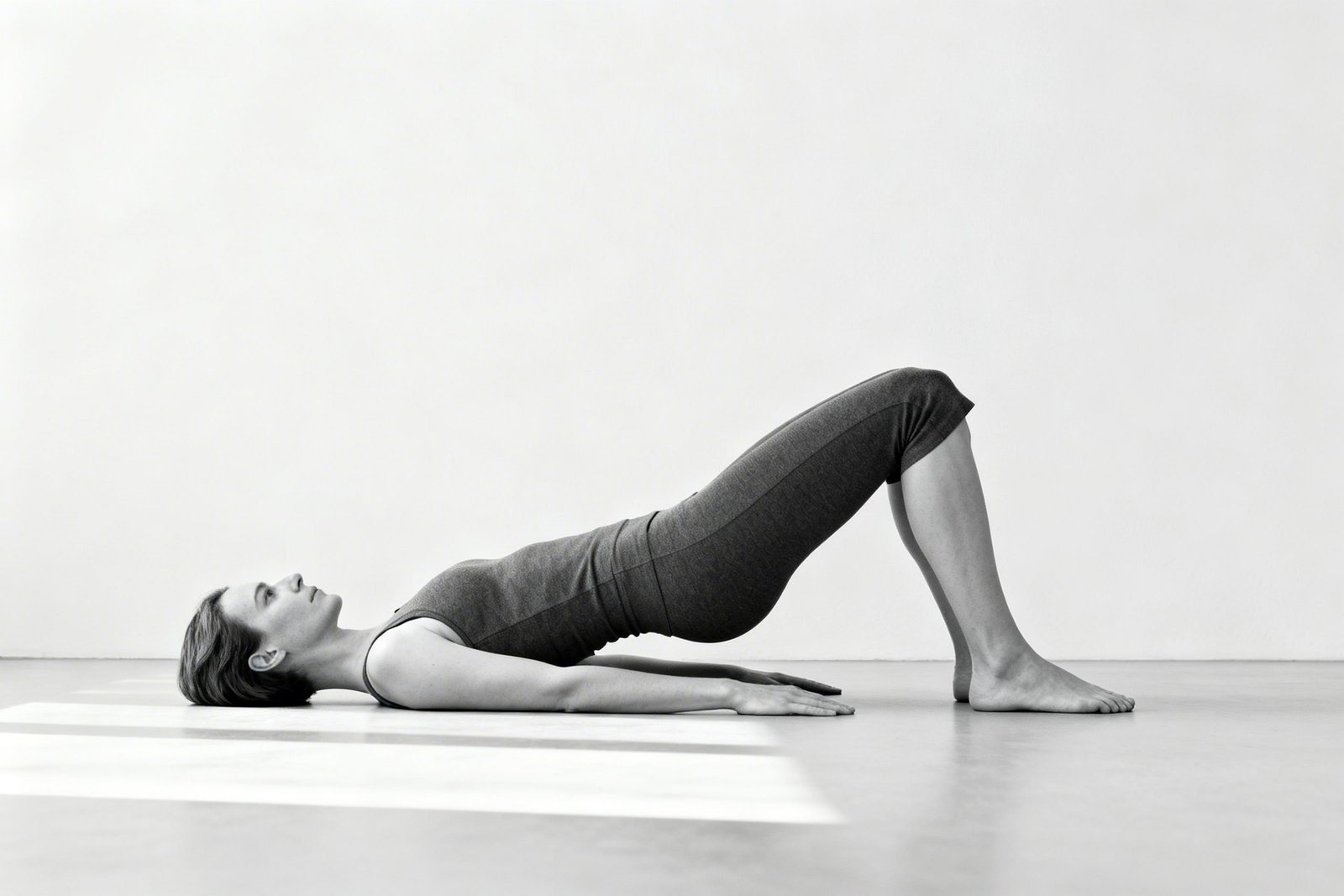
- Bridge progressions
- Wall-supported lower-body exercise
- Balance and proprioceptive challenge
Safety Considerations & Contraindications
Pilates is usually safe when it is modified well, but some situations require more caution, slower progression, or a temporary pause.
Pacing Guidance
Good pacing is one of the most important reasons Pilates succeeds or fails in people with trigger points and chronic myofascial pain.
Session Structure
Frequency
Progression: Mat to Reformer
Finding the Right Instructor
Sample Beginner Protocol
This 4-week progression is an example, not a rigid rule. Some patients move faster, some slower, and some need longer in the foundation phase.
Weeks 1-2: Foundation · 2x per week, shorter sessions
Focus: Breathing, spinal awareness, and low-threat movement
Session Exercises
- Brief self-release if needed5-10 min
- Breathing practice2-3 min
- Pelvic Tilts3-4 min
- Windscreen Wipers3-4 min
- Book Opening4-5 min
- Gentle trunk or shoulder control work5-8 min
Session Notes
Keep everything low-threat. Reduce range and duration quickly if symptoms rise.
Weeks 3-4: Build · 2-3x per week if recovery is good
Focus: More trunk control, mobility, and integrated movement
Session Exercises
- Self-release as needed5-10 min
- Breathing with trunk engagement2-3 min
- Pelvic Tilts / Bridge progression4-5 min
- Thread the Needle4-5 min
- Modified Neck Pull or cervical control work3-4 min
- Swimming (modified)4-5 min
- Spine Stretch / thoracic mobility sequence4-5 min
Session Notes
Add complexity only if the previous week was well tolerated. The goal is better control, not more exhaustion.
Release Before You Move
A short period of self-release before Pilates often improves comfort and makes the movement work more effective.
Core Stability Is a Major Reason Pilates Helps
Pilates can reduce compensatory loading by improving trunk and hip control, especially in posture- and sitting-related pain patterns.
Breathing Matters
Breathing is not a side detail. It often changes how tense, guarded, or overloaded the upper body feels during movement.
Progress Slowly
Consistency matters more than intensity. Start smaller than you think and progress only when recovery between sessions is good.
Monitor Pain Carefully
A temporary sense of muscle work is fine; clearly rising or lingering pain is a sign to reduce range, load, or complexity.
The Right Instructor Matters
An instructor who understands pain, pacing, and modification is far more valuable than one who simply teaches the classical repertoire well.
Continue Learning
Exercise Guide
A broader guide to exercise approaches for myofascial pain beyond Pilates alone.
Physical Therapy
How physiotherapy fits into a broader myofascial recovery plan.
Strength Training for Pain
How progressive strengthening supports long-term resilience once symptoms are calmer.
Yoga for Pain
Another movement-based approach that may complement trigger point treatment.
Foam Rolling Tools
A guide to self-release tools often used before Pilates sessions.