What Is Percussive Therapy?
Percussive therapy uses rapid repetitive contact from a handheld device to stimulate soft tissue. Many people use massage guns for warm-up, recovery, and short-term symptom relief.
What matters most is not the marketing language, but how the device affects pain, tissue tolerance, and movement in the real world.
Short-Term Sensory Modulation
Increased Local Blood Flow
Tissue Warm-Up and Movement Preparation
Possible Gate-Control Contribution
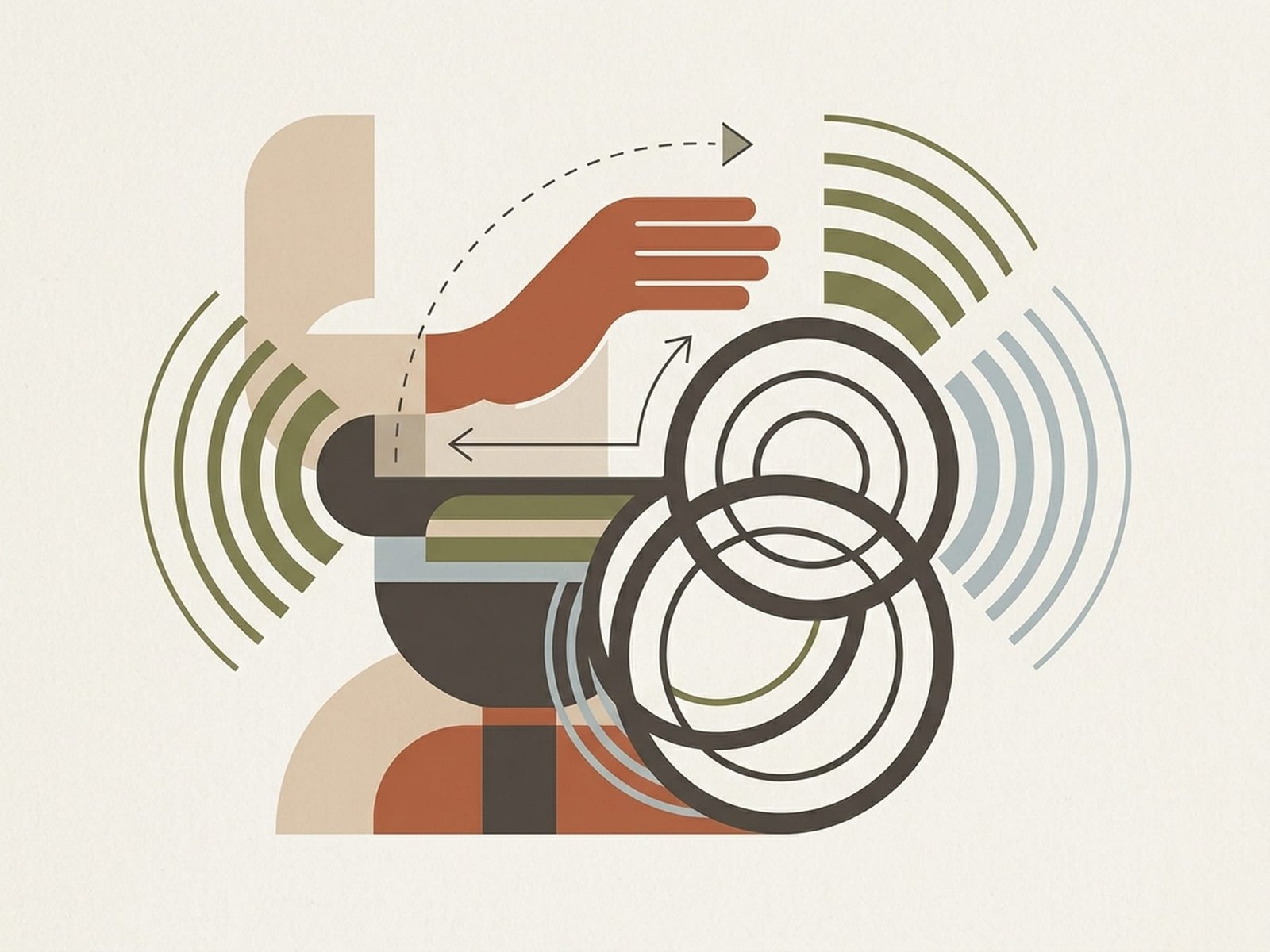
How Percussive Therapy Reaches Muscle Tissue
The Evidence Base
The research is strongest for delayed-onset muscle soreness, short-term range of motion changes, and short-term symptom relief. Evidence is thinner for chronic trigger point resolution specifically.
Massage guns are best understood as short-term self-care tools for symptom modulation and movement preparation — not as miracle devices.
Reduced DOMS Severity
The most cited evidence for massage guns sits in post-exercise soreness and short-term recovery contexts rather than chronic trigger point pathology. Most studies are small and short-term, so this should be read as a reasonable supportive use rather than as definitive proof.
Improved Range of Motion
Several small studies suggest short-term gains in range of motion after percussion, but study sizes are modest and effects tend to be brief. This is one practical reason people use percussion before activity, not evidence of lasting tissue change.
Short-Term Pain Relief
Massage guns can provide short-term symptom relief for some people. The relevant studies are mostly small and short-duration, and the effect should not be mistaken for structural correction.
Chronic Trigger Point Resolution
Direct evidence for long-term resolution of chronic trigger points using massage guns alone remains limited. They are better framed as an adjunctive self-care tool than as a definitive treatment.
Choosing a Device
The best device is the one you can use comfortably, consistently, and safely. Expensive devices are not automatically necessary.
Premium
$300-400Theragun PRO, Hypervolt 2 Pro
- Usually stronger motors and better ergonomics
- Often quieter under load
- More attachment options and guided-app features
- Better battery life and build quality
- High cost for a tool that many people will only use occasionally
- Heavier devices may be harder for some users to hold comfortably
Mid-Range
$200-300Theragun Prime, Hypervolt 2
- Often the best balance of price, power, and usability
- Usually enough amplitude and force for most users
- Commonly quieter and more comfortable than budget models
- Works well for general recovery and maintenance
- May still be more expensive than some people need
- May lack premium ergonomic features
Budget
$80-150Ekrin B37, Bob & Brad Q2 Mini
- Affordable entry point
- Usually enough for general soreness and lighter self-care
- Often lighter and simpler to use
- Good for trying the modality before investing more
- Usually less powerful on denser muscle groups
- May be louder under load
- May have shorter battery life and lower build quality
Mini / Travel
$150-250Theragun Mini, Hypervolt Go 2
- Easy to carry and store
- Useful for travel, office, or gym bag use
- Often quieter and easier to handle one-handed
- Good for smaller regions and brief routines
- Not ideal for deep or very dense tissues
- Usually less effective on larger muscle groups
- Portability can come at the expense of power
Key Features to Compare
- Amplitude (Stroke Length) — Higher amplitude usually means the device feels more percussive and may reach deeper tissue more effectively.
- Stall Force — This reflects how easily the device slows under pressure. More is not always necessary, but very low force may limit usefulness on larger muscle groups.
- Battery Life — Longer battery life matters mostly for frequent users.
- Noise Level — Quieter devices are easier to use regularly.
- Attachment Heads — Different heads matter because they change how focused or broad the force feels.
- Weight & Ergonomics — A device that is too heavy or awkward will be used less, regardless of its specs.
Attachment Heads Guide
Attachment choice changes how broad, deep, or focal the treatment feels. Softer and broader attachments are usually the safest place to start.
Standard Ball
General use on larger muscle groups such as quads, hamstrings, glutes, and lats.
Use moderate speed and keep the device moving slowly rather than drilling into one point for too long.
Less ideal for precise trigger points or areas close to bone.
Flat Head
Broader surface contact over flatter muscle regions such as pectorals or larger shoulder girdle areas.
Use for sweeping strokes and less focal work, especially when you want a gentler feel than a bullet head.
Not useful for pinpoint treatment and uncomfortable directly over bony areas.
Bullet / Pointer
More focal work on small areas when a clinician has already helped you identify the general target region.
Use lower speed and lighter pressure than most people think. Brief contact is usually enough.
Avoid aggressive use, especially near bone, nerves, the neck, or any uncertain anatomy.
Fork / U-Shape
Regions where you want to work alongside a structure rather than directly on it, such as paraspinal areas.
Use cautiously and keep the prongs on soft tissue rather than on the structure you are trying to avoid.
Do not treat it as permission to work directly over the spine or tendon insertions.
Dampener / Cushion
Sensitive regions, beginners, and people who bruise or flare easily.
A good starting option when you are unsure how reactive the area will be.
May feel too soft for people expecting very focal deep-tissue input.
Wedge
Some contour-following body regions such as around the shoulder blade or lateral thigh.
Use for controlled gliding rather than scraping aggressively.
Too much pressure with a wedge can make sensitive tissue more reactive rather than less.
Technique by Body Region
Different body regions tolerate percussion differently. Large, muscular areas are generally more forgiving than small, sensitive, or anatomically crowded areas.
Neck & Upper Traps
Low speed onlyThe neck is a high-caution region. Many people are better served by stretching, heat, or clinician-guided manual care rather than aggressive percussion here.
- Limit treatment to the upper trapezius and back of the neck musculature if a clinician has already said self-care is appropriate.
- Use the weight of the device rather than pushing down.
- Keep the device moving and stay conservative.
- Never use on the front or sides of the neck.
- Never use directly on the cervical spine.
- Stop immediately if you provoke dizziness, visual symptoms, or radiating arm symptoms.
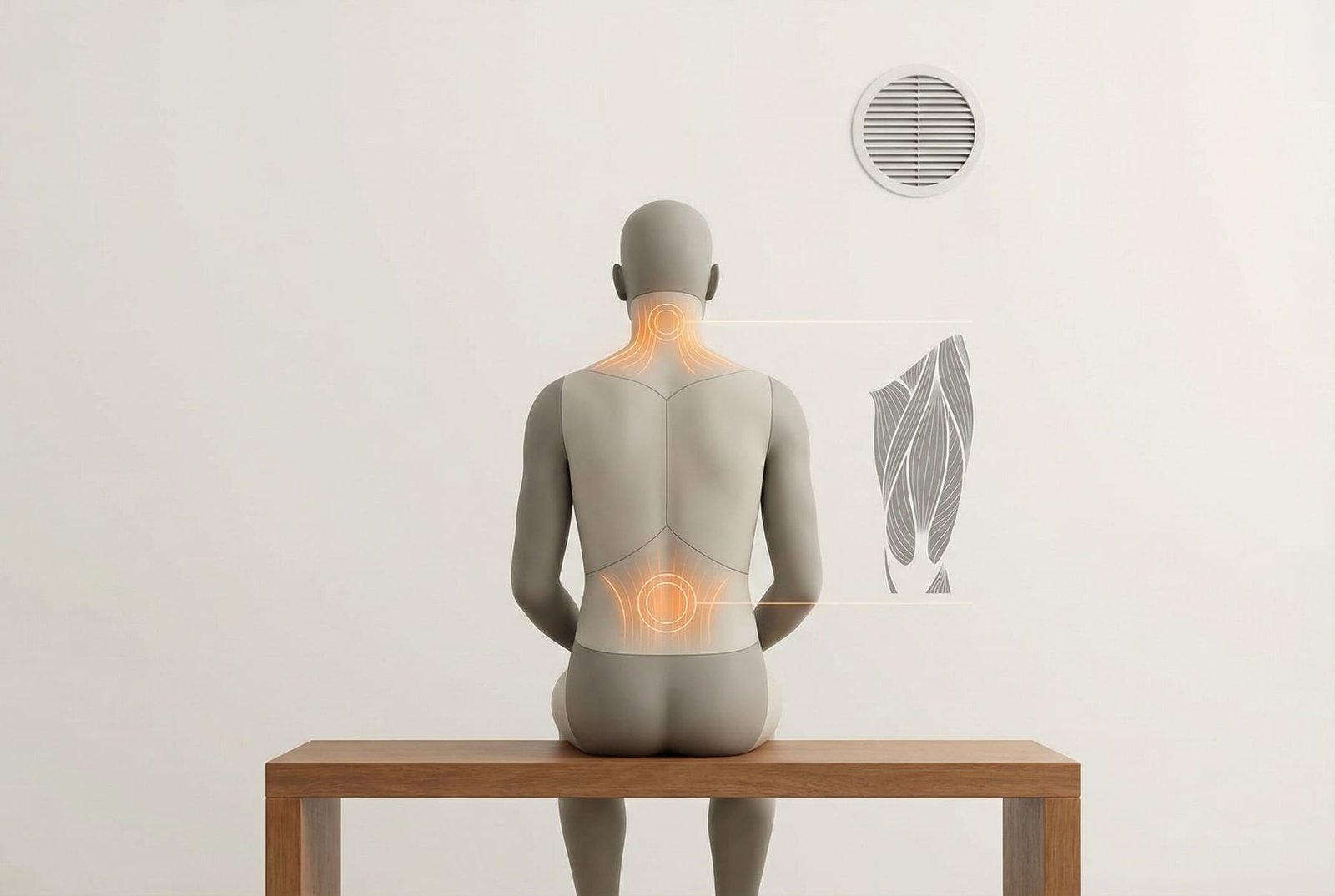
Body Region Technique Reference Diagram
Percussion vs. Foam Rolling vs. Manual Therapy
No single method is best for everything. Percussion, foam rolling, and hands-on care each have different strengths.
Percussive Therapy (Massage Gun)
Short bouts of self-care, generalized muscle soreness, and some selected trigger point-adjacent work when the target area is straightforward and low-risk.
Foam Rolling (SMR)
Broad tissue work over larger muscle groups and fascial chains rather than precise point treatment.
Manual Therapy (Hands-On)
Complex, deep, persistent, or diagnostically unclear cases where skilled assessment matters as much as treatment.
Safety & Contraindications
Massage guns are generally safe when used well, but they are still powerful devices. Using them in the wrong area or with the wrong intensity can make symptoms worse.
30–60s
60–90s
90–120s
Sample Protocols
The best protocol is usually the simplest one that the tissue tolerates and that fits the moment — warm-up, recovery, local symptom modulation, or relaxation.
Pre-Workout Warm-Up
A few minutes totalUse percussion briefly as a preparation tool rather than as deep treatment before training.
Speed Setting
Duration Per Area
Attachment
Technique
Follow With
Post-Workout Recovery
Short recovery sessionUse for short-term soreness management and recovery support after training.
Speed Setting
Duration Per Area
Attachment
Technique
Follow With
Trigger Point–Focused Session
Brief local treatmentThis should remain conservative. The goal is reducing local reactivity, not hammering a painful point into submission.
Speed Setting
Duration Per Trigger Point
Attachment
Technique
Follow With
Bedtime Relaxation
Short calming routineA lighter, quieter routine aimed more at downregulation than at tissue “release.”
Speed Setting
Duration Per Area
Attachment
Technique
Follow With
Start Lower Than You Think
Most people use too much speed or pressure at first. Conservative use is usually safer and often more effective.
Respect Time Limits
Longer or harsher treatment is not automatically better. Short, controlled sessions are usually enough.
Attachment Choice Matters
Different heads change how force is delivered. Use broader heads for broader tissue and reserve focal heads for selected low-risk regions.
Know the No-Go Zones
The front of the neck, spine, vascular regions, and medically uncertain areas are not appropriate targets for casual percussion.
Use It as a Tool, Not a Cure
Massage guns may help short-term pain modulation and tissue comfort, but they do not replace good diagnosis, rehabilitation, or clinician-guided care.
Movement Still Matters
Percussive therapy often works best when paired with stretching, mobility, strength work, or other active recovery strategies.
Continue Learning
Self-Myofascial Release
A broader guide to self-treatment methods including balls, pressure release, and manual self-care.
Foam Rolling Tools
How foam rollers, massage balls, and similar tools compare with percussive devices.
Physical Therapy
When self-treatment is not enough and a clinician-guided plan is needed.
Stretching Fundamentals
How stretching can complement self-treatment instead of competing with it.