A superficial micro-injection approach sometimes used for localized musculoskeletal pain in selected clinical settings
§ 01
What Is Mesotherapy?
Mesotherapy Treatment
Overview Diagram
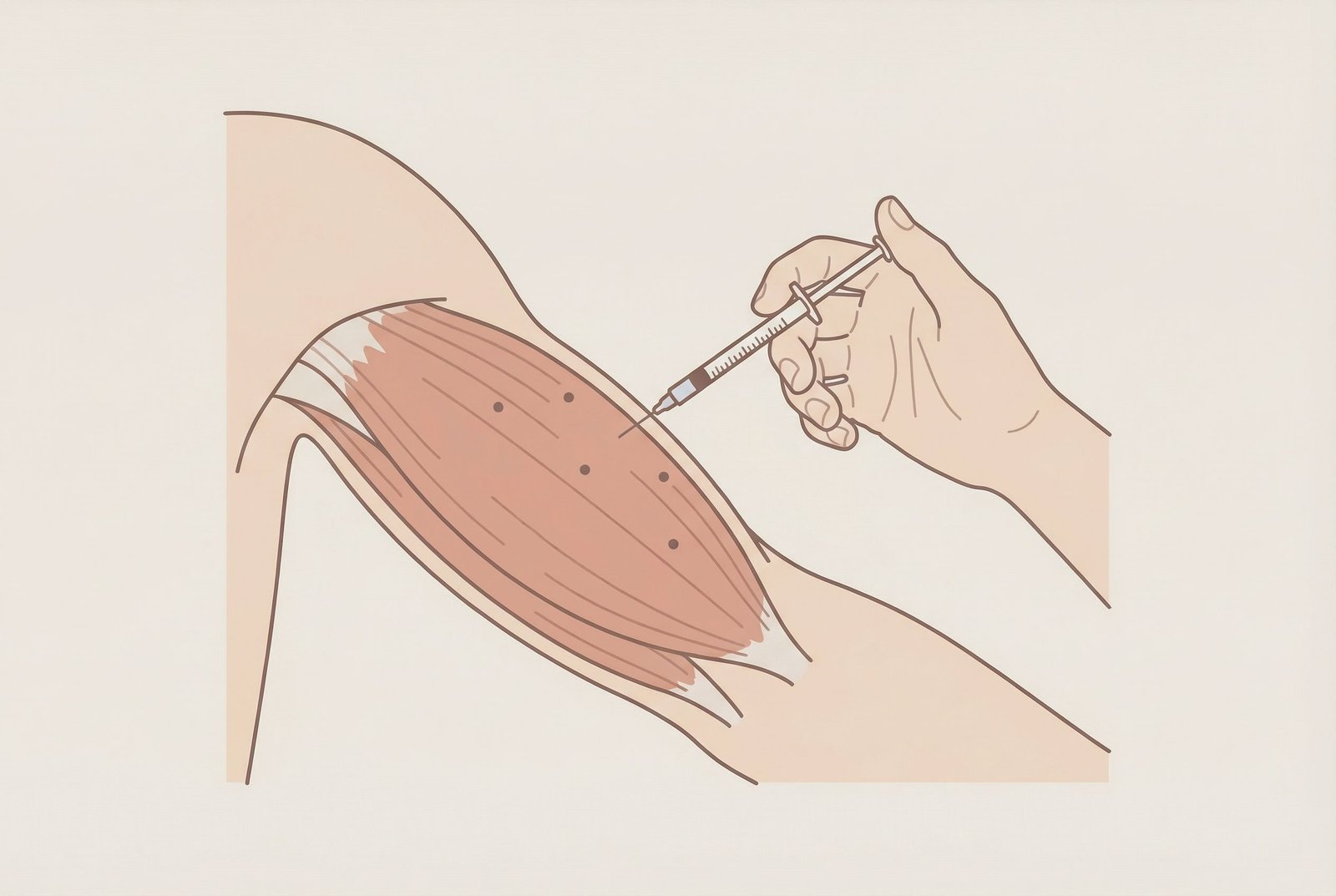
Mesotherapy is a minimally invasive injection technique in which small amounts of medication are placed superficially into or just beneath the skin over a painful area. It originated in France and became more established in parts of Europe and Latin America than in many English-speaking countries.
Its traditional guiding principle is often summarized as "little, rarely, in the right place" — meaning a relatively small amount of medication delivered locally and selectively rather than as a large systemic treatment.
In myofascial pain discussions, mesotherapy is sometimes presented as a way to combine local medication effect with the sensory effects of repeated superficial needling. The practical question for patients is not the theory alone, but whether the treatment is being offered in a trained, medically appropriate setting.
§ 02
Mechanisms of Action
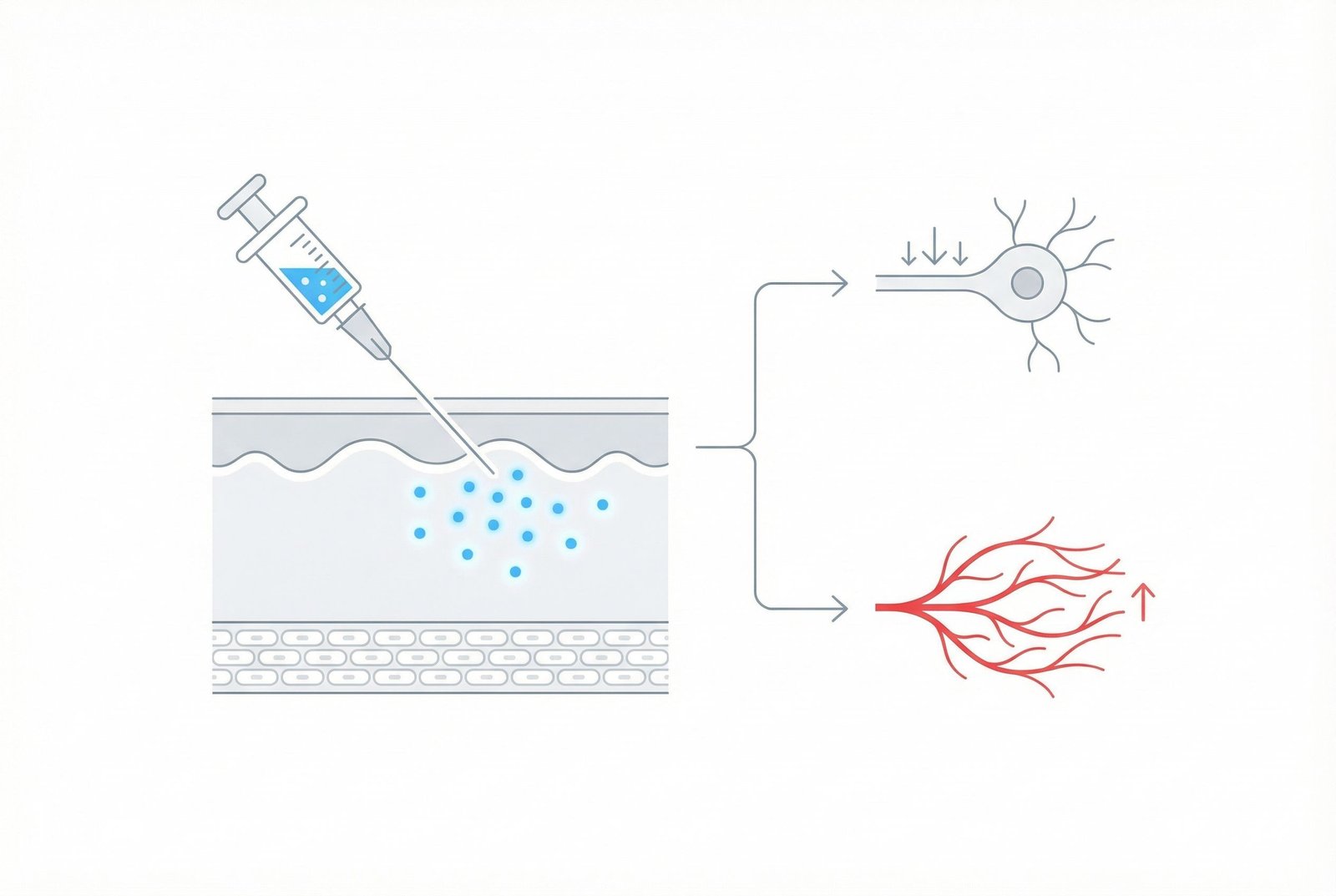
Mesotherapy is typically explained through a combination of localized pharmacology, repeated needle input, and regional tissue effects. These mechanisms are plausible, but they should be presented with appropriate caution rather than as settled fact.
The main clinical idea behind mesotherapy is simple: use a localized superficial injection strategy for selected regional pain states while trying to limit systemic exposure.
Mechanisms of Action
Mechanism Diagram
01
Localized Pharmacological Effect
Mesotherapy is discussed as a way to deliver small amounts of medication into superficial tissues overlying a painful region. The main clinical rationale is localized treatment with lower systemic exposure than oral medication.
02
Needle-Mediated Analgesic Effect
Because mesotherapy involves many superficial needle insertions, some of the short-term effect may come from the same broader sensory and neuromodulatory mechanisms discussed in other needling-based therapies.
03
Segmental / Neuroreflexive Rationale
Some mesotherapy traditions describe benefits through segmental and neuroreflexive effects. This is part of the conceptual framework used by practitioners, but it should be presented as a treatment model rather than as a universally proven mechanism.
04
Local Circulation and Tissue Tolerance
Mesotherapy is also sometimes discussed as a way to influence local circulation, sensitivity, and tissue tolerance. In practical terms, clinicians use it as a localized pain-management procedure rather than as a deep structural intervention.
§ 03
Cocktail Concepts
Mesotherapy formulations vary widely. Patients should understand the broad therapeutic intent of a cocktail, not memorize recipes. The exact agents and amounts belong to the treating clinician’s protocol and local standards.
Analgesic-Oriented Cocktail
Traditional
Local anesthetic + anti-inflammatory + supportive adjuncts
Traditional mesotherapy often uses a multi-agent mixture chosen by the treating clinician. The exact ingredients, concentration, and rationale vary by country, training tradition, and patient presentation.
Anti-Inflammatory-Oriented Cocktail
Acute
Local anesthetic + anti-inflammatory agents
Some practitioners choose a more inflammation-focused mixture when the painful region appears locally irritated. These choices are procedural and clinician-directed rather than suitable for self-management.
Chronic / Regenerative-Oriented Cocktail
Chronic
Local anesthetic + supportive adjuncts
In more chronic pain settings, some clinicians use formulations intended to support longer-term tissue recovery or symptom modulation. The evidence here is more variable and less standardized.
Spasm-Oriented Cocktail
Spasm
Local anesthetic + muscle-directed adjuncts
For presentations dominated by tightness or spasm, some practitioners use mixtures intended to reduce local irritability and muscle guarding. The exact choice is highly clinician-dependent.
Myofascial Pain-Focused Cocktail
Specialist
Multi-agent specialist formulation
Many mesotherapy practices use a customized combination aimed at pain, local sensitivity, and related factors. Because formulations vary widely, the broad concept is more important for patients than the exact recipe.
§ 04
Technique & Equipment
Mesotherapy technique varies by device, depth, pattern, and treatment area. These procedural details matter to practitioners, but from a patient perspective the key questions are safety, clinician training, and whether the approach fits the condition being treated.
Technique & Equipment
Step-by-Step Illustration
Injection Devices
01
Mesotherapy Gun / Automated Injector
Some clinicians use an automated multi-injection device to deliver many superficial microinjections quickly and consistently. This is mainly relevant to practitioner technique rather than to patient decision-making.
02
Manual Syringe Technique
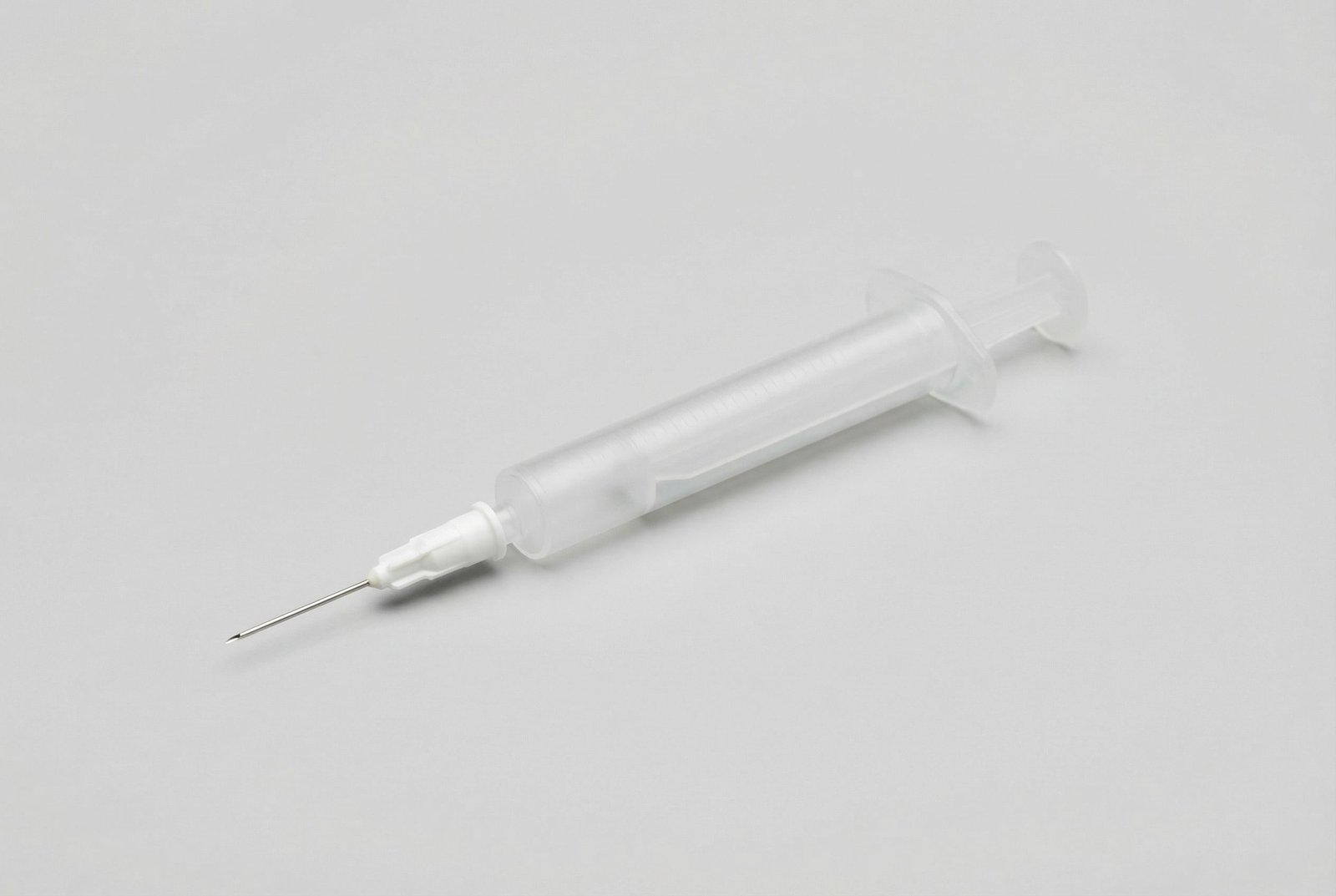
Other clinicians use a standard syringe and manually control the location and amount of each injection. This approach is often chosen when the target area is smaller or more focal.
Needle Specifications
01
Fine-Gauge Needles
Mesotherapy generally uses fine needles designed for superficial placement and lower tissue trauma than deeper intramuscular approaches.
02
Variable Needle Length
Needle choice depends on the intended tissue depth, the body region, and practitioner preference. Patients generally do not need the exact dimensions unless discussing comfort or safety.
Injection Depths
01
Superficial / Intradermal Placement
Classic mesotherapy emphasizes very superficial placement rather than deep intramuscular needling. This is one reason it is often framed as less invasive than conventional trigger point injection.
02
Slightly Deeper Superficial Placement
Some approaches target tissue just beneath the dermis when the goal is broader local spread rather than direct intramuscular delivery.
Injection Patterns
01
Point-by-Point Technique
A more focal technique in which the practitioner places injections at selected clinically relevant points across a painful region.
02
Nappage / Blanket Technique
A broader pattern in which many small superficial injections are distributed across an entire painful area rather than only a few focal points.
03
Very Superficial Technique
Some practitioners use a very superficial method when the primary goal is sensory modulation rather than deeper tissue targeting.
Session Protocol
01
Micro-Volumes Per Point
The defining procedural idea in mesotherapy is that each injection uses a very small amount — typically fractions of a millilitre per point — repeated across multiple sites. Precise volumes vary by compound, site, and practitioner protocol.
02
Treatment Course
Mesotherapy is often delivered as a short series rather than a one-time treatment. The number of sessions depends on the diagnosis, the product used, the patient’s response, and the clinician’s protocol.
§ 05
Evidence Base
Mesotherapy has a supportive but still limited evidence base in musculoskeletal pain. The literature is strongest in some European settings, but protocol heterogeneity remains a major limitation.
01
Costantino et al. (2011)
Randomized Controlled TrialFrequently cited as supportive evidence that mesotherapy may provide localized pain relief with lower systemic exposure than oral NSAID-based care in selected musculoskeletal pain states.
02
Paolucci et al. (2016)
Randomized Controlled TrialOften cited in support of mesotherapy for neck and musculoskeletal pain, though protocol differences between studies make broad generalization difficult.
03
Mammucari et al. (2012)
Multicenter Observational StudyObservational literature often reports favorable short-term outcomes and a low rate of major adverse events when the procedure is performed in trained settings.
04
Cacchio et al. (2009)
Controlled Clinical TrialComparative literature suggests mesotherapy may be a useful alternative or adjunct to other needling-based approaches in selected cases, especially for short-term symptom control.
05
Review-level literature
Narrative reviews and consensus statementsAvailable reviews generally conclude that mesotherapy is promising for localized musculoskeletal pain but still limited by heterogeneous protocols and the need for stronger standardized trials.
§ 06
Comparison: Mesotherapy vs Other Needle Therapies
Mesotherapy sits somewhere between topical pharmacology and deeper needling procedures. Its strongest distinction is the use of superficial localized medication delivery rather than direct deep target injection.
Parameter
MesotherapyTrigger Point InjectionDry NeedlingAcupuncture
Depth
Superficial
Direct focal injection
Variable, often deeper than mesotherapy
Variable
Substance
Multi-agent clinician-selected formulation
Usually single-agent local anesthetic or related injection strategy
One of the main attractions of mesotherapy is the possibility of achieving localized treatment with less systemic exposure than oral medication.
02
Multi-Agent Strategy
Practitioners may combine several pharmacologic aims in one procedure rather than relying on a single injected agent. This is part of the appeal, but it also contributes to the lack of standardization.
03
Potentially Fewer GI Effects Than Oral NSAIDs
Because treatment is localized rather than systemic, mesotherapy is often discussed as an option when oral NSAIDs are poorly tolerated. This benefit depends on the exact agents used and should not be generalized too aggressively.
04
More Superficial Than Deep Injection Therapies
Mesotherapy is often considered less invasive than deeper intramuscular procedures because the target tissue is more superficial.
05
Broad Area Coverage
In diffuse pain regions, the ability to cover a larger area superficially is one of the practical reasons some clinicians consider mesotherapy rather than more focal injection strategies.
§ 08
Limitations
01
Variable Practitioner Training
Training quality and procedural philosophy vary widely between countries and practitioner groups. This is one of the biggest practical limitations of mesotherapy outside its more established regions.
02
No Standardized Protocols
Cocktail composition, technique, session frequency, and target depth are not standardized internationally. This makes the literature harder to compare and the clinical practice harder to reproduce.
03
Limited High-Quality RCTs
The evidence base is supportive but still limited by small studies, regional concentration of research, and heterogeneous treatment protocols.
04
Limited Recognition Outside Europe and Parts of Latin America
Mesotherapy is much more established in some countries than others. That affects practitioner availability, insurance coverage, and how seriously the treatment is regarded in mainstream pain care.
§ 09
Safety Profile & Side Effects
Mesotherapy is usually described as relatively safe in trained hands, but it is still an injection procedure. Aseptic technique, correct product use, and clinician training are essential.
Contraindications
Contraindications
Active local infection at the treatment site — Injection into infected skin or tissue should be avoided because it can worsen or spread infection.
Known allergy to formulation components — Any known allergy to the intended agents is a contraindication unless an alternative clinician-approved formulation is chosen.
Anticoagulant therapy or bleeding tendency — This does not always prohibit treatment, but bruising and bleeding risk are increased and require clinician judgment.
Pregnancy — Pregnancy is generally treated cautiously because mesotherapy formulations and procedural safety are not standardized enough to assume routine use is appropriate.
Significant immunosuppression — Immunosuppression can increase infection risk and may change the risk-benefit balance of any injection procedure.
Uncontrolled seizure disorder or major instability relevant to planned drugs — Any condition that materially changes drug or procedural risk should be reviewed before treatment.
How Mesotherapy May Help
Localized Drug Delivery
Superficial placement of small amounts of medication in the painful region.
Needle-Mediated Sensory Effects
Repeated superficial puncture may contribute to short-term analgesic or modulatory effects.
Regional Tissue Response
Local circulation and tissue tolerance may be influenced in some patients.
Multi-Agent Strategy
Some clinicians use multiple pharmacologic aims in one localized procedure.
Key Takeaways
01
Mesotherapy is a superficial micro-injection technique used in some pain practices for localized musculoskeletal pain.
02
Its main appeal is localized treatment with potentially lower systemic exposure than oral medication.
03
The treatment is less standardized than many other pain procedures, which is both one of its attractions and one of its main evidence limitations.
04
Supportive evidence exists, but protocols vary too much to present mesotherapy as a universally established standard for MPS.
05
The procedure should only be performed by trained clinicians using appropriate medical products and sterile technique.
06
Mesotherapy is best framed as a selective adjunctive interventional option, not as a routine default treatment for all trigger points.
Bottom line:Mesotherapy is a localized micro-injection strategy used in some chronic pain settings, especially for regional musculoskeletal pain. It may offer practical advantages in selected patients, but it remains less standardized and less universally accepted than more established pain procedures.