01
Reference dashboard
HILT vs LLLT comparison dashboard
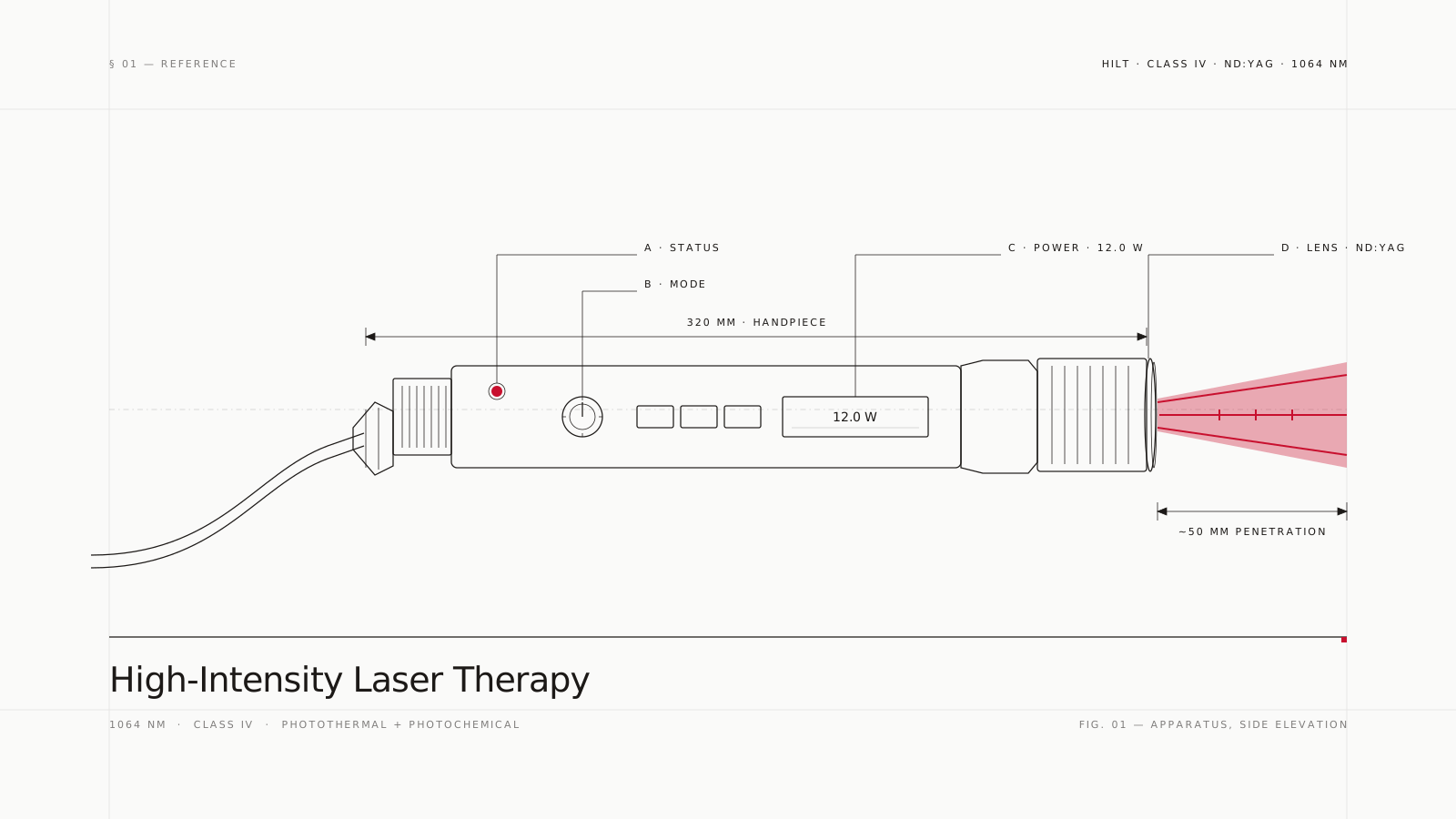
Compare High-Intensity Laser Therapy (e.g., iLux Smart, 1064 nm class IV) and Low-Level Laser Therapy devices side-by-side: power, wavelength, penetration, dose, and outcomes from musculoskeletal pain RCTs.
12
Devices
1.6–25 W
HILT range
5–800 mW
LLLT range
12
RCT entries
02
What this dashboard compares
HILT and LLLT differ in three orders of magnitude on average power output, but they also differ in wavelength, pulse structure, and treatment dose. The tables below let you sort and filter the most clinically common platforms (e.g. ASA iLux Smart and Hiro, K-Laser Cube, LightForce, BTL-6000, plus LLLT references like THOR LX2, MR4 ACTIV, BioFlex) and cross-reference them against the dose / wavelength used in published RCTs.
How to read the numbers
- 01Peak power applies to pulsed emission (super-pulse devices reach kW peaks at very short duty cycles).
- 02Average power is what reaches the tissue across the whole session and drives dose calculations.
- 03Penetration depth is the depth at which 1/e of the surface fluence remains; longer wavelengths (1064 nm) penetrate further than visible red.
- 04Energy density (J/cm²) is the dose actually applied to the tissue — WALT recommends 4–10 J/cm² for LLLT, 8–14 J/cm² is typical for HILT.
HILT devices in view
5
Class IV
LLLT devices in view
6
Class IIIB
Avg power (HILT)
14.5 W
45 mm — typical depth
Avg power (LLLT)
259 mW
27 mm — typical depth
03
Filter devices
Class
Wavelength band
Max average power
Search
04
Device specifications
12LightForce XLR8 Enovis / LightForce · FDA IV Up to 25 W deep-tissue therapy; influence-mode pulsing. | HILT Continuous · Pulsed | 810 / 980 nm | 25 W | 25 W | 40 mm | 8–20 J/cm² | 3–10 min |
K-Laser Cube 4 K-Laser USA · FDA IV Four-wavelength dynamic emission; 970 nm targets water. | HILT Continuous · Pulsed · ISP | 660 / 800 / 905 / 970 nm | 15 W | 15 W | 40 mm | 6–12 J/cm² | 4–10 min |
BTL-6000 High Intensity Laser BTL Industries · FDA IV Nd:YAG-class 1064 nm; common in European RCTs. | HILT Continuous · Pulsed | 1064 nm | 12 W | 12 W | 45 mm | 8–14 J/cm² | 8–12 min |
Hiro TT (HILT) ASA Laser · FDA IV High peak power (kW), short duty cycle; 1064 nm. | HILT Pulsed (super-pulse) | 1064 nm | 3.0 kW | 10.5 W | 50 mm | 10–12 J/cm² | 10–15 min |
iLux Smart ASA Laser · FDA IV Nd:YAG-equivalent 1064 nm; chromophore-selective heating with cooling tip. | HILT Continuous · Pulsed | 1064 nm | 12 W | 10 W | 50 mm | 8–14 J/cm² | 8–15 min |
MLS M6 ASA Laser · FDA IIIB/IV Patented dual-wavelength locked emission; bridges LLLT and HILT. | MLS Synchronised continuous + pulsed | 808 / 905 nm | 75 W | 3.3 W | 35 mm | 4–8 J/cm² | 10–15 min |
Intelect Laser Chattanooga / DJO · FDA IIIB Common rehab clinic LLLT; 980 nm option for deeper targets. | LLLT Continuous · Pulsed | 660 / 830 / 980 nm | 500 mW | 500 mW | 30 mm | 4–8 J/cm² | 3–10 min |
Apollo Cold Laser Pivotal Health · FDA IIIB Mid-range LLLT at the upper edge of Class IIIB output. | LLLT Continuous · Pulsed | 810 / 830 nm | 500 mW | 500 mW | 30 mm | 4–8 J/cm² | 2–8 min |
BioFlex Pro Meditech BioFlex · FDA IIIB Cluster array allows higher delivered fluence per session. | LLLT Continuous + cluster array | 660 / 830 nm | 300 mW | 300 mW | 30 mm | 4–10 J/cm² | 10–20 min |
THOR LX2 THOR Photomedicine · FDA IIIB WALT-protocol reference device for many MSK pain RCTs. | LLLT Continuous | 660 / 810 nm | 200 mW | 200 mW | 30 mm | 4–6 J/cm² | 1–5 min |
Multi Radiance MR4 ACTIV Multi Radiance Medical · FDA IIIB Super-pulsed 905 nm peaks (kW range) with very low average power. | LLLT Super-pulsed + cluster | 660 / 875 / 905 nm | 25 W | 50 mW | 30 mm | 4–8 J/cm² | 1–3 min |
Erchonia PL5 Erchonia · FDA IIIB Low-output cold laser; FDA-cleared for several MSK indications. | LLLT Pulsed (sweep) | 635 / 405 nm | 5 mW | 5 mW | 10 mm | 0.5–2 J/cm² | 10–20 min |
05
HILT vs LLLT at a glance
HILT — Class IV
e.g., iLux Smart, Hiro TT, K-Laser Cube, LightForce, BTL-6000
- Average power
- 1.6–25 W
- Peak power (pulsed)
- Up to 3 kW (super-pulse)
- Wavelengths
- 808 / 905 / 970 / 980 / 1064 nm
- Penetration
- 40–50 mm (1064 nm best)
- Typical dose
- 8–14 J/cm²
- Session length
- 8–15 min
- Mechanism
- Photothermal + photochemical (selective heating)
- Best for
- Deep MSK pain — LBP, knee OA, shoulder, plantar fasciitis
LLLT — Class IIIB
e.g., THOR LX2, MR4 ACTIV, BioFlex, Erchonia, Apollo, Intelect
- Average power
- 5 mW – 800 mW
- Peak power (pulsed)
- Up to 25 kW super-pulsed (very short)
- Wavelengths
- 405 / 635 / 660 / 810 / 830 / 904 nm
- Penetration
- 10–30 mm
- Typical dose
- 4–10 J/cm² (WALT)
- Session length
- 1–20 min
- Mechanism
- Photochemical (cytochrome c oxidase / ATP)
- Best for
- Superficial tendinopathy, neck pain, wound healing
06
Clinical outcomes — RCT evidence
Condition
Class
| Citation | ||||||||
|---|---|---|---|---|---|---|---|---|
| Chronic low back pain | HILT | 1064 nm Nd:YAG (Hiro) | 1064 | 12 | 12 | 73% | 12 | Alayat MS et al., Lasers Med Sci 2014;29(3):1065-73. |
| Plantar fasciitis | HILT | 1064 nm HILT | 1064 | 12 | 12 | 70% | 4 | Cinar E et al., Lasers Med Sci 2018;33(5):949-58. |
| Knee osteoarthritis | HILT | 1064 nm HILT | 1064 | 12 | 12 | 67% | 6 | Kheshie AR et al., Lasers Med Sci 2014;29(4):1371-6. |
| Chronic low back pain | HILT | 1064 nm HILT | 1064 | 11 | 15 | 65% | 3 | Fiore P et al., Eur J Phys Rehabil Med 2011;47(3):367-73. |
| Subacromial impingement | HILT | 1064 nm HILT | 1064 | 10 | 10 | 65% | 3 | Santamato A et al., Phys Ther 2009;89(7):643-52. |
| Chronic neck pain | HILT | Hiro 1064 nm | 1064 | 10 | 10 | 60% | 4 | Salli A et al., Lasers Med Sci 2010;25(5):743-9. |
| Chronic neck pain | LLLT | THOR-class 830 nm | 830 | 5.4 | 14 | 55% | 12 | Chow R et al., Lancet 2009;374(9705):1897-908 (meta-analysis). |
| Subacromial impingement | MLS | MLS 808/905 nm | 905 | 6 | 10 | 55% | 4 | Angelova A, Ilieva EM. Folia Med 2016;58(2):99-104. |
| Frozen shoulder | LLLT | BioFlex 660/830 nm cluster | 830 | 6 | 12 | 50% | 8 | Ip D, Fu NY. Clin Interv Aging 2015;10:1257-61. |
| Plantar fasciitis | LLLT | 830 nm LLLT | 830 | 8 | 8 | 45% | 12 | Macias DM et al., J Foot Ankle Surg 2015;54(5):768-72. |
| Tendinopathy (mixed) | LLLT | WALT-protocol 820–904 nm | 904 | 4 | 10 | 40% | 4 | Bjordal JM et al., BMC Musculoskelet Disord 2008;9:75. |
| Knee osteoarthritis | LLLT | 904 nm super-pulsed (MR4-class) | 904 | 6 | 9 | 38% | 4 | Kingsley JD et al., Lasers Med Sci 2014;29(4):1357-64. |
!
Effect-size caveats
VAS reduction percentages are point estimates from the cited papers and reflect the intervention arm change, not always the between-group difference vs sham. Heterogeneity across studies (dose, sessions, control type) limits direct head-to-head comparison. Use this dashboard for orientation; verify against the underlying paper before clinical decisions. Dose ranges follow WALT (LLLT) and IFU guidance (HILT) and are not a substitute for device-specific protocols.
07
Why power and wavelength both matter
Wavelength determines which chromophore absorbs the photon. 1064 nm sits in the “optical window” with low absorption by water and haemoglobin, allowing it to reach the deep paraspinals or rotator cuff with usable fluence. 808–830 nm targets cytochrome c oxidase efficiently but attenuates faster. 660 nm is largely superficial.
Power determines how much energy you can deliver per unit time without the session running into clinical impracticality. A 200 mW LLLT probe needs ~50 s/cm² to deliver 10 J/cm²; a 10 W HILT delivers the same dose in a single second — which is why HILT sessions can paint over multiple cm² in 8–15 min while LLLT spot-treats fewer points.
Pulse structure (super-pulsed peaks vs continuous wave) shifts the balance between photochemical and photothermal effects. Most modern HILT platforms (and MLS) deliberately combine both modes within a single protocol.
Devices do not live on a strict HILT/LLLT binary. MLS systems and some super-pulsed Class IIIB platforms occupy a middle band: low average power but very high peak power. The class label tells you regulatory tier; the dose, wavelength, and session structure tell you what actually reaches the tissue.
Reference dashboard · 12 DEV · 12 RCT