What Is Fascia?
The body's continuous connective tissue web
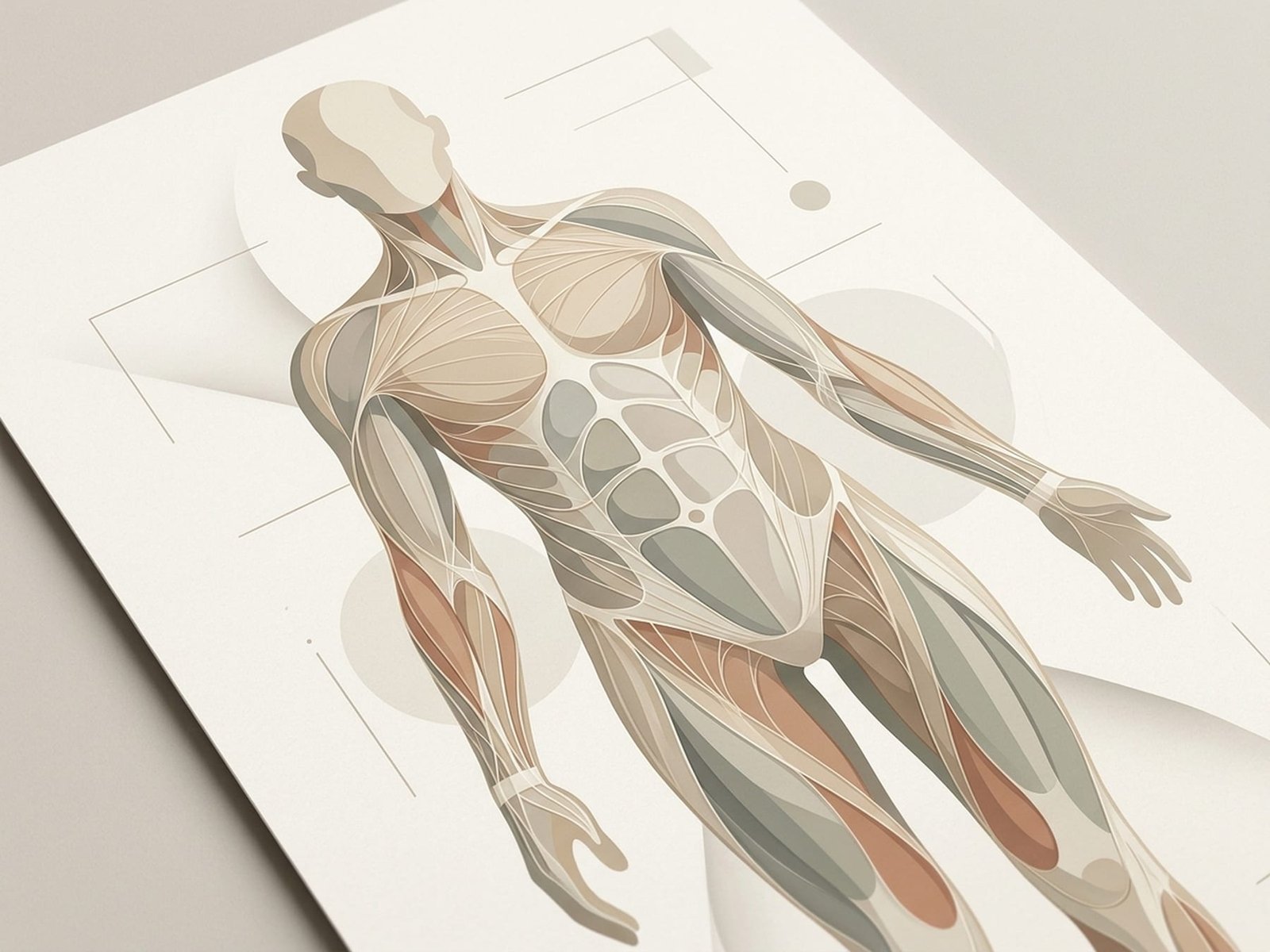
Fascial Web Overview
Layers from Skin to BoneIf you could isolate the body's connective tissue framework, you would still see a remarkably complete scaffold of your overall form — muscles, organs, bones, and compartments all shaped by that web. Fascia is that pervasive.
Fascia is not just wrapping material — it is a continuous connective tissue network running throughout the whole body.
Fascia is a continuous sheet of connective tissue composed primarily of collagen fibers, elastin, and a ground substance rich in water, hyaluronic acid, and proteoglycans. It surrounds, penetrates, and connects every muscle, bone, nerve, blood vessel, and organ in the body without a clear hard stop. Think of it as part of the biological fabric that helps hold you together.
For decades, fascia was often treated as mere "packing material" — the white tissue surgeons passed through to reach other structures. Modern research has changed that view substantially. Fascia is now understood as a sensory, mechanical, and biologically active tissue that likely plays an important role in force transmission, posture, proprioception, and pain.
The Spider Web Analogy
Imagine a three-dimensional spider web stretching throughout your body. If you pull on one part of that web, tension redistributes elsewhere. This is a useful analogy for fascia: a tensional network in which one area can influence another. A restriction in the ankle does not guarantee a shoulder problem, but it can alter how force and movement are managed through the rest of the system.
Three Types of Fascia
Superficial Fascia
Just beneath the skin
A loose, areolar connective tissue layer that lies directly beneath the dermis. It stores fat and water, cushions the body, and allows the skin to glide over deeper structures. Think of it as part of the body's built-in padding and insulation layer.
Key fact: Contains many sensory nerve endings, making it responsive to touch, pressure, and temperature.
Deep Fascia
Surrounding muscles, bones, nerves, and blood vessels
A dense, organized connective tissue that wraps around individual muscles (epimysium), groups of muscles (intermuscular septa), and entire body compartments. It is generally tougher and less compliant than superficial fascia, helping transmit mechanical forces and maintain structural integrity.
Key fact: Has substantial tensile strength and contributes meaningfully to force transmission between neighboring tissues.
Visceral Fascia
Surrounding internal organs
Supports and helps suspend internal organs within their cavities. Each organ has connective tissue layers that help protect it and allow motion during breathing, digestion, and changes in pressure.
Key fact: Restrictions or sensitivity in visceral connective tissues may contribute to some abdominal, pelvic, or breathing-related discomfort patterns in selected patients.
Key Properties of Fascia
Viscoelasticity
Fascia behaves like both a liquid and a solid. Under slow, sustained pressure, it deforms and lengthens (viscous behavior). Under quicker forces, it resists and recoils more elastically. This is one reason slow, sustained myofascial techniques feel different from rapid stretching.
Clinical note: Longer holds during manual therapy may allow the tissue to yield more gradually than brief or bouncing techniques, although there is no single exact hold time that works for every tissue or patient.
Thixotropy
Fascia may become more fluid and pliable when mechanically stimulated through movement or manual work, and relatively stiffer after long periods of stillness. This helps explain why many people feel stiff after sitting for hours and looser after warming up.
Clinical note: Morning stiffness may partly reflect this change in tissue behavior, which is one reason gentle early movement often helps.
Piezoelectricity
Collagen-containing tissues can generate small electrical potentials when mechanically stressed. These bioelectric effects are one of several proposed ways mechanical loading may influence cell behavior, tissue repair, and collagen organization.
Clinical note: This is one reason appropriate mechanical loading after injury is thought to support better healing and more organized tissue adaptation over time.
The Fascial Network
Fascial chains, lines, and how tension may travel through the body
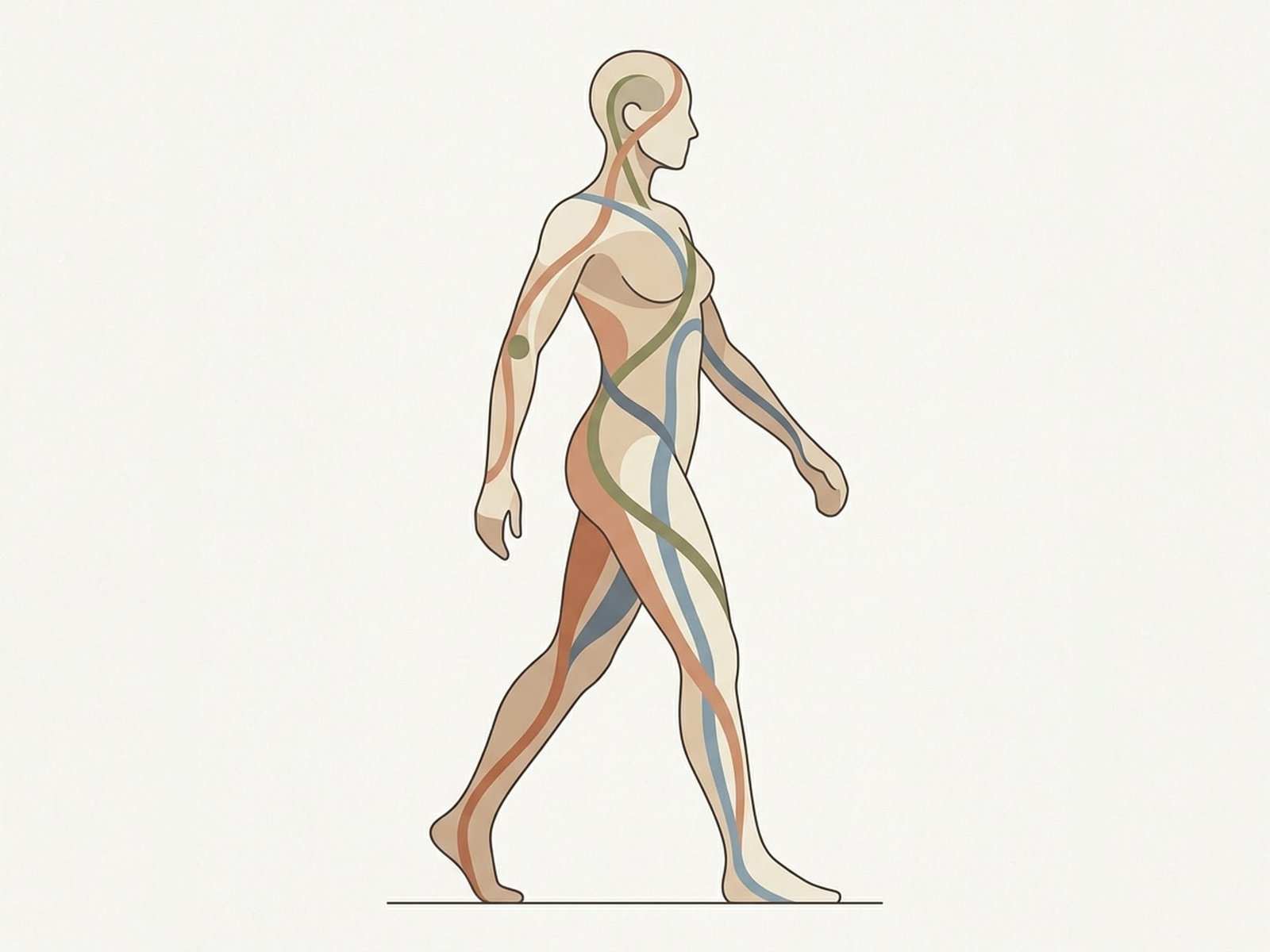
Fascial Lines
Anatomy Trains OverviewOne of the most influential ideas in modern fascia research is that muscles do not function as isolated units. Instead, they are linked by continuous connective tissue into functional chains — lines of pull that may help explain how force, tension, and dysfunction travel through the body. These fascial-chain models, popularized by Thomas Myers as "Anatomy Trains," are widely used clinically, though they remain partly model-based rather than fully settled in every detail.
When a muscle contracts, some force is transmitted not only through tendon to bone, but also laterally through fascial connections to adjacent tissues. The exact proportion varies by tissue, task, and model, but the general principle of lateral force transmission is increasingly supported biomechanically.
How Tension Transmits
Research using cadaveric dissection and some in-vivo imaging supports the idea that loading one region can influence tissue displacement elsewhere along connected fascial pathways. This does not mean every distant symptom is explained by fascia, but it does support the broader concept that body regions are mechanically linked more than older models assumed.
Fascia & Trigger Points
How fascial restrictions may help create and perpetuate myofascial trigger points
Trigger points do not exist in isolation — they form within a broader connective tissue and neuromuscular environment. When fascia becomes restricted, dehydrated, scarred, or adhered, it may alter the mechanical and sensory environment around muscle tissue in ways that favor ongoing irritability.
Fascial adhesions and reduced glide may increase local mechanical stress. One proposed model is that this changes the environment around motor endplates and contributes to abnormal contraction, guarding, and sensitization. That model is clinically useful, though the exact tissue sequence remains partly inferential rather than definitively proven step by step.
The fascial network also provides one plausible pathway through which trigger points influence distant tissues. When a trigger point causes a muscle region to shorten and stiffen, that change may be transmitted through surrounding fascial connections to neighboring muscles and broader movement chains. This may help explain why a local hip trigger point can sometimes contribute to symptoms higher up the chain over time.
Understanding "Fuzzing"
Anatomist and structural-integration teacher Gil Hedley popularized the term "fuzz" to describe the thin, cobweb-like filaments of connective tissue that can appear between fascial layers during periods of stillness, particularly during sleep or reduced movement. In a healthy body, much of this may be dispersed through normal movement on waking.
When movement is insufficient — due to injury, pain avoidance, or a sedentary lifestyle — these filaments may accumulate and become denser over time, potentially contributing to real restrictions. The exact biology is more complex than the metaphor, but the image is useful clinically.
This is one reason morning stiffness and movement-related "stuckness" often worsen over time if reduced movement becomes the norm.
The Fascial-Neural Connection
How fascia senses, communicates, and influences your nervous system
One of the most important developments in fascia research is the recognition that fascia is heavily innervated. The thoracolumbar fascia in particular appears to contain substantial proprioceptive and nociceptive input. This means fascia is not just a structural tissue — it is also a sensory tissue.
Multiple types of mechanoreceptors are embedded within fascial tissue, each specialized to detect different aspects of mechanical stimulation. Understanding these receptors helps explain why different manual therapy techniques can produce different subjective and physiological effects.
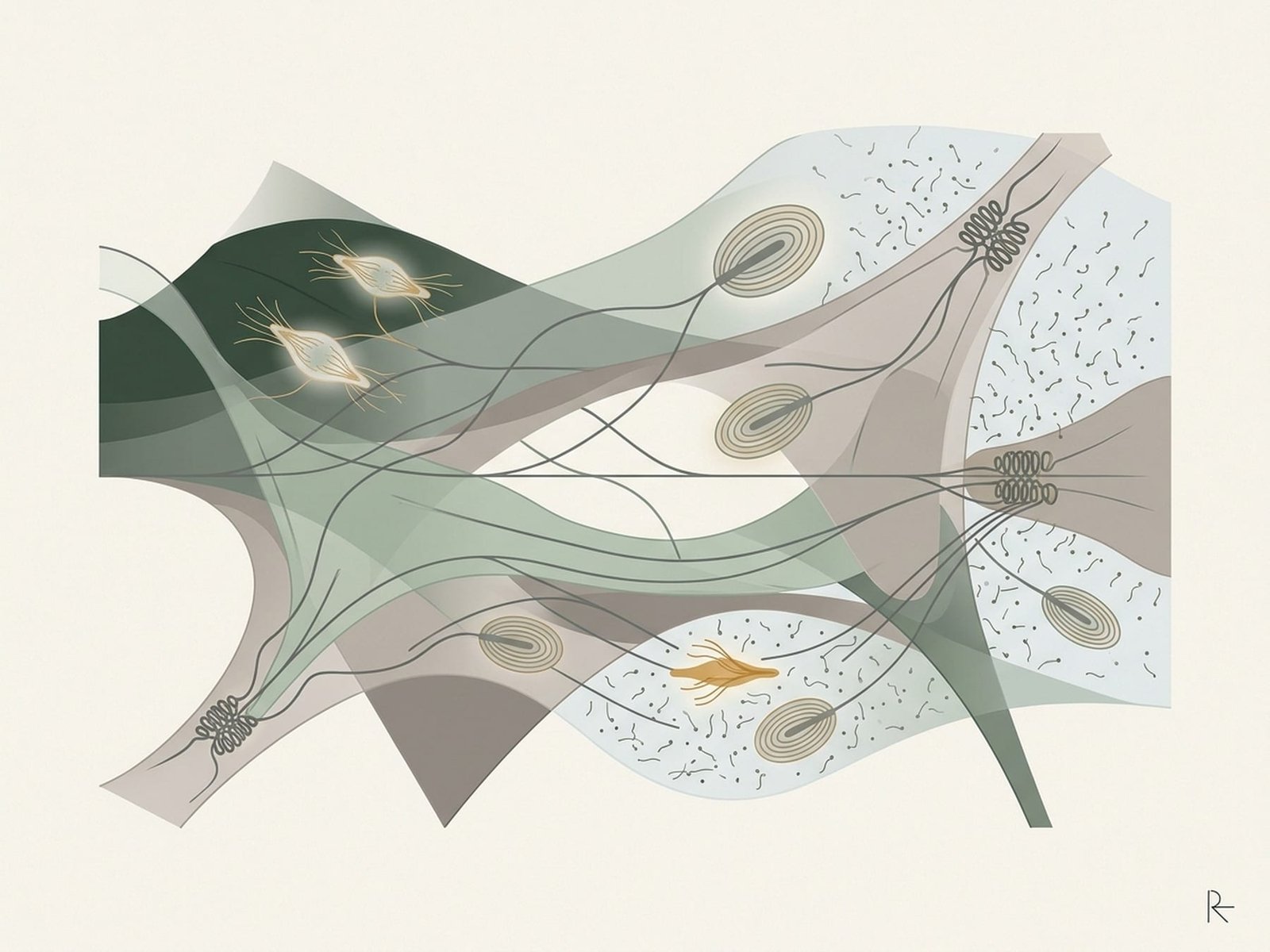
Fascial Mechanoreceptors
Types and DistributionWhy Fascial Pain Feels Different
If you have experienced a deep, aching, burning pain that is hard to pinpoint exactly, you may have felt a pattern consistent with fascial pain. Unlike sharp joint or nerve pain that can be highly localized, fascial pain is often diffuse and poorly localized. This may relate partly to the free nerve endings in fascia, including slow-conducting C-fiber input.
What Goes Wrong
Fascial dysfunction — from dehydration and fibrosis to adhesions and stiffness
Contributing Factors
Prolonged Immobility
Desk work, bed rest, or immobilization can contribute to rapid fascial stiffening and reduced glide. Measurable changes may occur surprisingly quickly, even though the exact timeline varies.
Repetitive Strain Injury
Performing the same motion repeatedly can contribute to localized fascial thickening and increased tissue sensitivity along the overused pathway.
Surgical Scarring
Any incision passes through multiple tissue layers. Scar tissue that forms during healing is denser and less organized, and may become a focal point of restriction or sensitivity.
Chronic Inflammation
Inflammatory states may alter the composition and behavior of the fascial ground substance, making tissue stiffer and more sensitive. Systemic inflammation can affect fascia beyond one local region.
Emotional Stress
The thoracolumbar fascia appears to have meaningful sympathetic innervation. Chronic stress may contribute to increased fascial tone, guarding, and perceived stiffness.
Aging
With aging, connective tissues often become less hydrated and less elastic. Collagen cross-linking may increase, while tissue adaptability may decline.
Fascial Chain Explorer
Select a fascial line to see its route, muscles, and common problems
Superficial Back Line
Plantar fascia → calves → hamstrings → sacrolumbar fascia → erector spinae → epicranial fascia (scalp)
A useful conceptual line for understanding how the posterior body works together in upright posture. It helps support extension, resist collapse forward, and link the lower limb to the trunk and head in a continuous posterior chain.
Muscles & Structures in This Chain
Common Problems
Clinical Insight
When you cannot touch your toes, the main restriction is not always the hamstrings alone — calf, plantar, spinal, and broader posterior-chain stiffness may all contribute.
Treatment Approaches
Professional and clinical methods for addressing fascial dysfunction
Because fascia has biomechanical properties that differ somewhat from pure contractile muscle tissue, fascial treatment is often approached with sustained pressure, slow application, and a whole-body perspective. These principles are common across many fascial therapies, even though the exact mechanism of benefit is still debated.
Self-Care for Fascial Health
Daily habits and techniques to keep your fascial system healthy and resilient
The Good News About Fascia
Connective tissue is responsive to appropriate loading and lifestyle input. Over time, fascia adapts to movement, rest, hydration, and mechanical demand. This means that with consistent, appropriate self-care, tissue behavior and comfort can change meaningfully. The key is consistency rather than intensity.
Hydration Is Foundational
Fascial tissues depend on adequate fluid balance for normal ground-substance behavior and tissue glide. Aim for consistent hydration across the day, especially if you exercise or live in a hot or dry climate. Water-rich foods may also help. The effect of hydration on stiffness is gradual, so daily consistency matters more than drinking a large amount immediately before activity.
Movement Variety Over Repetition
Your fascia adapts to the loads you place on it most often. If you only walk, your tissues adapt to walking. If you only sit, they adapt to sitting. A useful principle for fascial health is movement variety — incorporating different planes of motion, speeds, and intensities throughout the week. Twisting, reaching, squatting, crawling, balancing, climbing, dancing, yoga, and varied daily movement may all help maintain tissue adaptability.
Heat Therapy Before Movement
Applying heat to stiff areas for 15-20 minutes before movement or self-treatment may make tissues feel more pliable. Warm baths, heating pads, or a warm shower can all help. This is often particularly useful first thing in the morning when tissues feel stiff after overnight stillness.
Self-Myofascial Release Techniques
Use a foam roller, lacrosse ball, or tennis ball to apply sustained pressure to stiff areas. The key principle is slow and sustained — hold pressure on a tender point for 30-90 seconds rather than rapidly rolling back and forth. It is often useful to work along broader tissue lines rather than only isolated painful spots. Intensity should be moderate and tolerable rather than aggressive.
Fascial Stretching vs. Muscle Stretching
Muscle stretching often targets a single muscle group and uses shorter holds. Fascial-style stretching tends to involve longer holds, multiple planes of motion, and broader tissue lines. Yin yoga is often given as an example of this slower approach. These are useful conceptual differences, but in practice muscle and fascia are not completely separable, so both styles may overlap and help in different ways.
Micro-Movement Breaks
Set a timer to move for 2-3 minutes every 30-45 minutes during sedentary work. This does not need to be formal exercise — simply standing, twisting, reaching overhead, doing gentle circles with your hips and shoulders, or taking a brief walk may be enough to reduce tissue stiffness and restore glide. Consistency matters more than intensity.
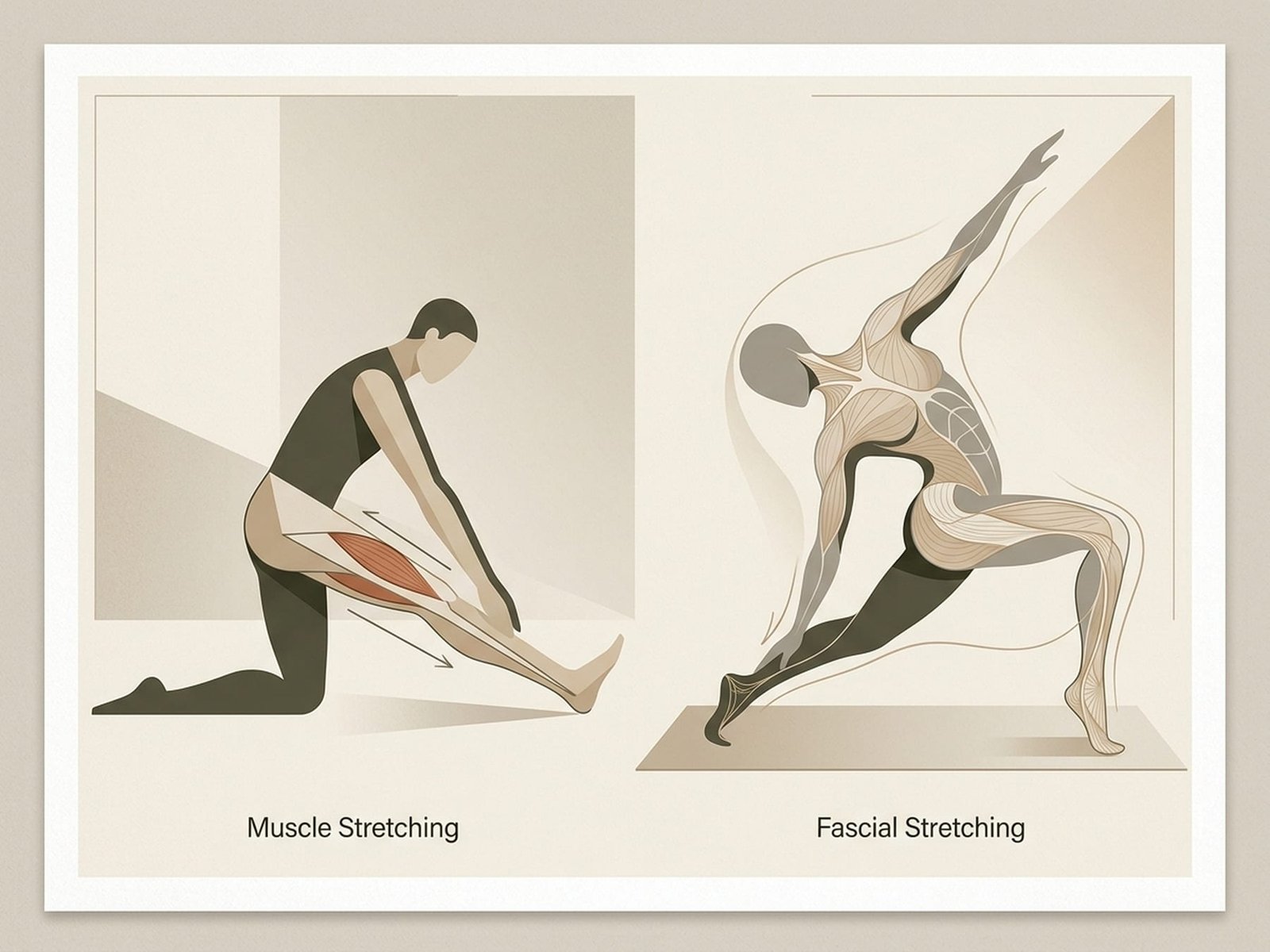
Muscle Stretching vs Fascial Stretching
Technique ComparisonMuscle Stretching vs. Fascial Stretching
Traditional Muscle Stretching
- Often held for 15-30 seconds
- Usually more single-plane
- Focuses more on isolated muscle groups
- Static position often maintained
- Primarily conceptualized around contractile tissue
- Often produces quick but sometimes short-lived changes
Fascial Stretching
- Often uses longer holds
- May involve multiple planes simultaneously
- Follows broader tissue lines rather than a single muscle only
- May include gentle oscillation or micro-movement at end range
- Conceptually targets connective tissue behavior as well as muscle
- Tends to emphasize slower, cumulative change
Viscoelasticity
Fascia responds to sustained pressure by gradually yielding and lengthening, which is one reason slower manual approaches often feel different from rapid stretching.
Thixotropy
Fascia may become more fluid with movement and relatively stiffer with inactivity, helping explain morning stiffness and why gentle movement often helps.
Piezoelectricity
Mechanical loading can generate small electrical potentials in collagen-containing tissues, offering one plausible mechanism by which exercise and loading influence tissue remodeling.
Force Transmission
Fascia helps transmit mechanical force across body regions through continuous connective tissue chains, which may help explain why distant regions sometimes influence each other.
Key Takeaways
The most important concepts to remember about fascia and the myofascial system
Fascia Is a Body-Wide Communication Network
Fascia is not merely passive packing material. It is a continuous connective tissue network that helps transmit force, houses many sensory nerve endings, and influences posture, movement, proprioception, and pain signaling.
Tension Can Travel Along Fascial Lines
A restriction in one area of the fascial web may influence symptoms elsewhere. Fascial-chain models help explain why treating only the site of pain sometimes fails to address the bigger mechanical picture.
Fascial Health Requires Movement Diversity
Fascia remodels continuously in response to the forces placed upon it. Varied, multi-directional movement helps keep tissues adaptable. Prolonged immobility is one of the faster ways to create stiffness and reduced glide.
Fascia and Trigger Points Are Closely Connected
Fascial restrictions may help create the environment in which trigger points form and persist. Addressing only the trigger point without considering the surrounding connective tissue and movement pattern may leave some drivers untouched.
Slow, Sustained Approaches Often Work Well for Fascia
Because of its viscoelastic properties, fascia often responds better to slow, sustained mechanical input than to rapid, forceful manipulation. Whether through professional treatment or self-care, patience and tolerable pressure are important principles.
Hydration and Stress Management Matter
Hydration, sleep, movement, and stress regulation may all influence how fascia feels and functions. Chronic sympathetic arousal appears to increase tissue tension and pain sensitivity in at least some patients.
Continue Learning
Related topics to deepen your understanding
Trigger Points 101
Understand the fundamental science of myofascial trigger points and how they relate to the surrounding connective tissue web.
Manual Therapy
Explore hands-on treatment approaches that aim to address fascial restrictions and trigger points.
Self-Care Guide
Evidence-based self-treatment techniques including myofascial release, stretching, and foam rolling.
Exercise Guide
Therapeutic exercises that promote movement variety, tissue loading, and long-term resilience.