Driving as a Trigger Point Perpetuating Factor
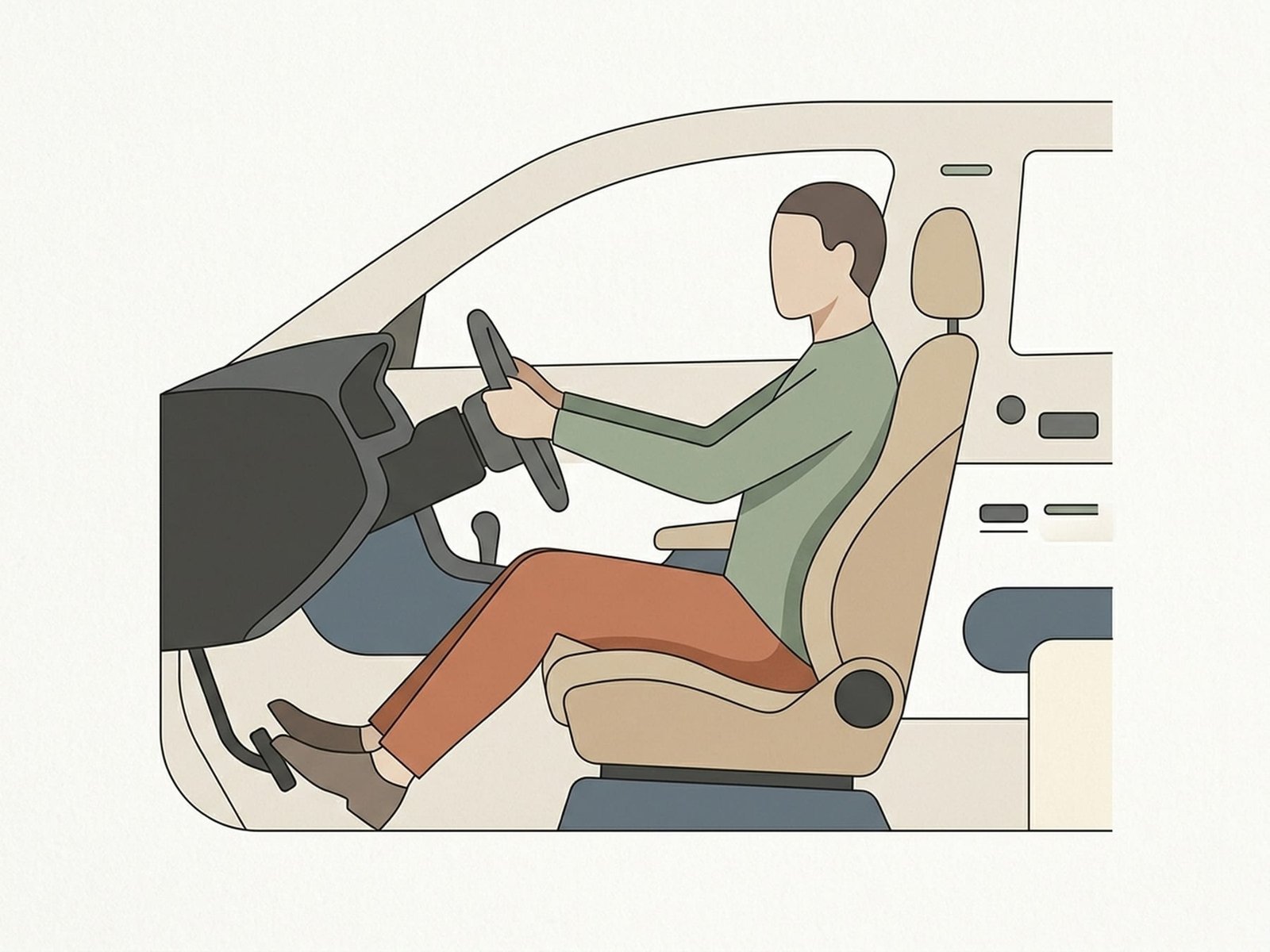
Driving Ergonomics
Key Adjustment Points OverviewMany patients arrive at treatment after a drive that has already aggravated the very muscles they are trying to calm. The journey itself — especially in a poorly configured seat or during stop-start traffic — can help reactivate cervical, gluteal, lumbar, and hip trigger point patterns. Driving is therefore worth assessing much more often than it currently is.
The biomechanical demands of driving are significant and unusually sustained. Hip flexion is maintained for long periods, cervical and shoulder muscles may co-contract during traffic vigilance, and road vibration adds low-level repeated load. None of these factors alone explains all driving pain, but together they can create a strong perpetuating environment.
Whiplash-associated myofascial pain is one of the clearest examples of why vehicle setup matters. Headrest distance and height influence how much support the head receives in rear-impact situations. Even outside collisions, poor headrest geometry may leave drivers with chronic neck sensitivity feeling unsupported on routine drives.
For professional drivers, long-haul commuters, ride-share drivers, and other high-mileage groups, driving is not a minor daily activity — it is a major physical exposure. In those patients, ergonomic optimisation plus a structured maintenance routine often makes more sense than trying to rely on treatment sessions alone.
Key Ergonomic Factors
Five main ergonomic factors shape whether driving becomes a symptom trigger or a relatively neutral activity. Looking at all five together is usually more useful than obsessing over a single adjustment.
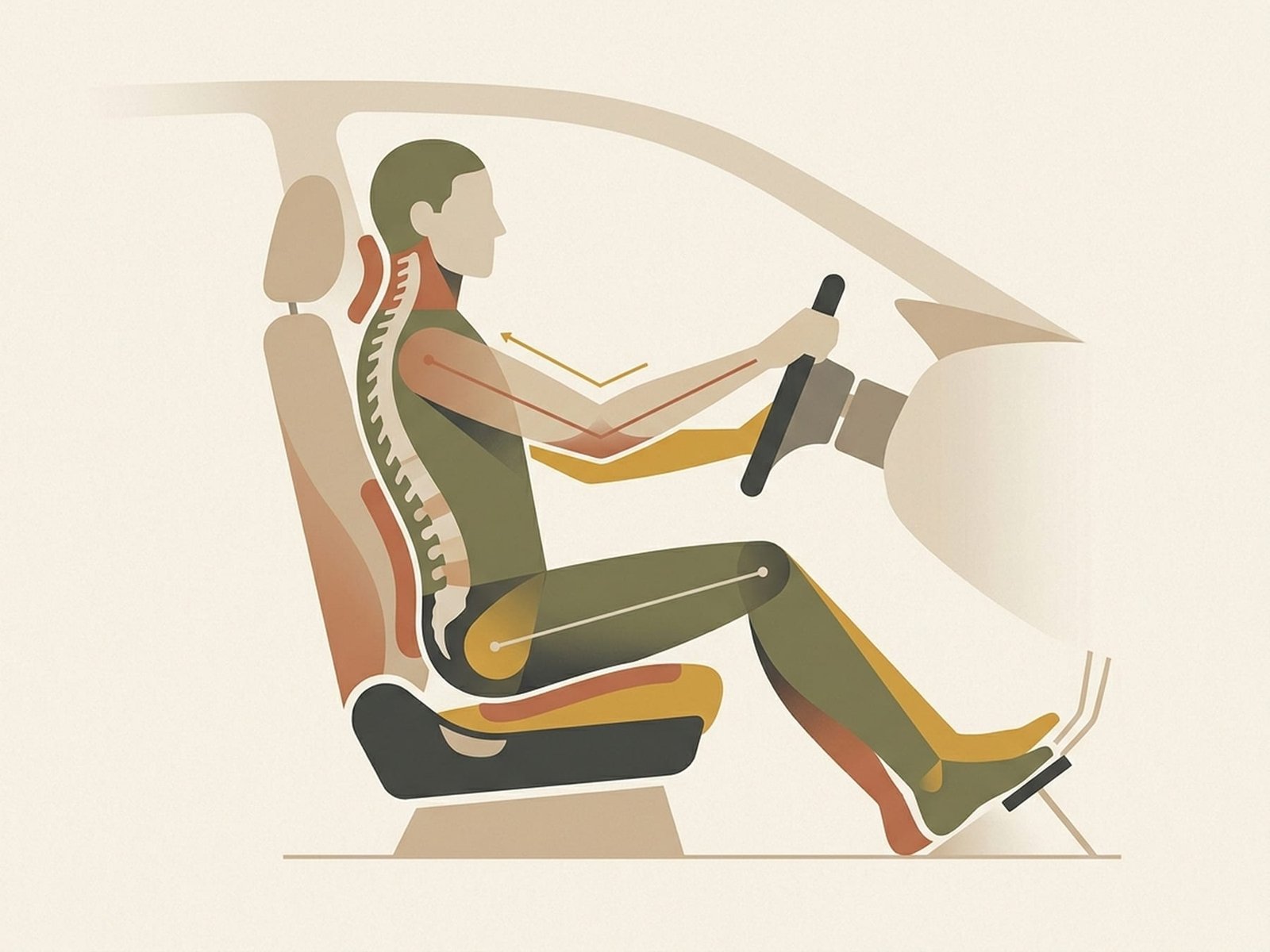
Vehicle Ergonomic Factors
Seat, Headrest, Steering, Pedals, MirrorsSeat Position & Lumbar Support
Important contributor to lumbar MPSSeat height ideally places the hip at or slightly above the knee, which may reduce excessive hip flexion load. Distance from the pedals should allow comfortable access with hips and knees usually around 90-100° of flexion rather than jammed into a tight position. Lumbar support should contact the low back without pushing the thorax and head excessively forward. In vehicles without adjustable lumbar support, an aftermarket lumbar roll can be helpful when placed at the low-lumbar region and adjusted to comfort rather than aggressively forcing posture.
Headrest Position
Relevant for cervical comfort and whiplash protectionCorrect headrest position generally places the top of the headrest near the top of the skull, with the headrest as close to the back of the head as practical without forcing an awkward posture. This matters both for comfort and for reducing excessive head excursion in a rear impact. A headrest that is too low or too far back may provide less support than intended. Drivers with cervicogenic headache or post-whiplash sensitivity may benefit from especially careful headrest adjustment, and some may find a small cervical support helpful if the vehicle geometry is poor.
Steering Wheel & Arm Position
Shoulder and cervical loading factorA 9-and-3 hand position is often more comfortable than 10-and-2 because it usually reduces sustained shoulder elevation. Steering wheel tilt and telescope adjustment should allow wrists to rest on the wheel with elbows slightly bent and shoulders relaxed rather than reaching or shrugging. Grip pressure is also important: a chronically tense grip may overload the forearm, shoulder, and cervical muscles even when the wheel position itself is reasonable.
Pedal Use & Hip Flexor Tension
Hip and lumbar loading factorContinuous sitting with the hips flexed during driving may aggravate the psoas, iliacus, TFL, and anterior hip region in susceptible patients. Some people with lumbar or hip MPS tolerate shorter drive intervals better and benefit from more frequent breaks. In manual transmission vehicles, clutch use and unsupported positioning of the left leg may add extra load in some drivers. Cruise control, when safe and appropriate, may allow periodic redistribution of load on long drives. The right heel is usually best supported on the floor with the forefoot operating the pedals, rather than holding the entire leg suspended.
Mirror Positioning & Cervical Load
Reducing repetitive neck strainWell-positioned mirrors reduce the need for repeated leaning or excessive cervical rotation. Rear-view and side mirrors should be adjusted so the driver can scan efficiently without major compensatory posture. Backup camera use may reduce cervical extension-rotation demand during reversing. GPS and phone mount position also matter: devices placed far off to one side can create repeated asymmetric neck loading over time.
Why Driving Setup Matters
The driving position combines prolonged sitting, limited movement variability, repetitive pedal use, visual vigilance, and often vibration exposure. That mix makes it a plausible aggravator for myofascial pain, particularly in the cervical, lumbar, gluteal, and hip-flexor regions.
Vibration is especially relevant in some vehicles and road conditions. Rough roads, poor seat support, and long durations can increase muscle co-contraction and fatigue. In patients with existing lumbar or gluteal trigger points, this may worsen symptoms even when the sitting posture looks acceptable.
A well-designed treatment plan can be undermined by an everyday activity that keeps reloading the same tissue for 30, 60, or 120 minutes at a time.
Lumbar / Gluteal
Often aggravated by sustained sitting, hip flexion, and vibration
Cervical
Often aggravated by vigilance, headrest mismatch, and repeated scanning
Highly Modifiable
Many driving aggravators improve with relatively simple adjustments
Vehicle Setup Assessment
These assessments can be used in clinic or assigned as a self-review task. Together they help estimate how much the vehicle environment is contributing to the patient’s overall MPS load.
Quick Car Ergonomics Audit
5-Minute In-Car Setup Checklist
A structured 5-step in-seat assessment: (1) Seat height — can you see comfortably over the dashboard without craning your neck? (2) Headrest — is it close enough to be supportive without forcing your head forward? (3) Steering wheel — can you hold 9-and-3 with relaxed shoulders? (4) Mirrors — do you have adequate visibility without repeated leaning or excessive neck rotation? (5) Lumbar — does the low back feel supported without pushing the rest of the body awkwardly forward? This audit can be repeated whenever using a new vehicle or after major seat adjustments.
Long Drive Tolerance Assessment
How Long Before Pain Starts?
Track when discomfort first begins during a typical drive and which body region complains first. Also note whether symptoms ease within several minutes of stopping and walking. This helps guide break scheduling. Pain that begins very early often suggests that setup, tolerance, or both need attention. Tracking the trend over 2-4 weeks after changes is more useful than judging a single drive in isolation.
Rental/Unfamiliar Vehicle Adaptation
Quick Adaptation Protocol
A practical adjustment sequence for unfamiliar vehicles: (1) seat distance from pedals, (2) seat height, (3) headrest, (4) mirrors, (5) steering column tilt and telescope. If time is limited, prioritise the features that affect safety and gross comfort first. Some drivers find it useful to store preferred settings or notes for common vehicle types.
Comparison Between Car and Office Setup
Inconsistency Between Work and Drive Ergonomics
A common clinical pattern is that office ergonomics improve while driving posture remains poor. In that situation, vehicle setup may continue to reinforce cervical, gluteal, or lumbar symptoms despite good desk habits. Ask whether pain reliably worsens after commutes, traffic exposure, or long seated drives. That pattern often reveals driving as a meaningful perpetuating factor even when the patient did not initially identify it.
Ergonomic Protocols
The protocols below address different pieces of the driving–MPS relationship. Basic setup is the foundation, but break scheduling and recovery routines often determine whether a technically “good” setup actually works for the patient in real life.
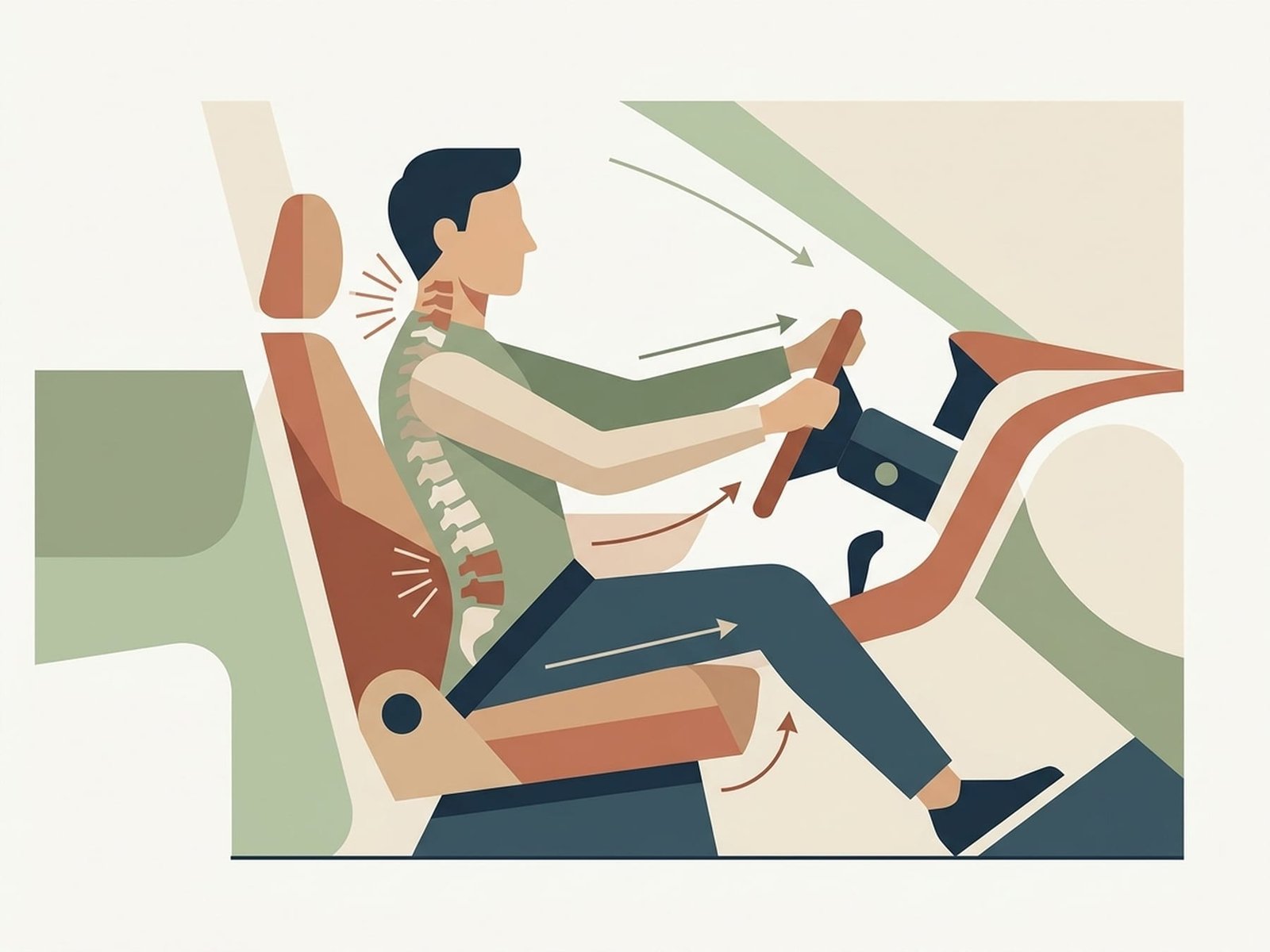
Driving Ergonomics Protocols
Vehicle Setup and Break Protocol DiagramsComplete Vehicle Setup Protocol
A full adjustment sequence to be performed once per vehicle, then fine-tuned with real driving experience. Using a consistent order helps because each adjustment influences the next.
- (1) Seat distance from pedals: full pedal depression with the knee still slightly bent
- (2) Seat height: enough visibility over the dash without needing neck extension
- (3) Seat pan angle: neutral or slight tilt according to comfort — avoid positions that clearly worsen hip or lumbar symptoms
- (4) Lumbar support: contact at the low back without pushing the head and thorax excessively forward
- (5) Headrest: near crown height and as close as practical to the back of the head
- (6) Steering wheel: adjusted so wrists can rest on the rim with elbows slightly bent and shoulders relaxed
- (7) Mirrors: set for coverage without repeated leaning or excessive rotation
Break Protocol for Long Drives
Regular breaks are one of the highest-yield strategies for long-drive MPS management. Break frequency often matters more than the exact exercise menu, because the main goal is interrupting sustained loading.
- More sensitive patients may need breaks every 20-30 minutes, while others tolerate 45-90 minutes depending on symptoms and conditioning
- Before exiting, several gentle gluteal contractions or posture resets can help unload the seated position
- Outside the vehicle, use a short walk plus one or two targeted stretches such as hip flexor, cervical retraction, or scapular reset drills
- Longer stops can include a more complete movement sequence when needed
- Re-enter the vehicle gradually rather than collapsing quickly back into the seat after a break
Whiplash-Associated Cervical MPS Management
Drivers with post-whiplash cervical MPS may need more careful vehicle adaptation than standard comfort-oriented ergonomics alone. The vehicle can remain a perpetuating factor if head and neck support are poor.
- Headrest adjustment is a high-priority intervention and should be checked carefully
- Routine neck braces for driving are usually not preferred unless specifically prescribed, because they may reduce normal movement and confidence
- A small cervical support may help some drivers when fixed headrests are poorly shaped, but it should not force the head into an unnatural position
- Seat or cushion options that reduce vibration and improve trunk support may help some patients
- Cervical symptoms that consistently worsen with driving, especially with new arm symptoms, warrant medical reassessment rather than repeated self-adjustment alone
Long-Distance Drive Preparation Programme
For professional drivers, long-haul commuters, and anyone spending long daily periods behind the wheel, a maintenance routine may matter almost as much as the vehicle setup itself.
- Seat cushion modifications may help depending on whether the main issue is coccygeal pressure, vibration, or pressure distribution
- Aftermarket lumbar support options can be trialed and adjusted rather than assuming one shape works for everyone
- A padded steering wheel cover may reduce grip strain for some drivers
- A brief pre-drive routine can include heat, hip flexor opening, and cervical mobility if these consistently help
- A post-drive routine may include self-release, stretching, and thoracic or hip mobility work
- High-mileage drivers often benefit from treating recovery habits as part of the job rather than an optional add-on
Red Flags — When Driving Pain Needs Medical Attention
Most driving-related MPS can be improved with ergonomic changes and symptom-guided management. The following patterns deserve medical review rather than relying on ergonomics alone.
Pain radiating down the arm or leg that is new or consistently worsening with driving
This may reflect radiculopathy or another neurological issue rather than a simple ergonomic aggravation. Medical evaluation is appropriate before assuming the problem is only mechanical.
Fainting, near-fainting, or syncope during or after prolonged driving
This is a safety issue and requires medical evaluation before resuming long-distance driving or relying only on ergonomic changes.
Driving pain so severe that it impairs concentration, reaction time, or decision-making
At this point the issue affects driving safety, not only comfort. The patient may need to avoid driving until symptoms are better controlled.
Neck pain following a motor vehicle accident — even a minor one
Post-accident neck pain should be medically evaluated before treating it as a routine ergonomic issue. Structural injury needs to be considered first.
Key Takeaways
Driving can be a meaningful perpetuating factor in cervical, lumbar, gluteal, and hip-related myofascial pain, especially when daily exposure is high.
Headrest position is often overlooked, but it matters both for comfort and for whiplash-related protection.
Break frequency often matters more than the exact break routine. Short, regular interruptions of sitting usually outperform infrequent long stops.
Professional and high-mileage drivers often need both ergonomic optimisation and a repeatable pre-drive / post-drive maintenance routine.
Vehicle ergonomics deserve formal assessment in patients whose symptoms reliably worsen with commuting or longer drives.