Understanding Bruxism & Orofacial Pain

Bruxism
Orofacial Anatomy and Trigger Point Pattern OverviewBruxism refers to repetitive jaw-muscle activity such as teeth grinding or clenching during sleep or wakefulness. It is common and varies in severity. In some people it causes little harm, while in others it contributes to jaw pain, morning tightness, tooth wear, headache, temporomandibular symptoms, and wider orofacial myofascial pain.
Sustained or repetitive contraction of the jaw elevators may contribute to hypertrophy, tenderness, and trigger point formation in the masseter, temporalis, and pterygoids. These muscles can produce pain patterns that overlap with tooth pain, temple headache, ear discomfort, and deep jaw ache, which is one reason bruxism-related myofascial pain is often mistaken for other conditions.
The relationship between bruxism and temporomandibular joint dysfunction (TMD) is complex and not purely one-directional. Chronic clenching may increase joint loading, while joint irritation may also alter muscle behavior. In many patients, both muscular and articular factors are present to some degree rather than one cleanly replacing the other.
Jaw symptoms also often overlap with cervical and upper-quarter dysfunction. Forward head posture, stress-related guarding, poor sleep, and persistent neck tension may all increase jaw-muscle activity. That is why effective management often includes more than the teeth and jaw alone.
Anatomy & Trigger Points
Bruxism-related myofascial pain usually involves a network of jaw-closing, opening, and accessory muscles rather than one single painful structure. Understanding the common symptom patterns of each region can support better assessment and treatment planning.
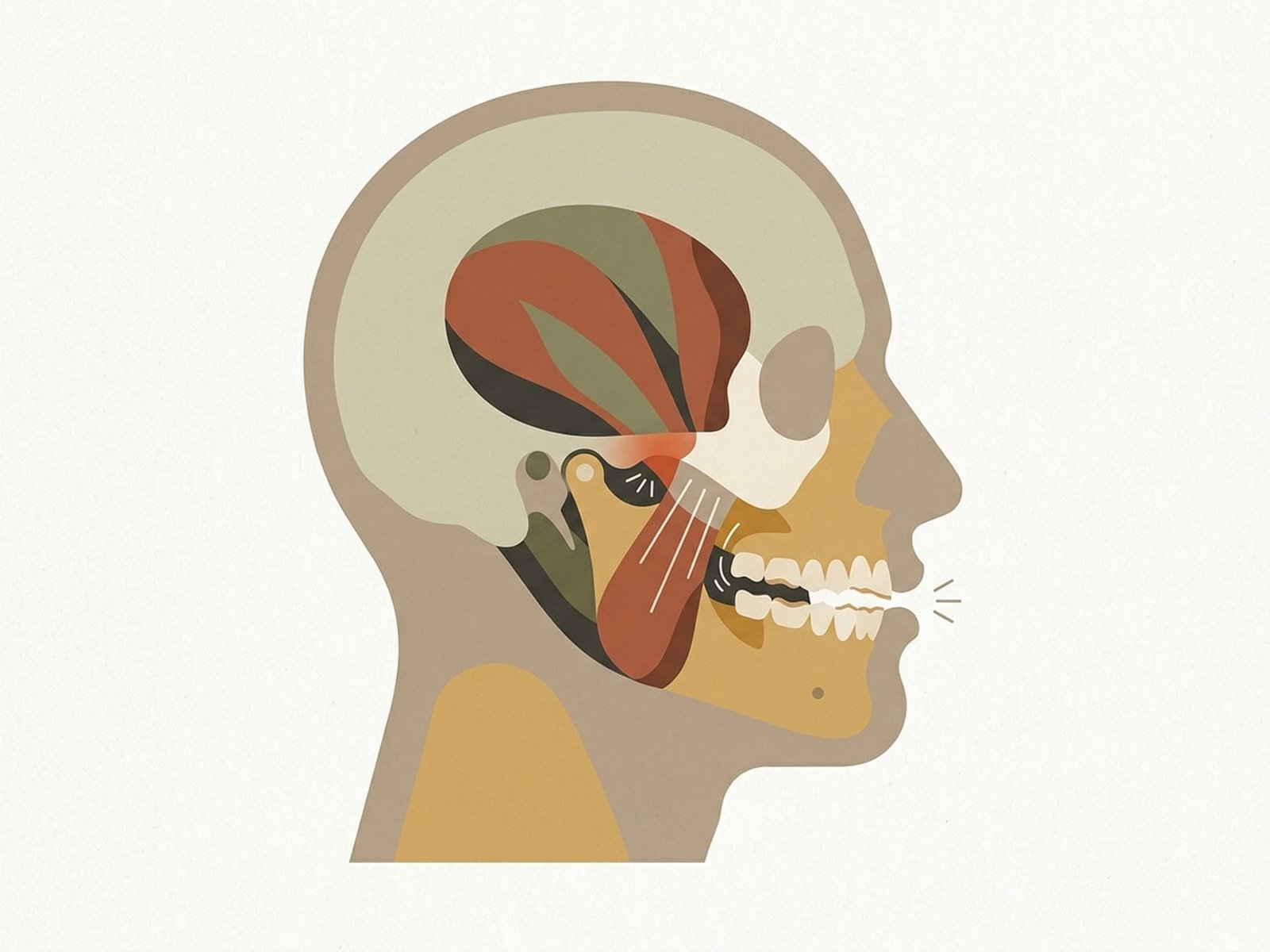
Masseter, Pterygoids, and Temporalis
Masseter
- Trigger points in the masseter may contribute to toothache-like pain in the upper or lower molar region, diffuse aching across the jaw, temporal headache, and sometimes ear-related symptoms such as fullness or discomfort. These patterns can overlap with dental or ear complaints, which is one reason careful differential evaluation matters.
Medial Pterygoid
- Trigger points in the medial pterygoid may contribute to pain felt inside the mouth, throat, tongue, or deep jaw region. Patients often describe this as poorly localized discomfort or a deep ache “inside” the jaw. Because the symptoms can be diffuse, this muscle is easy to overlook in orofacial pain assessment.
Lateral Pterygoid
- Lateral pterygoid dysfunction may contribute to deep temporomandibular region pain, jaw deviation on opening, clicking, or difficulty opening fully. It is commonly discussed in temporomandibular dysfunction, though joint symptoms are not always purely muscular and should not be assumed to come from this muscle alone.
Temporalis
- Trigger points in the temporalis may contribute to temple pain, forehead pain, and upper toothache-like symptoms, especially in patients with clenching or grinding. Temporalis-related pain is one possible contributor to headache in bruxism, but it is not the only explanation for temporal headache patterns.
Digastric & Suprahyoids
- Trigger points in the digastric and related suprahyoid muscles may contribute to discomfort in the lower front teeth, floor of the mouth, throat, or swallowing region. These muscles are often less obvious on routine palpation and may coexist with masseter, temporalis, or pterygoid dysfunction.
Referral Patterns
A major challenge in orofacial myofascial pain is that symptom referral often does not map neatly onto the structure generating it. Masseter trigger points may feel like molar pain. Temporalis pain may feel like temple headache or upper tooth pain. Pterygoid dysfunction may feel deep, difficult to localize, or “inside the joint.” These patterns are clinically useful, but they are not specific enough to stand alone as a diagnosis.
Ear-related symptoms are another common source of confusion. Jaw muscles can contribute to ear fullness, non-otologic ear pain, and sometimes tinnitus-like complaints in selected patients. At the same time, ear symptoms still require appropriate ENT or dental consideration when the picture is not clear. A myofascial explanation should be treated as one possibility, not an automatic conclusion.
Jaw-muscle pain can mimic dental pain, ear pain, and temple headache — which is why careful examination matters before irreversible treatment decisions are made.
Teeth & Jaw
Temple & Head
Ear & Throat
Self-Assessment Tests
No single assessment is definitive for bruxism-related myofascial pain. Combining jaw range of motion, palpation findings, sleep or clenching history, and TMJ findings provides a more useful clinical picture than relying on any one sign in isolation.
Mandibular Opening Test
Masseter Compression Test
Sleep Bruxism Assessment
TMJ Auscultation
Treatment Pathways
Treatment of bruxism and orofacial myofascial pain is often multidisciplinary. A night guard may protect teeth, but muscular pain, clenching habits, stress, sleep quality, and cervical factors often need attention as well. The most effective plan depends on which contributors are most active in the individual patient.

Bruxism Treatment Pathways
Overview DiagramSelf-Care
- Jaw stretching: gentle passive opening within comfort, held briefly and repeated as tolerated
- Heat application to the masseter and temporalis (for example a warm compress for 10–15 minutes if comfortable)
- Self-massage of the masseter body with gentle circular or sustained pressure externally; intraoral work should be approached cautiously
- Use of a small ball or pressure tool only if comfortable and not excessively provocative
- Daytime jaw-rest awareness: lips together, teeth apart, tongue relaxed on the palate if comfortable
Manual Therapy
- Extraoral masseter release: sustained pressure or soft tissue work over tender masseter regions
- Intraoral masseter or pterygoid techniques only by appropriately trained clinicians
- Gentle jaw opening or mobility work after soft tissue treatment when tolerated
- Post-isometric or relaxation-based techniques may help some patients improve opening comfort
- Manual treatment is usually most useful when paired with habit change, stress reduction, and jaw-use modification
Dental Interventions
- Occlusal splint (night guard): custom appliances may help protect teeth and reduce grinding-related dental load during sleep
- Occlusal adjustment should be considered cautiously and only when there is a clear dental rationale
- Botulinum toxin to the masseter may be considered in selected chronic bruxism cases, but it should not be framed as a universal frontline approach
- Trigger point injections may be considered in selected refractory myofascial pain cases
- Dry needling of jaw-related muscles may help some patients when performed by appropriately trained clinicians
Rehabilitation
- Jaw coordination exercises: controlled opening and closing with feedback when helpful
- Daytime clenching awareness and biofeedback-based strategies in selected patients
- Sleep hygiene work when sleep disturbance appears to worsen bruxism or pain
- Cervical posture and upper-quarter mechanics may deserve attention when jaw and neck symptoms coexist
- Cognitive behavioral approaches may help when stress, arousal, or health anxiety are clearly contributing factors
Red Flags — When to See a Doctor
Most bruxism-related myofascial pain is benign, but jaw and facial pain can also reflect infection, structural joint disease, neuralgia, inflammatory arthritis, or other pathology. The following features deserve more urgent or more focused evaluation.
Bruxism can contribute to sustained jaw-muscle overload, tenderness, and trigger point formation in susceptible patients.
Orofacial myofascial pain may overlap with dental pain, ear discomfort, headache, and neck symptoms, which is why careful differential assessment matters.
A night guard may protect teeth and reduce dental wear, but it does not by itself address all muscular, behavioral, or stress-related contributors.
Jaw rest posture, stress reduction, sleep factors, and daytime clenching awareness are often important parts of long-term management.
Jaw and cervical symptoms often coexist, so some patients improve more when both regions are assessed rather than treating the jaw in isolation.