§ 01

What Is BOTOX for Trigger Points?

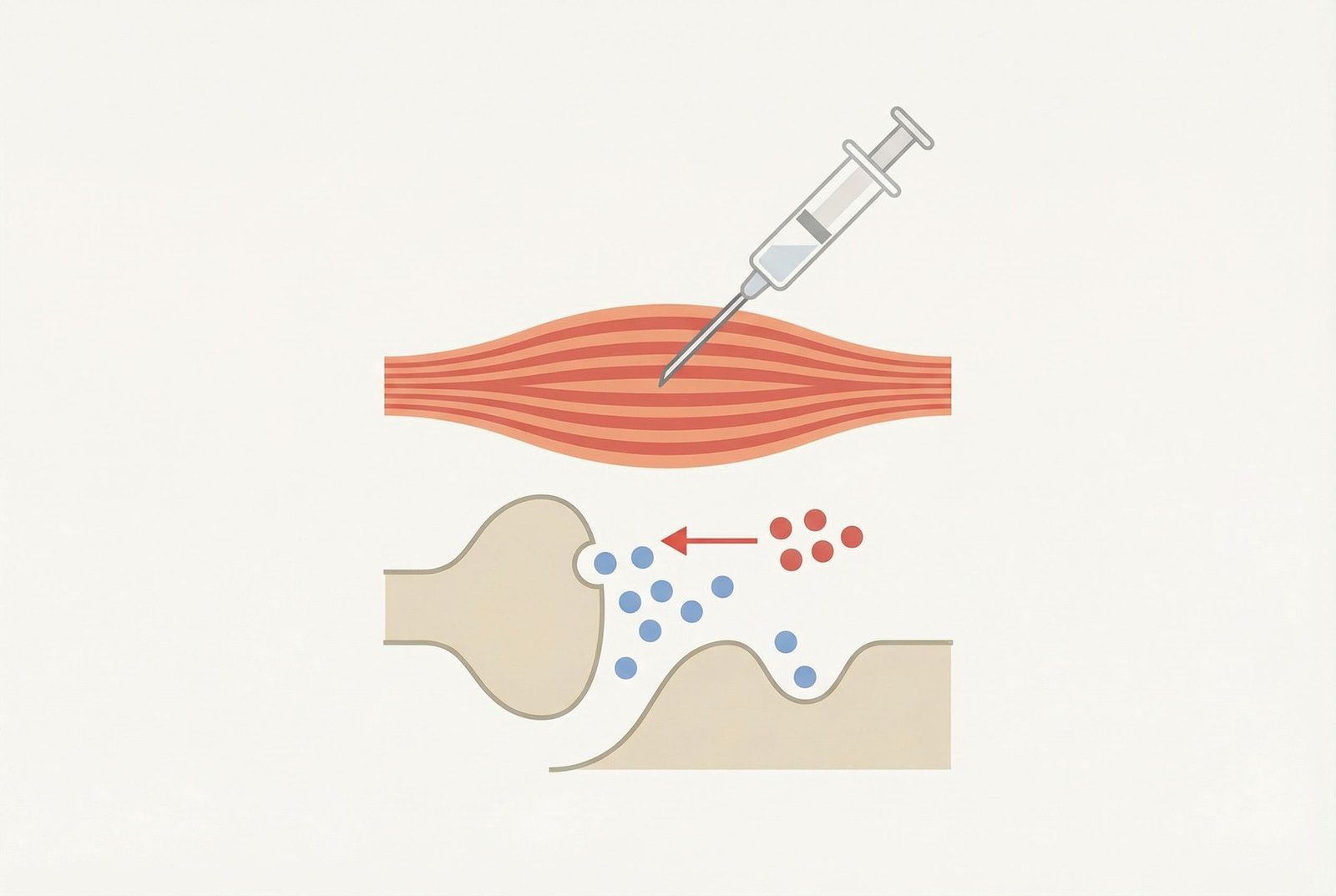
Botulinum toxin is a powerful biologic neurotoxin produced by Clostridium botulinum. In carefully controlled medical doses, it is used therapeutically in several neurological, pain-related, and movement-disorder contexts.

Three type A formulations are widely used clinically: onabotulinumtoxinA (Botox), abobotulinumtoxinA (Dysport), and incobotulinumtoxinA (Xeomin). A type B formulation, rimabotulinumtoxinB (Myobloc), is also available. These products are not unit-equivalent and should not be treated as interchangeable by dose.

In myofascial pain practice, botulinum toxin is sometimes used in selected refractory cases with the aim of reducing focal muscle overactivity and possibly modulating pain signaling. Its use for trigger points is off-label, and the evidence is mixed and condition-specific.

§ 02

Mechanism of Action

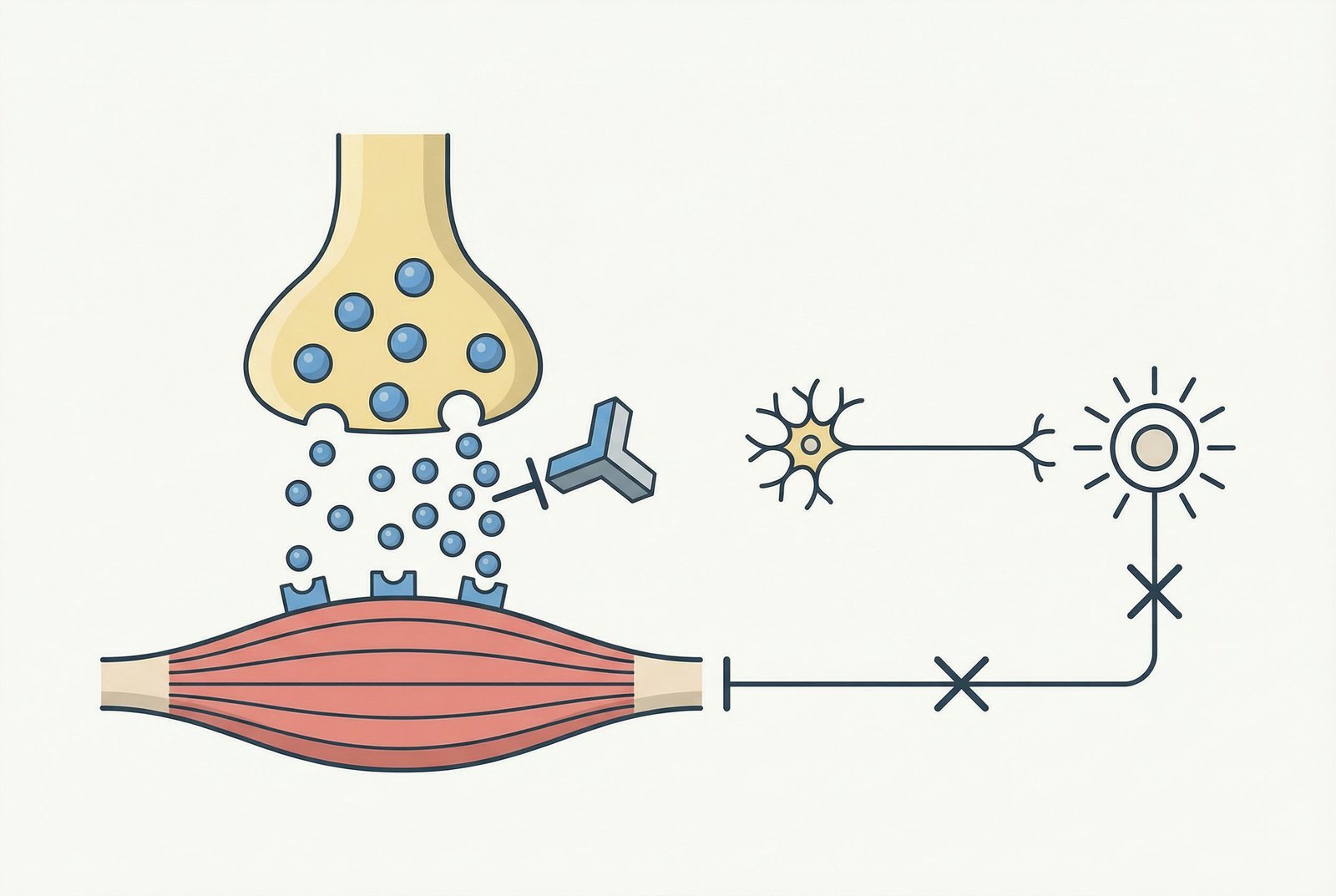
Botulinum toxin reduces neurotransmitter release through a well-described molecular process at the neuromuscular junction. Additional pain-modulating effects have been proposed, though not all of these are equally established in clinical myofascial pain practice.

Botulinum toxin may help some refractory trigger point cases through both reduced muscle overactivity and broader pain-modulating effects.
BOTOX

BOTOX

Mechanism of Action at Neuromuscular Junction
01

Acetylcholine Release Blockade

Botulinum toxin binds to presynaptic cholinergic nerve terminals at the neuromuscular junction and reduces release of acetylcholine (ACh). By limiting ACh at nicotinic receptors on the motor endplate, the toxin reduces the signal for muscle contraction. This is the main reason botulinum toxin can decrease focal muscle overactivity in selected clinical settings.

02

SNARE Protein Complex Cleavage

The light chain of botulinum toxin type A cleaves SNAP-25, one of the proteins in the SNARE complex that is required for synaptic vesicle docking and fusion. Disruption of this complex reduces neurotransmitter release. This is a well-established molecular mechanism, though the clinical effect still depends on dose, placement, muscle selection, and patient-specific factors.

03

Synaptic Vesicle Fusion Prevention

With the SNARE complex impaired, acetylcholine-containing vesicles cannot fuse normally with the presynaptic membrane. This reduces neurotransmitter release until the nerve terminal function gradually recovers. Clinically, this is why effects develop over days rather than minutes and then fade over months rather than hours.

04

Reduction of Local Muscle Overactivity

In selected trigger point practice models, botulinum toxin is used with the goal of reducing persistent focal muscle overactivity or irritability in a painful region. This is one reason it has been studied for refractory myofascial pain. It should not be understood as “fixing” every trigger point mechanism, but rather as one possible intervention for carefully chosen cases.

05

Pain Neurotransmitter Modulation

Beyond neuromuscular effects, botulinum toxin may reduce release of some pain-related neuropeptides and neurotransmitters, including substance P, glutamate, and CGRP. This is one reason researchers have proposed antinociceptive effects beyond muscle relaxation alone. The clinical importance of these mechanisms in myofascial pain is plausible but not fully settled.

06

Possible Antinociceptive Effects Beyond Muscle Relaxation

Some research suggests botulinum toxin may also influence pain signaling through mechanisms not fully explained by local muscle weakening alone, including effects on peripheral nociceptors and possibly broader pain modulation pathways. These ideas are still evolving and should be treated as mechanistically interesting rather than fully established explanations for clinical response.

§ 03

Formulations & Dosing

OnabotulinumtoxinA (Botox)

Most Studied

Allergan/AbbVie

DosingClinician-selected and condition-specific; no standard MPS dose
Onset2–7 days
Peak2–4 weeks
DurationMuscle effects and useful pain relief differ
The best-known botulinum toxin type A formulation and one of the most studied in pain-related and neuromuscular indications. In myofascial pain practice, dosing varies by muscle, region, clinician approach, and the number of sites treated. Reported onset is usually within several days, with peak effect over the following weeks and duration often measured in months rather than days. Because unit definitions are product-specific, dosing should not be generalized casually across formulations.

AbobotulinumtoxinA (Dysport)

Different Unit Potency

Ipsen/Galderma

DosingProduct-specific units; do not convert using a generic ratio
Onset1–3 days
Peak2–4 weeks
DurationMuscle effects and useful pain relief differ
AbobotulinumtoxinA has different potency units and diffusion characteristics than onabotulinumtoxinA. Potency units are not interchangeable and should not be converted with a generic ratio. Some clinicians consider diffusion characteristics when selecting a formulation, especially in larger muscles or anatomically sensitive regions.

IncobotulinumtoxinA (Xeomin)

No Complexing Proteins

Merz Pharmaceuticals

DosingProduct-specific dosing; the piriformis trial is not a universal regimen
Onset2–7 days
Peak2–4 weeks
DurationMuscle effects and useful pain relief differ
IncobotulinumtoxinA is formulated without accessory complexing proteins, which has led to discussion of potentially lower immunogenicity with repeated use. In practice, it is generally considered similar in broad clinical use to Botox in many settings, but product-specific handling and clinician familiarity still matter.

RimabotulinumtoxinB (Myobloc)

Type B Serotype

Supernus Pharmaceuticals

DosingProduct-specific; not directly comparable to type A units
Onset24–48 hours
Peak1–2 weeks
DurationMuscle effects and useful pain relief differ
RimabotulinumtoxinB is a type B botulinum toxin with different molecular targeting and a different unit system. It is less commonly used in myofascial pain contexts and is more often discussed in other neuromuscular indications. In selected situations, it may be considered when type A formulations are not suitable, but its use in myofascial pain is less established.
§ 04

Clinical Evidence

BOTOX for Myofascial Pain

BOTOX for Myofascial Pain

Evidence Summary Chart
Mixed, condition-specific evidenceSelected chronic refractory myofascial pain populations

Neck and shoulder MPS trials disagree: a large dose-ranging study was negative, an upper-back trial reported benefit, and a responder-enriched study supported retreatment. Tenderness or a referral map does not predict which result applies to an individual.

Selected piriformis trials support specialist discussion. Jaw pain studies include both positive and negative results, and chronic-TMD guidance recommends against routine toxin. Ordinary MPS, painful TMD and piriformis syndrome are off-label uses in the United States.

Ferrante et al. (2005)

A randomized dose-ranging trial in 132 patients injected up to five patient-specific active cervicothoracic points with saline or one of three toxin doses. Pain, pressure-threshold and rescue-medication outcomes did not differ through 12 weeks. It was not a fixed-site, fixed-dose study.

Göbel et al. (2006)

AbobotulinumtoxinA at ten individualized tender upper-back points produced mild/no pain at week 5 in 51% versus 26% after saline. This regional study does not establish an indication for every neck muscle or toxin formulation.

Nicol et al. (2014)

114 patients first received toxin; 54 responders were then randomized to a second toxin treatment or saline. Repeat treatment improved average pain over the next 12 weeks. This is responder-enriched retreatment evidence, not an unselected first-treatment success rate.

Fishman et al. (2017) — piriformis

56 selected patients with FAIR-position H-reflex delay and normal paraspinal EMG received incobotulinumtoxinA plus PT or saline plus PT. Pain favored toxin at 2–12 weeks. These entry criteria describe the trial, not a routine diagnostic test for a tender buttock.

De la Torre Canales et al. and Sitnikova et al. (2024) — jaw myalgia

A small refractory-pain trial (32 randomized, 28 completed; PMID 38378855) favored toxin at 1 and 6 months. A 66-person crossover trial (PMID 38963228) found no clear pain/disability advantage over saline and reduced muscle performance. The 2023 chronic-TMD guideline conditionally recommends against routine toxin or TPI (PMID 38101929).

PREEMPT (2010) — chronic migraine

The pooled migraine-prevention trials included 1,384 adults and found reductions of 8.4 versus 6.6 headache days per four weeks at week 24. This tested chronic-migraine treatment, not injection selection from an atlas pain map.

Selected Responders

Outcomes vary by subgroup and protocol

Specific Diagnosis

Useful pain relief may differ from muscle weakening

Variable

Condition and comparator determine applicability
§ 05

The Injection Procedure

Pre-Procedure Assessment & Trigger Point Mapping

A careful clinical evaluation is used to identify target areas through history, palpation, symptom pattern, and functional context. In practice, the clinician selects only the most clinically relevant regions rather than trying to treat every tender point. Documentation of the number, location, and rationale for treatment sites is important, especially when the intervention is being used off-label.

Imaging Guidance (When Indicated)

For deeper muscles or anatomically sensitive areas, ultrasound or electromyographic (EMG) guidance may improve accuracy and safety. Guidance is not required for every case, but it may be especially helpful when landmarks are difficult, nearby neurovascular structures are relevant, or prior blind injections have been unsuccessful.

Preparation & Needle Selection

The injection site is cleaned with standard antiseptic technique. Needle gauge and length are selected based on muscle depth, body habitus, and target region. Reconstitution and handling follow product-specific guidance. Because botulinum toxin is a biologic product, careful preparation matters for both efficacy and safety.

Injection Into the Target Region

The clinician stabilizes the target area and advances the needle into the selected region. Depending on technique and anatomy, the injection may be placed into one point or distributed across a painful band or muscle area. The goal is careful, anatomically appropriate placement rather than chasing a single ritualized sign. Local twitch response may be observed in some approaches, but it is not a universal requirement for treatment.

Treatment of Multiple Trigger Points

Multiple painful areas may be treated in a single session if clinically appropriate and if the total dose remains within safe limits. In most cases, clinicians prioritize the most symptomatic or functionally important sites rather than treating every possible point.

Post-Injection Observation

Patients are typically observed briefly after the procedure for immediate adverse effects such as vasovagal reaction, unexpected weakness, or injection-related symptoms. Education should include the expected delayed onset of benefit, the possibility of transient soreness, and clear instructions on what symptoms require follow-up.
§ 06

When a Specialist Discussion May Be Appropriate

Chronic Myofascial Pain Syndrome Unresponsive to Conservative Treatment

Patients with persistent myofascial pain who have not improved sufficiently with more conservative approaches such as exercise-based rehabilitation, manual therapy, activity modification, sleep optimization, and other lower-risk treatments may be considered for botulinum toxin in selected cases. It is generally not used as a first-line treatment.

Persistent Symptoms After Appropriate Conservative Care

Previous DN or local-anesthetic failure does not predict toxin benefit or establish a mandatory sequence. Reassess the diagnosis and functional limitation; discuss the evidence for the actual condition before a specialist procedure.

Confirm the Headache Diagnosis

OnabotulinumtoxinA has an established chronic-migraine prevention role. A tender neck or temple does not establish that indication. Cervicogenic and tension-type headache trials are inconsistent, including negative placebo-controlled trials; these are not routine toxin indications.

Concurrent Dystonia

Patients who already have an established botulinum toxin indication such as cervical dystonia and who also have clinically relevant myofascial pain may be particularly reasonable candidates for a more integrated treatment approach.

A Measurable Functional Goal and Review Plan

Choose the intervention by diagnosis and expected benefit, with a goal such as eating, sitting or working more comfortably. Difficulty attending appointments or wanting long relief is not itself evidence of toxin responsiveness. Reassess function and weakness before any repeat treatment.
§ 07

Contraindications & Risks

Absolute Contraindications

Relative Contraindications

Potential Side Effects

§ 08

BOTOX vs Other Injection Therapies

Feature
BOTOXLidocaine Trigger Point InjectionDry NeedlingCorticosteroids

Onset of Action

Usually 2–7 days
Immediate to very rapid
Variable; sometimes immediate, sometimes delayed soreness before improvement
No established added analgesic benefit for routine TPI

Duration of Relief

Useful pain relief varies by condition; muscle weakening may last longer
Numbness is brief; any clinical pain or activity benefit can outlast it
Days to weeks per session, depending on response
No routine duration advantage established for TPI

Mechanism

Neuromuscular blockade with possible antinociceptive effects
Local anesthetic effect plus needling-related mechanical effect
Needling-related mechanical and neurophysiological effects
Anti-inflammatory effect plus injection-related mechanical effect

Cost per Session

$500–1,500
$75–200
$50–150
$100–300

Repeat Frequency

Based on meaningful prior benefit, adverse effects and product-specific limits
Reassess response; no universal repeat schedule
A limited condition-specific trial with functional review
Not a routine repeat-TPI strategy

Best For

Selected chronic, refractory cases
Local anesthetic-based trigger point injection when immediate numbing is helpful
Earlier-line interventional option in many practices
No routine added benefit for TPI; separate inflammatory diagnoses need their own evidence
§ 09

Cost & Insurance

Cost is an important practical consideration. The medication itself is expensive, and total session cost may increase further if imaging guidance or multiple sites are involved.

Typical Costs

  • $500 to $1,500 per session depending on dose, number of sites, setting, and region
  • Medication cost is often the main driver of total expense
  • Additional costs may apply for ultrasound or EMG guidance when used

Insurance Considerations

  • Coverage is often limited because this use may be considered off-label
  • Prior authorization may be required and may still be denied
  • Coverage sometimes depends on diagnosis coding and insurer policy
  • Appeals may succeed in some cases, but approval is not predictable
§ 10

Expected Timeline

2–7 days — Onset of Muscle Effects

Muscle effects develop over days. The timing and extent of useful pain relief depend on the condition and response.

2–4 weeks — Review Early Response

Pain, strength and daily function should be reviewed over the following weeks. A change in muscle force is not proof of analgesic benefit.

Variable — Duration of Useful Relief

Muscle effects may persist for months without worthwhile pain relief. Follow the activity goal and adverse effects separately; no cross-condition duration hierarchy is established.
Key Takeaways
  1. Botulinum toxin for trigger points is an off-label option sometimes considered for selected chronic, refractory myofascial pain cases.

  2. It is generally not used as a first-line treatment and is more often considered after lower-risk and better-established conservative approaches have been tried.

  3. Its main mechanism is reduction of acetylcholine release at the neuromuscular junction, with possible additional pain-modulating effects beyond muscle relaxation alone.

  4. Accurate anatomical placement, dose selection, and careful patient selection are important to both efficacy and safety.

  5. Potential risks include local soreness, temporary weakness, antibody-related treatment failure with repeated exposure, and rare distant spread of toxin effect.

  6. Neck and jaw pain trials disagree. Selected piriformis studies show benefit, but findings cannot be transferred to every painful muscle.

  7. Cost and insurance coverage remain major barriers because this use is often off-label and not consistently reimbursed.

  8. Botulinum toxin is best understood as one possible component of a broader pain-management strategy rather than a standalone solution.